


 English
  Español
  عربى
عربى 
High-Strength Fiberglass Mesh Tape for Industrial Packaging and Reinforcement
Content
- 1 Understanding Fiberglass Mesh Tape
- 2 Why Reinforcement Matters in Industrial Packaging
- 3 Product Structure and Core Materials
- 4 Technical Performance Overview
- 5 Advantages Over Conventional Packaging Tapes
- 6 Application Scenarios in Detail
- 7 Manufacturing Strength Behind Reliable Tape Performance
- 8 Company Capabilities and Integrated Packaging Solutions
- 9 How Fiberglass Mesh Tape Improves Total Packaging Efficiency
- 10 Comparison with Common Tape Alternatives
- 11 Best Practices for Application
- 12 Storage and Handling Recommendations
- 13 Environmental and Operational Considerations
- 14 Customization and Product Selection
- 15 Quality Control Standards and Testing Significance
- 16 Why Professional Manufacturing Matters
- 17 Purchasing Considerations for Industrial Buyers
- 18 Q&A Section
- 18.1 Q1: What is 319-36 Fiberglass Mesh Tape mainly used for?
- 18.2 Q2: How is fiberglass mesh tape different from ordinary packaging tape?
- 18.3 Q3: Can the tape be used for heavy cartons?
- 18.4 Q4: What surfaces can the tape bond to?
- 18.5 Q5: Is the tape suitable for outdoor use?
- 18.6 Q6: What is the recommended temperature range?
- 18.7 Q7: Why is low elongation important?
- 18.8 Q8: Can it replace strapping band?
- 18.9 Q9: How should the tape be stored?
- 18.10 Q10: Why choose a manufacturer with multiple packaging product lines?
- 19 Conclusion
- 20 References
- 21 Product: 319-36 Fiberglass mesh tape
In modern packaging, logistics, construction support, and industrial maintenance, adhesive tape is no longer a simple accessory used only to close cartons. It has become a functional material that can reinforce structures, protect surfaces, stabilize loads, and reduce the risk of failure during handling and transportation. Among the many tape products used in industrial environments, 319-36 Fiberglass Mesh Tape stands out because it combines strong adhesion with a reinforced fiberglass mesh backing. This combination gives the tape a practical balance of tensile strength, abrasion resistance, dimensional stability, and reliable bonding performance.
Fiberglass mesh tape is designed for demanding applications where ordinary packaging tape may not provide enough mechanical strength. The open-weave fiberglass cloth backing allows the tape to resist tearing and deformation, while the high-tack pressure-sensitive adhesive helps it form a firm bond with cartons, pipes, profiles, boards, tarps, canvas, and many other surfaces. Whether used for heavy-duty bundling, carton edge reinforcement, seam repair, temporary surface protection, or industrial fixing, this tape provides a robust solution for users who need packaging materials that can withstand real-world stress.
For businesses operating in logistics, warehousing, manufacturing, construction, furniture handling, electronics assembly, and export packaging, tape failure can cause product damage, additional labor costs, customer complaints, and shipment delays. A reinforced fiberglass mesh tape helps reduce these risks by improving load-bearing capability and providing a stronger physical barrier against abrasion and tearing. Compared with standard BOPP tape, masking tape, or light-duty cloth tape, fiberglass mesh tape offers higher tensile resistance, lower elongation, and greater stability during demanding use.
This article explores the structure, performance advantages, manufacturing considerations, technical specifications, application methods, quality control, and practical value of 319-36 Fiberglass Mesh Tape. It also explains why a professional packaging materials manufacturer with advanced production processes, strict inspection systems, and experience in tapes, films, and strapping products can provide more reliable solutions for industrial users.
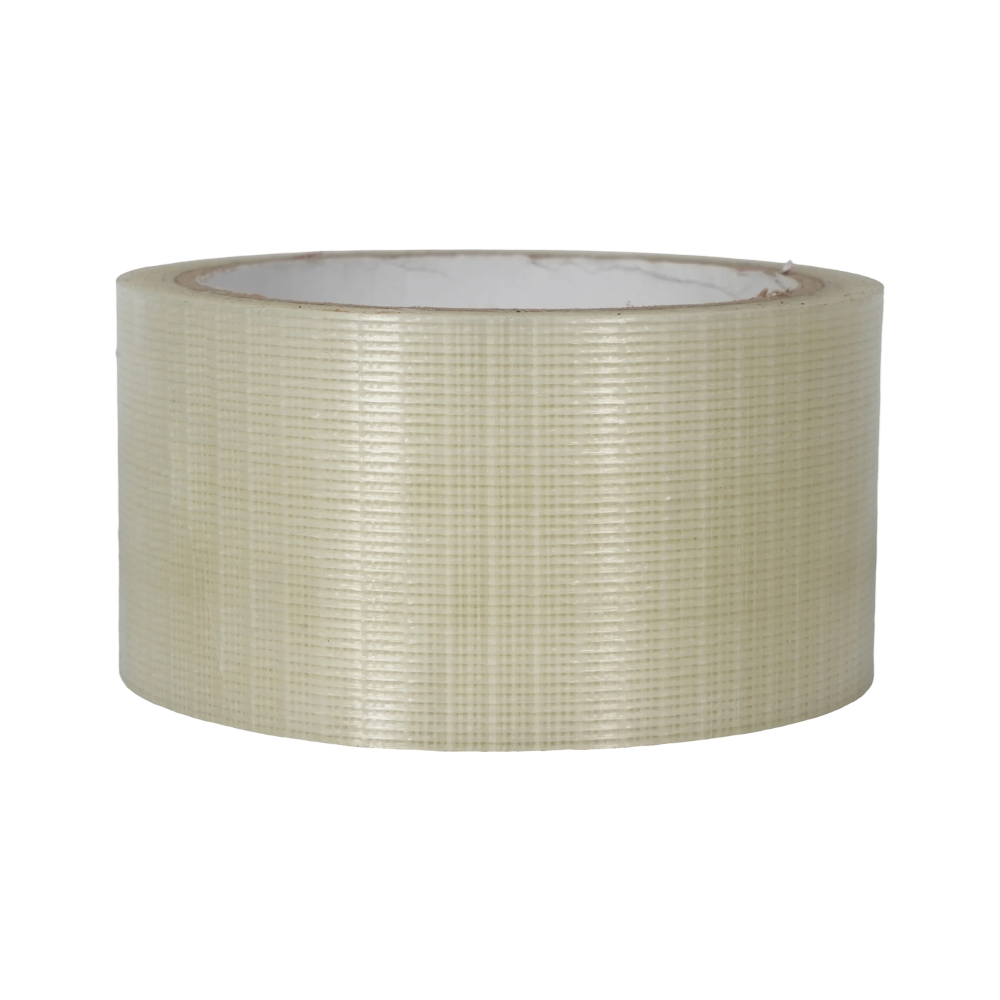
Understanding Fiberglass Mesh Tape
Fiberglass mesh tape is a pressure-sensitive adhesive tape made with an open-weave fiberglass cloth backing. Unlike conventional plastic film tape, which relies mainly on the strength of the film, fiberglass mesh tape obtains much of its performance from reinforced glass fibers arranged in a mesh structure. These fibers provide high tensile strength in both longitudinal and transverse directions, helping the tape resist breaking when exposed to pulling force, load stress, or movement during transportation.
The adhesive layer is usually made from a high-tack rubber-based or acrylic-based pressure-sensitive adhesive. Rubber-based adhesives typically offer strong initial tack and fast bonding, making them useful for immediate holding and fixing. Acrylic-based adhesives generally provide good aging resistance, stable adhesion, and better resistance to environmental changes. The choice of adhesive depends on the intended use, surface type, storage conditions, and required service life.
The mesh design gives the tape several important properties. First, it reduces the risk of sudden tearing because stress is distributed across the fiberglass network. Second, it provides enhanced abrasion resistance, making the tape suitable for edge protection and surface guarding. Third, it offers dimensional stability because fiberglass has low stretch compared with many polymer films. The typical elongation at break of this product is about 5%, which means it does not stretch excessively under force. This is valuable in bundling and reinforcement applications where maintaining shape and tension is important.
319-36 Fiberglass Mesh Tape has a typical total thickness of 0.135 mm, a 180-degree peel strength of 27.3 N/25 mm, a tensile strength of 650 N/in, and an initial tack corresponding to a No. 28 steel ball test. These values indicate that the tape is built for high-performance holding and reinforcement rather than only light sealing. It is especially suitable for users who need a tape that adheres firmly while also contributing mechanical strength.
Why Reinforcement Matters in Industrial Packaging
Industrial packaging faces several kinds of stress. Cartons may be stacked, compressed, dragged, dropped, or exposed to vibration during transport. Pipes, profiles, and long materials may shift inside bundles. Furniture edges and board corners may be scratched during loading. Tarps and canvas covers may tear at seams or stressed points. In all these situations, tape is expected not only to stick but also to help protect the package or material from mechanical damage.
Ordinary packaging tape may be sufficient for lightweight cartons, but it can fail when cartons are heavy, surfaces are rough, or the package is exposed to continuous movement. The most common failure modes include adhesive separation, film tearing, edge splitting, and excessive stretching. Once one failure begins, the entire package may lose stability. Reinforced tape addresses these problems by adding a structural backing that carries load and resists deformation.
Fiberglass mesh tape is particularly effective because fiberglass has excellent tensile properties. When a taped seam or edge is pulled, the fibers help absorb and distribute force. When a carton corner rubs against another surface, the reinforced backing helps prevent rapid wear. When a bundle of pipes or profiles needs temporary stabilization, the tape can hold items together with less elongation than conventional plastic tape. These advantages make it suitable for heavy-duty packaging, warehousing, and industrial handling.
Another reason reinforcement matters is the cost of failure. A damaged carton may lead to product returns. A torn cover may expose goods to dust or moisture. A loose bundle may require repacking. A scratched surface may reduce product value. In many cases, the tape itself represents only a small percentage of total packaging cost, but choosing a stronger tape can significantly reduce downstream losses. Therefore, fiberglass mesh tape should be evaluated not only by unit price but also by total packaging reliability.
Product Structure and Core Materials
The performance of 319-36 Fiberglass Mesh Tape is based on the interaction of three major components: the fiberglass mesh backing, the pressure-sensitive adhesive, and the production process that bonds them together into a stable tape roll. Each component must be carefully selected and controlled to achieve consistent product quality.
Open-Weave Fiberglass Cloth Backing
The backing is an open-weave fiberglass cloth. This structure gives the tape its mechanical strength and dimensional stability. Fiberglass is known for high tensile strength, low elongation, and resistance to many environmental factors. The open-weave design also helps maintain flexibility, allowing the tape to conform to corners, edges, and irregular surfaces better than a rigid reinforcement sheet.
In use, the mesh works like a reinforcing frame. The longitudinal fibers resist pulling along the length of the tape, while the transverse fibers provide cross-direction stability. This is useful when the tape is applied over seams, carton edges, or damaged fabric. The mesh helps prevent cracks or tears from spreading, making it valuable for repair and reinforcement.
High-Tack Pressure-Sensitive Adhesive
The adhesive layer provides the bonding function. A pressure-sensitive adhesive is designed to bond when pressure is applied, without requiring water, heat, or solvent activation. For industrial tape, adhesive performance must include initial tack, peel strength, shear resistance, and aging stability. 319-36 Fiberglass Mesh Tape offers strong initial tack and a durable bond on many surfaces, helping users achieve fast application and dependable performance.
High initial tack is important in warehouse and production environments where operators need immediate holding power. Peel strength is important when the tape must resist lifting from surfaces. Stability is important when products will be stored or transported for extended periods. A well-formulated rubber-based or acrylic-based adhesive can be selected according to the required balance of these properties.
Controlled Tape Thickness
The typical total thickness of 0.135 mm provides a practical balance between strength, flexibility, and handling convenience. A tape that is too thin may lack protection and strength, while a tape that is too thick may be difficult to conform around corners or apply smoothly. The controlled thickness of this fiberglass mesh tape supports both manual and semi-automated usage in practical packaging operations.
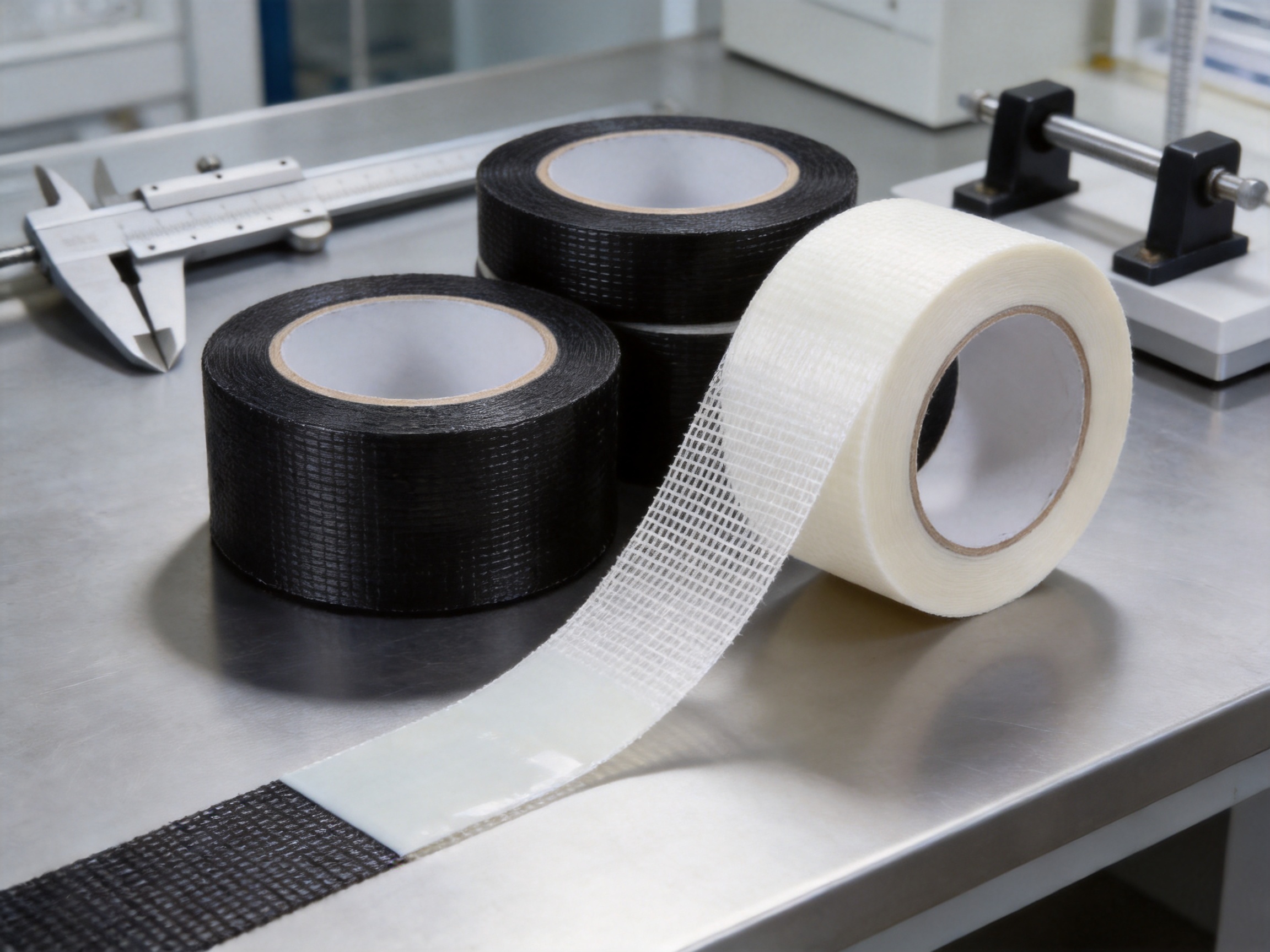
Technical Performance Overview
Technical data allows industrial buyers to compare tape products using measurable indicators rather than relying only on general claims. The following table summarizes typical values for 319-36 Fiberglass Mesh Tape based on recognized reference standards.
| Test Item | Reference Standard | Typical Value | Practical Meaning |
| Total Thickness | GB/T 7125-2014 | 0.135 mm | Provides a balance of strength, flexibility, and ease of application. |
| Initial Tack | GB/T 4852-2002 | No. 28 steel ball | Indicates strong immediate gripping ability after contact pressure. |
| 180-Degree Peel Strength | GB/T 2792-2014 | 27.3 N/25 mm | Shows reliable resistance to peeling from bonded surfaces. |
| Tensile Strength | GB/T 7753-87 | 650 N/in | Demonstrates high resistance to breaking under pulling force. |
| Elongation at Break | GB/T 7753-87 | 5% | Indicates low stretch and strong dimensional stability. |
| Typical Temperature Range | Application dependent | -10°C to 60°C | Suitable for many normal storage, handling, and transportation conditions. |
These values show that the tape is engineered for reinforcement rather than only closure. A tensile strength of 650 N/in is particularly important for applications such as heavy carton sealing, pipe bundling, and edge protection. The low elongation at break helps the tape maintain stable tension, which is valuable when holding objects in place. The peel strength and initial tack support dependable adhesion, while the thickness provides a practical working profile.
Advantages Over Conventional Packaging Tapes
When selecting industrial tape, users often compare fiberglass mesh tape with BOPP tape, kraft paper tape, masking tape, cloth tape, and ordinary filament tape. Each product has its own role, but fiberglass mesh tape has distinct advantages in applications requiring both adhesion and mechanical reinforcement.
Higher Tensile Resistance
The most important advantage is tensile strength. Standard film tapes may tear under heavy pulling force, especially if the film is thin or if the carton is overfilled. Fiberglass mesh tape uses reinforced glass fibers to carry load, giving it much greater resistance to breakage. This makes it suitable for heavy cartons, bundled materials, and reinforced seams.
Lower Stretch and Better Shape Retention
Some tapes stretch significantly under tension. While stretch can be useful in certain wrapping applications, it can be a disadvantage when the purpose is to stabilize a bundle or reinforce a seam. Excessive stretch may allow movement, loosen packaging, or reduce holding force over time. With an elongation at break of about 5%, fiberglass mesh tape provides excellent shape retention and tension stability.
Improved Abrasion Protection
The fiberglass backing resists wear better than many lightweight film tapes. When applied to carton edges, furniture corners, board edges, or exposed seams, it provides a protective barrier against rubbing and scratching. This is especially useful during transport, where packages are often handled by multiple people and moved through several environments.
Enhanced Tear Resistance
Once a tear begins in ordinary film tape, it may spread quickly. The mesh structure helps prevent tear propagation because the fibers interrupt the tear path. This feature is useful for repairing tarps, canvas, and other flexible materials, as well as reinforcing carton corners that are vulnerable to damage.
Reliable Bonding on Various Surfaces
The high-tack adhesive helps the tape bond to paperboard, plastic, metal, wood, painted surfaces, and fabric-like materials, depending on surface condition. For best performance, surfaces should be clean, dry, and free of oil or dust. When properly applied, the tape forms a strong bond that supports long-lasting performance.
Practical Versatility
Unlike some specialty tapes that are suitable only for narrow uses, fiberglass mesh tape can be used in many industrial scenarios. It can reinforce cartons, bundle profiles, repair covers, protect edges, and temporarily fix lightweight components. This versatility helps purchasing teams reduce the number of tape types they need to keep in stock.
Application Scenarios in Detail
319-36 Fiberglass Mesh Tape is suitable for a wide range of demanding applications. Its strength, adhesion, and protective ability make it valuable in both packaging and industrial support tasks.
Heavy-Duty Carton Sealing
Heavy cartons require more than a simple closure strip. When a carton contains dense products, metal parts, hardware, tools, machinery accessories, or export goods, the sealing tape must withstand weight, compression, vibration, and handling impact. Fiberglass mesh tape can be applied along the center seam, across the end flaps, or around stress points to improve carton integrity.
For long-distance shipping, reinforcement is especially important. Cartons may be transferred between trucks, warehouses, ports, and distribution centers. Each transfer creates the possibility of impact and abrasion. Reinforced tape helps keep the carton closed and reduces the risk of seam rupture.
Carton Edge and Corner Protection
Carton corners are vulnerable because they absorb impact during stacking and movement. Applying fiberglass mesh tape to edges and corners can create a protective layer that resists scraping and tearing. This is useful for packaging furniture components, boards, panels, metal accessories, and other items with sharp or heavy contact points.
Bundling Pipes, Profiles, and Long Materials
Warehouses and factories frequently need to bundle pipes, plastic profiles, aluminum sections, wooden strips, and similar long materials. A tape used for bundling should resist stretching and breaking. Fiberglass mesh tape performs well in this role because it offers strong tensile resistance and stable tension. It can be used as a temporary or supporting bundling material, especially where additional reinforcement is needed.
Seam Reinforcement and Repair
Tarps, canvas covers, fabric curtains, and protective sheets may develop tears during use. Fiberglass mesh tape can be applied over damaged sections to limit further tearing and restore temporary usability. The mesh backing distributes stress around the damaged area, while the adhesive bonds to the surface. It can also be used to reinforce seams before failure occurs.
Temporary Surface Protection
During moving, assembly, and handling, the edges of furniture, boards, and panels may be damaged by contact. Fiberglass mesh tape can provide temporary surface protection. It is especially useful for exposed corners and high-contact areas. Users should always test compatibility on sensitive surfaces before large-scale use, especially if the surface has delicate coating, paint, or decorative finish.
Industrial Fixing and Cable Bundling
In production and maintenance environments, lightweight components sometimes need temporary fixing before final installation. Wires and cables may also require bundling during assembly or storage. Fiberglass mesh tape can provide quick, strong, and stable holding. Because it is not designed to replace permanent mechanical fasteners in high-load safety-critical applications, users should evaluate the actual load and environment before relying on it for structural fixing.
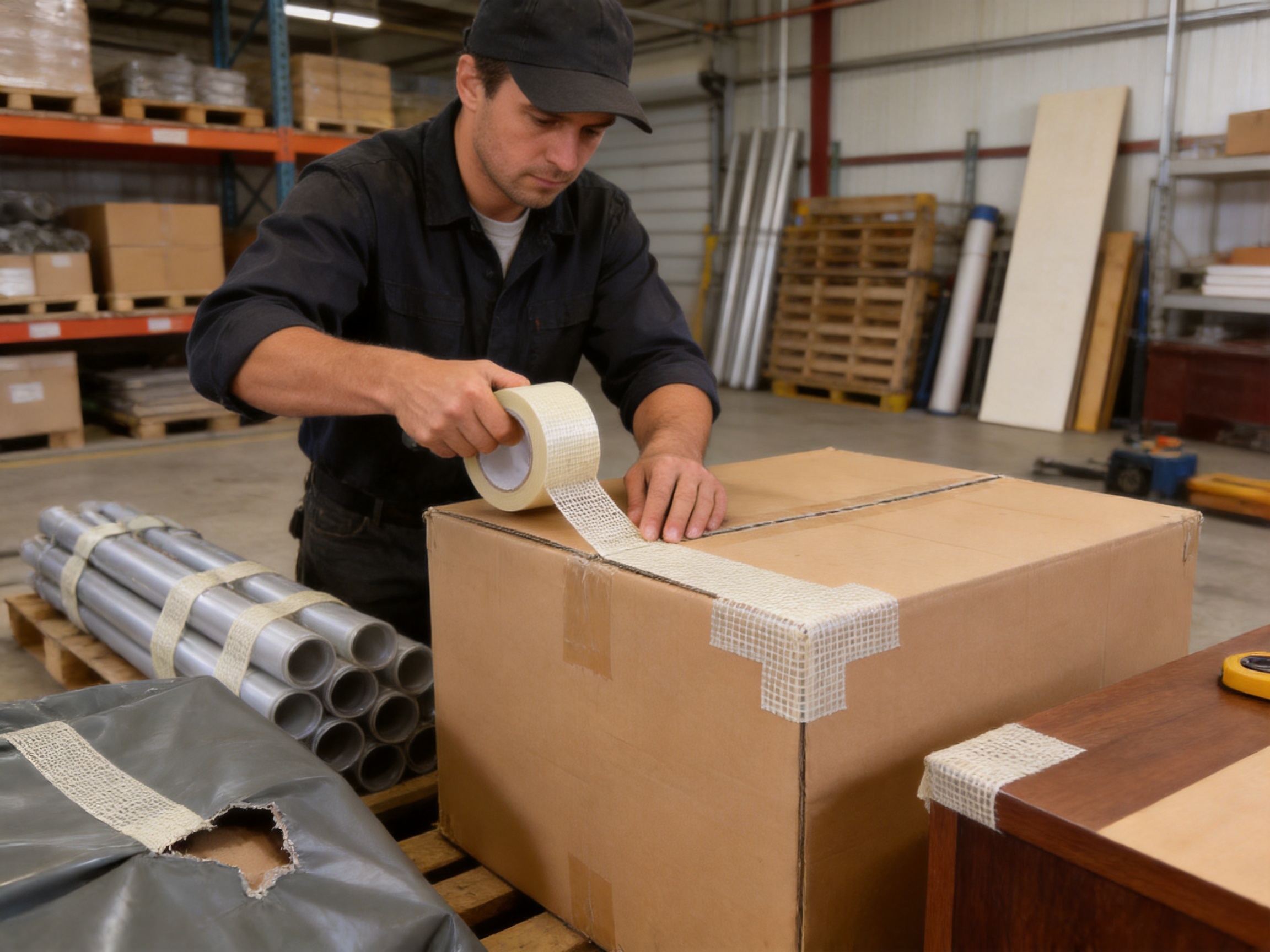
Manufacturing Strength Behind Reliable Tape Performance
The quality of fiberglass mesh tape depends not only on raw materials but also on the manufacturing process. A professional packaging materials manufacturer must control coating, drying, winding, slitting, inspection, and packaging. Zhejiang Geruite Packaging Materials Co., Ltd. has developed capabilities across adhesive tape, strapping band, and film products, allowing it to understand the complete requirements of industrial packaging systems.
The company is located in Zhejiang Province, China, an area known for developed manufacturing resources, skilled labor, industrial supply chains, and logistics advantages. This regional foundation supports efficient raw material sourcing, equipment maintenance, production planning, and product delivery. For customers, this means more stable supply and the ability to obtain multiple packaging material categories from one experienced manufacturer.
Raw Material Selection
Reliable tape begins with consistent raw materials. Fiberglass cloth must have uniform mesh structure, stable fiber distribution, and suitable strength. Adhesive raw materials must meet requirements for tack, peel strength, aging resistance, and coating stability. Release materials, cores, and packaging also influence final product quality. By controlling procurement and supplier qualification, the manufacturer can reduce batch variation and improve customer confidence.
Adhesive Formulation Control
Adhesive performance is one of the most critical factors in tape quality. A high-tack adhesive must be formulated to achieve immediate bonding without sacrificing long-term holding power. The balance of tackifying resins, elastomers, acrylic components, stabilizers, and coating viscosity affects how the adhesive behaves during production and use. Professional formulation control helps ensure that each roll performs consistently.
Precision Coating
Coating is the process of applying adhesive to the fiberglass backing at a controlled thickness and weight. Uneven coating can cause weak adhesion, adhesive overflow, poor unwinding, or inconsistent performance. Advanced coating equipment helps maintain uniform adhesive distribution across the tape width. This is especially important for mesh-backed tape because the backing structure is different from smooth film. The adhesive must integrate properly with the mesh while maintaining an effective bonding surface.
Drying and Curing Management
After coating, the adhesive layer may require drying or curing depending on the adhesive system. Temperature, line speed, ventilation, and residence time must be controlled. Inadequate drying can lead to residual solvent, poor adhesion stability, or blocking. Excessive heat can damage materials or affect adhesive properties. A controlled drying system supports stable tape performance and safer finished products.
Winding and Tension Control
Winding quality affects roll appearance and usability. If the tape is wound too tightly, it may deform or become difficult to unwind. If it is wound too loosely, the roll may telescope or become unstable during transport. Tension control is especially important for reinforced tapes because the backing has low elongation. Proper winding supports smooth dispensing, clean edges, and reliable storage.
Slitting Accuracy
Slitting converts master rolls into customer-specified widths. Accurate slitting ensures clean edges, consistent roll width, and reduced edge fraying. Poor slitting can damage the fiberglass mesh or create loose fibers, affecting application quality. Professional slitting equipment and sharp blades help deliver neat finished rolls that are easier for customers to use.
Final Inspection and Quality Assurance
Quality inspection should cover appearance, width, length, thickness, peel strength, tack, tensile strength, elongation, and packaging condition. A rigorous quality control system helps identify potential problems before shipment. By testing according to recognized standards such as GB/T 7125, GB/T 4852, GB/T 2792, and GB/T 7753, the manufacturer can provide objective performance data and maintain consistent product quality.
Company Capabilities and Integrated Packaging Solutions
Zhejiang Geruite Packaging Materials Co., Ltd. focuses on research, development, production, and sales of high-performance tapes and packaging materials. Its product range includes BOPP tapes, kraft paper tapes, masking tapes, high-temperature resistant tapes, metal tapes, PE stretch film, PP strapping, and high-strength PET strapping. This broad product structure gives the company a practical understanding of how different packaging materials work together in logistics and industrial environments.
For many customers, the best packaging system does not rely on a single product. A heavy shipment may require carton tape, reinforced tape, stretch film, and strapping band. Electronics packaging may require masking tape, protective film, and carton sealing tape. Construction materials may require heavy-duty reinforcement tape and PET strapping. By offering multiple categories, the company can support customers with coordinated packaging solutions rather than isolated products.
The company emphasizes quality as a core principle. From raw material procurement to production and final inspection, each stage is managed to ensure stable product performance. This approach is particularly important for industrial customers who need repeatable quality from batch to batch. A tape that performs well once but varies significantly in the next shipment can disrupt production and increase risk. Consistent manufacturing and inspection help prevent this problem.
With an annual output value exceeding RMB 60 million, the company has the production scale to support wholesale and industrial supply needs. Scale also allows investment in equipment, process improvement, technical development, and service capability. Customers benefit from a manufacturer that can respond to changing demand, provide stable supply, and continue improving product performance.
How Fiberglass Mesh Tape Improves Total Packaging Efficiency
Industrial buyers often focus on unit cost, but total packaging efficiency is a broader calculation. It includes labor time, rework, damage rates, storage requirements, product returns, and customer satisfaction. A stronger tape may cost more per roll than ordinary tape, but it can reduce hidden costs by preventing failures and improving handling reliability.
First, fiberglass mesh tape can reduce the need for multiple layers of standard tape. If operators must apply three or four strips of ordinary tape to achieve acceptable strength, a reinforced tape may provide better performance with fewer applications. This can save labor and reduce material waste.
Second, it can reduce repacking. When packages fail during internal handling, workers must reopen, repair, or replace packaging. This consumes time and interrupts workflow. Stronger reinforcement at stress points can reduce the frequency of these problems.
Third, it can improve transport reliability. Packaging damage during shipping may result in claims, returns, or customer dissatisfaction. Reinforced tape helps maintain carton integrity and protect vulnerable edges, reducing the probability of visible package damage.
Fourth, it supports inventory simplification. Because fiberglass mesh tape can be used for sealing, bundling, repair, and protection, it can replace several lower-strength tapes in certain applications. This simplifies purchasing and warehouse management.
Comparison with Common Tape Alternatives
BOPP packaging tape is widely used for carton sealing because it is economical, transparent or colored, and suitable for general packaging. However, BOPP tape may not provide enough tensile strength for heavy-duty reinforcement. Fiberglass mesh tape is stronger and more suitable for demanding loads.
Kraft paper tape offers good presentation and is often used for recyclable packaging. Reinforced paper tape can provide improved strength, but paper may be less resistant to abrasion or moisture depending on formulation. Fiberglass mesh tape offers superior tear resistance and physical protection in many industrial conditions.
Masking tape is useful for painting, labeling, temporary holding, and light-duty applications. It is not designed for heavy load-bearing packaging. Fiberglass mesh tape is a better choice when tensile strength and abrasion resistance are required.
Ordinary cloth tape has flexibility and easy hand tearability, but its strength depends on fabric type and adhesive quality. Fiberglass mesh tape generally provides higher tensile resistance and lower elongation than many common cloth tapes.
Filament tape uses fiberglass filaments embedded in a film backing and is known for high tensile strength. Fiberglass mesh tape differs by using a mesh cloth backing that provides strength in both directions and improved surface protection. For edge guarding, seam reinforcement, and abrasion resistance, mesh backing can offer practical advantages.
Best Practices for Application
Proper application is essential to achieve the best performance from any pressure-sensitive adhesive tape. Even a high-quality tape may underperform if applied to dirty, wet, oily, or dusty surfaces. Users should follow several practical steps.
First, clean the surface before application. Remove loose dust, oil, grease, water, and other contaminants. If necessary, use an appropriate cleaning method compatible with the surface. Allow the surface to dry completely before taping.
Second, apply the tape at room temperature when possible. Extreme cold may reduce initial tack because the adhesive becomes firmer and less able to wet the surface. If goods are stored in a cold environment, consider warming the tape and surface before application.
Third, apply firm pressure after positioning the tape. Pressure-sensitive adhesive requires pressure to flow into surface irregularities and create full contact. A hand roller, squeegee, or firm manual pressing can improve bonding.
Fourth, avoid touching the adhesive surface with fingers, as skin oils can reduce adhesion. Cut the tape with appropriate tools to avoid frayed edges and to protect hands from sharp fibers or edges.
Fifth, allow time for bond development. Many pressure-sensitive adhesives gain strength after application as they wet the surface more fully. If the package will experience immediate stress, apply sufficient pressure and consider additional reinforcement at high-load points.
Storage and Handling Recommendations
Storage conditions influence tape performance. Fiberglass mesh tape should be stored in a cool, dry place away from direct sunlight, heat sources, and excessive humidity. A recommended storage temperature is generally 15°C to 30°C. Rolls should remain in original packaging until use to prevent dust contamination and edge damage.
Avoid placing heavy objects on tape rolls, as this may deform the rolls and affect unwinding. Store rolls upright or according to packaging instructions. Rotate inventory using a first-in, first-out method to ensure older stock is used before newer stock. Although high-quality tape is designed for stability, all adhesive products can change over time, especially under poor storage conditions.
During handling, workers should use suitable cutting tools. Fiberglass reinforcement can create sharp edges if torn improperly. Gloves may be useful when applying large quantities or handling cut sections. Safety awareness helps prevent minor cuts and improves workplace efficiency.
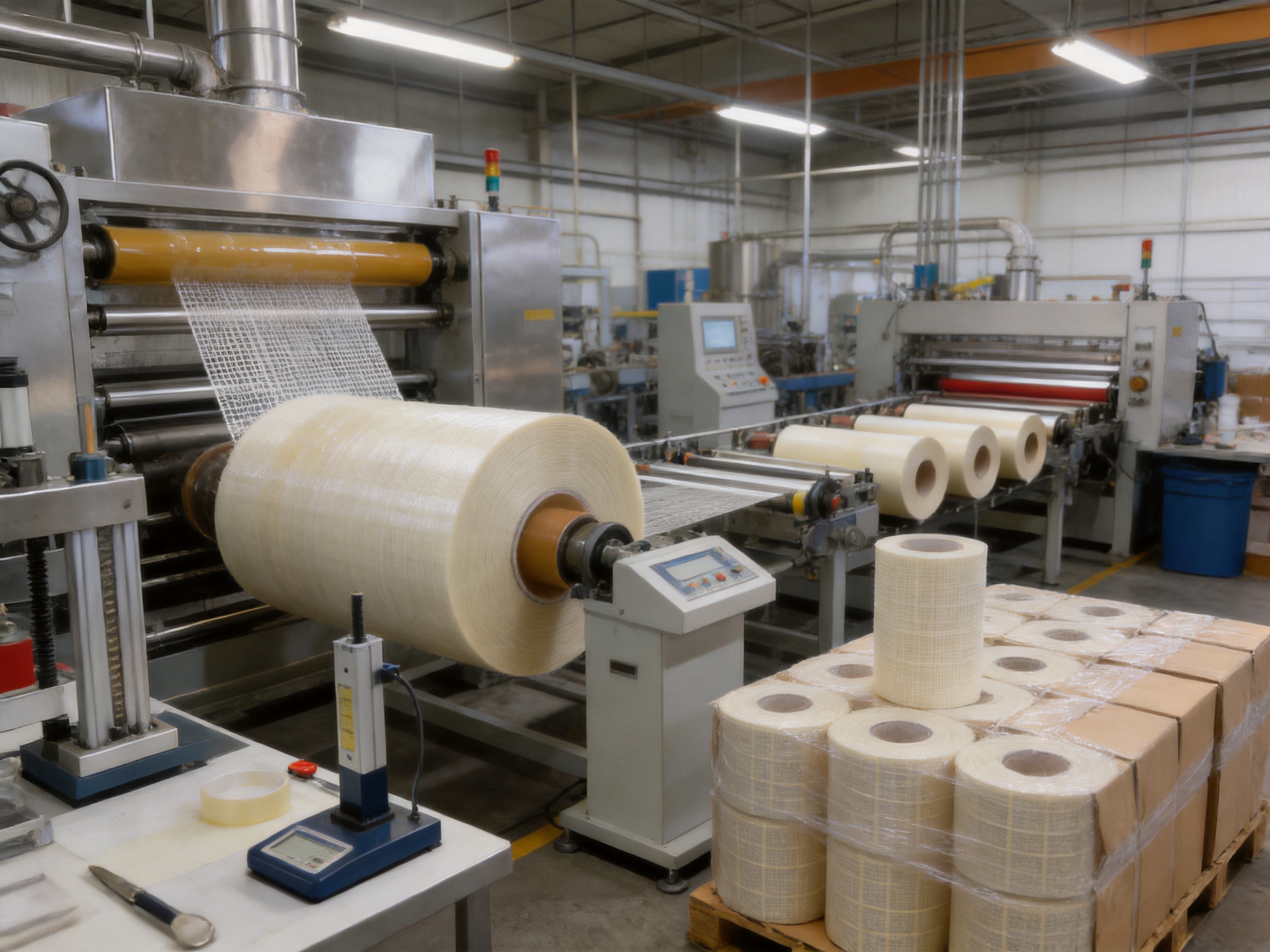
Environmental and Operational Considerations
Industrial packaging increasingly requires attention to material efficiency, waste reduction, and responsible production. While reinforced tape contains fiberglass and adhesive components that must be managed appropriately, it can contribute to waste reduction by preventing package failure and reducing the need for excessive layers of lower-strength tape. A tape that protects goods effectively can also prevent the much larger environmental and economic cost of damaged products.
Operationally, fiberglass mesh tape supports leaner packaging processes. Workers can reinforce critical points quickly, reducing the need for complex protective methods in some situations. For example, carton corners can be strengthened with targeted tape strips. Bundles can be stabilized without excessive wrapping. Minor tears in covers can be repaired instead of replacing the entire cover immediately. These practical benefits help companies operate more efficiently.
Customization and Product Selection
Different customers may require different tape widths, lengths, colors, adhesive systems, thicknesses, or packaging formats. Fiberglass mesh tape is typically available in black or off-white, and thickness options may vary according to specification. A professional manufacturer can help customers evaluate requirements and select the most suitable configuration.
For heavy carton sealing, wider tape may provide better coverage and load distribution. For edge protection, a specific width may be selected according to edge size. For repair work, users may need a balance between flexibility and strength. For export packaging, customers may require consistent roll length, packaging labels, and stable supply. Technical communication with the manufacturer helps avoid over-specification or under-specification.
Customers should consider the surface material, expected load, application temperature, storage duration, transport conditions, and removal requirements. For temporary applications, residue and surface compatibility may be important. For long-term reinforcement, aging resistance and environmental stability become more important. Sampling and testing under actual conditions are recommended before large-scale use.
Quality Control Standards and Testing Significance
Testing standards provide a common language between manufacturer and customer. The specifications for 319-36 Fiberglass Mesh Tape reference several GB/T standards. Total thickness testing helps confirm product structure. Initial tack testing indicates immediate adhesion ability. Peel strength testing measures resistance to removal from a surface. Tensile strength and elongation testing evaluate mechanical reinforcement properties.
These tests are important because visual inspection alone cannot confirm performance. Two tapes may look similar but behave very differently under load. A tape with insufficient adhesive may lift from surfaces. A tape with weak backing may tear during bundling. A tape with excessive elongation may loosen after application. Objective testing reduces uncertainty and supports consistent purchasing decisions.
In addition to formal testing, practical application trials are valuable. Customers can apply tape to their actual cartons, profiles, covers, or surfaces and then simulate handling, storage, and transportation. This real-world evaluation helps confirm suitability and can identify optimal application methods.
Why Professional Manufacturing Matters
The difference between average tape and dependable industrial tape often lies in manufacturing discipline. A professional manufacturer does not only produce rolls; it controls raw materials, equipment conditions, coating precision, drying parameters, slitting quality, inspection procedures, packaging, and delivery. Each step affects the final user experience.
For fiberglass mesh tape, manufacturing consistency is especially important because the product must deliver both adhesive and mechanical performance. If the mesh is inconsistent, tensile strength may vary. If adhesive coating is uneven, parts of the tape may fail. If drying is poorly controlled, the adhesive may not age well. If slitting damages the edges, the tape may be difficult to apply neatly. Advanced manufacturing processes reduce these risks.
Zhejiang Geruite Packaging Materials Co., Ltd. combines production experience with a broad packaging material portfolio. This enables the company to understand different market needs, from logistics and express delivery to construction, decoration, electronics, industrial manufacturing, cargo stabilization, and packaging protection. Its commitment to research, development, and quality control supports continuous product improvement.
Purchasing Considerations for Industrial Buyers
When purchasing fiberglass mesh tape, buyers should evaluate more than price. Key considerations include technical performance, supplier reliability, production capacity, consistency, application support, packaging format, delivery time, and after-sales communication. A low-cost tape that fails during use may become expensive when damage, rework, and delays are considered.
Buyers should request technical data and confirm that the tape has been tested according to relevant standards. They should also clarify whether the adhesive type is suitable for their surfaces and temperature conditions. If the tape will be used for export packaging, long-distance shipping, or heavy goods, trial testing is strongly recommended.
Supplier stability is also important. Industrial users often need repeat orders with consistent quality. A manufacturer with established production systems, quality inspection, and sufficient capacity is more likely to support long-term supply. Communication capability matters as well, especially when customers need customized specifications or technical adjustments.
Q&A Section
Q1: What is 319-36 Fiberglass Mesh Tape mainly used for?
It is mainly used for heavy-duty fixing, bundling, carton sealing, edge protection, seam reinforcement, tarp or canvas repair, temporary surface protection, and industrial holding applications. It is suitable for situations where ordinary tape may not provide enough tensile strength or tear resistance.
Q2: How is fiberglass mesh tape different from ordinary packaging tape?
Ordinary packaging tape usually uses a plastic film backing and is designed mainly for carton closure. Fiberglass mesh tape uses reinforced fiberglass cloth backing, giving it much higher tensile strength, lower elongation, better tear resistance, and improved abrasion protection.
Q3: Can the tape be used for heavy cartons?
Yes. The tape is well suited for reinforcing heavy cartons, especially for long-distance transportation or storage. It can be applied to seams, edges, corners, and stress points to improve carton strength and reduce the risk of tearing.
Q4: What surfaces can the tape bond to?
It can bond to many surfaces such as paperboard, plastic, metal, wood, painted surfaces, fabric, tarps, and canvas, depending on surface condition. For best results, the surface should be clean, dry, and free of oil, dust, and loose particles.
Q5: Is the tape suitable for outdoor use?
The tape has good stability against normal temperature fluctuations and moisture, but actual outdoor performance depends on adhesive type, exposure duration, sunlight, rain, and surface material. For prolonged outdoor use, testing under real conditions is recommended.
Q6: What is the recommended temperature range?
The typical applicable range is generally from -10°C to 60°C, though the exact range may vary by adhesive formulation. Application at room temperature is recommended because extreme cold can reduce initial tack.
Q7: Why is low elongation important?
Low elongation means the tape does not stretch much under load. This helps maintain stable tension when bundling materials or reinforcing cartons. It reduces loosening and improves shape retention during handling and transport.
Q8: Can it replace strapping band?
Fiberglass mesh tape can support bundling and reinforcement, but it should not automatically be considered a full replacement for PP or PET strapping in high-load cargo stabilization. For heavy pallets or large loads, strapping may still be required. The tape can be used as a complementary reinforcement material.
Q9: How should the tape be stored?
It should be stored in a cool, dry place away from direct sunlight and heat sources. A recommended storage temperature is 15°C to 30°C. Keep rolls in original packaging until use and apply first-in, first-out inventory management.
Q10: Why choose a manufacturer with multiple packaging product lines?
A manufacturer experienced in adhesive tapes, stretch film, and strapping can better understand complete packaging systems. This helps customers select compatible materials and improve overall packaging reliability rather than focusing on one product alone.
Conclusion
319-36 Fiberglass Mesh Tape is a high-performance industrial tape designed for users who need more than ordinary adhesion. Its reinforced open-weave fiberglass backing provides high tensile strength, low elongation, tear resistance, and abrasion protection. Its high-tack pressure-sensitive adhesive supports strong initial bonding and durable attachment to many surfaces. With typical values such as 0.135 mm total thickness, 27.3 N/25 mm peel strength, 650 N/in tensile strength, and 5% elongation at break, the tape is clearly positioned for demanding reinforcement and protection tasks.
Its advantages are especially clear in heavy-duty carton sealing, edge protection, pipe and profile bundling, seam repair, tarp reinforcement, temporary surface guarding, and industrial fixing. Compared with conventional packaging tapes, it offers stronger mechanical support and greater resistance to damage. For businesses that face packaging failures, product damage, or inefficient reinforcement methods, fiberglass mesh tape can improve reliability and reduce hidden costs.
Behind this product, professional manufacturing plays a critical role. Zhejiang Geruite Packaging Materials Co., Ltd. brings experience in adhesive tape, strapping band, stretch film, and other packaging materials, supported by quality control, production capacity, and a commitment to continuous improvement. Its capabilities in raw material selection, adhesive formulation, coating, drying, winding, slitting, and inspection help ensure consistent tape performance.
For industrial buyers, the right tape is not simply the cheapest roll available. It is the tape that protects products, supports efficient operations, and performs consistently under real handling conditions. 319-36 Fiberglass Mesh Tape offers a dependable solution for packaging and reinforcement challenges where strength, adhesion, and protection are essential.
References
GB/T 7125-2014, Test Methods for Thickness of Adhesive Tapes.
GB/T 4852-2002, Test Method for Initial Tack of Pressure Sensitive Adhesive Tapes by Rolling Ball.
GB/T 2792-2014, Measurement of Peel Adhesion Properties for Adhesive Tapes.
GB/T 7753-87, Test Method for Tensile Strength and Elongation of Pressure Sensitive Adhesive Tapes.
Petrie, E. M., Handbook of Adhesives and Sealants, McGraw-Hill Education.
Kinloch, A. J., Adhesion and Adhesives: Science and Technology, Springer.
Pressure Sensitive Tape Council, Pressure Sensitive Adhesive Tape Technical Guide.
Ebnesajjad, S., Adhesives Technology Handbook, William Andrew Publishing.
Product: 319-36 Fiberglass mesh tape

LATEST POST
Let’s create something amazing together
contact us
CONTACT DETAILS
- Address:No. 241, Yaojiafan, Zhangpanqiao, Shushan Street, Xiaoshan District, Hangzhou City, Zhejiang Province, China
- TEL:+86-0571-83175630
- Phone:+86-13336160217
- Email:anqiaocun@163.com
PRODUCTS
NEWS CENTER
MOBILE TERMINAL
Copyright© Zhejiang Geruite Packaging Materials Co., Ltd. All Rights Reserved.
Privacy Wholesale industrial packaging tape Manufacturers