


 English
  Español
  عربى
عربى 
Aluminum Foil Adhesive Tape for High-Performance Industrial Packaging and Insulation
Content
- 1 Product Overview
- 2 Key Specifications
- 3 Why Aluminum Foil Matters as a Base Material
- 4 Advantages Over Conventional Packaging Tapes
- 5 Wear Resistance for Industrial Environments
- 6 Heat Insulation and Thermal Management
- 7 High Temperature Resistance in Demanding Applications
- 8 Lined and Unlined Options
- 9 Pure Aluminum and Film-Coated Structures
- 10 Custom Widths for Practical Efficiency
- 11 Flexible Lengths for Different Workflows
- 12 Manufacturing Process and Production Strength
- 13 Quality Control from Raw Material to Final Inspection
- 14 Applications in Logistics and Express Delivery
- 15 Applications in Electronics and Industrial Manufacturing
- 16 Applications in Construction and Decoration
- 17 Applications in Cargo Stabilization and Packaging Protection
- 18 Comparison with Competing Products
- 19 Company Strength and Industrial Experience
- 20 How to Select the Right Aluminum Foil Adhesive Tape
- 21 Installation and Handling Guidelines
- 22 Environmental and Cost Efficiency Considerations
- 23 Why Choose a Professional Packaging Materials Manufacturer
- 24 Frequently Asked Questions
- 24.1 What is aluminum foil adhesive tape mainly used for?
- 24.2 What is the base material of this tape?
- 24.3 What options are available?
- 24.4 What widths can be supplied?
- 24.5 What roll lengths are available?
- 24.6 How does aluminum foil adhesive tape compare with ordinary packaging tape?
- 24.7 Is lined or unlined tape better?
- 24.8 When should film-coated aluminum foil tape be selected?
- 24.9 Can the tape be used for insulation systems?
- 24.10 Why is manufacturer quality important for this product?
- 25 Conclusion
- 26 References
- 27 Product: Aluminum Foil Adhesive Tape
Aluminum foil adhesive tape is a specialized industrial tape designed for applications where ordinary packaging tape, cloth tape, or plastic film tape cannot provide sufficient heat resistance, insulation performance, surface protection, or long-term stability. Built with aluminum foil as the base material and coated with adhesive, this tape combines metallic barrier properties with practical bonding performance, making it suitable for packaging protection, equipment sealing, insulation reinforcement, repair work, industrial manufacturing, and construction-related uses.
In modern packaging and industrial assembly environments, tapes are expected to do far more than simply close a box. They must withstand temperature changes, resist abrasion, protect sensitive surfaces, reduce heat transfer, conform to different materials, and maintain stable performance during storage, transport, and use. Aluminum foil adhesive tape answers these demands by offering a strong balance of wear resistance, heat insulation, and high temperature resistance. Its structure gives it a distinct advantage over many conventional adhesive products used in general packaging.
Zhejiang Geruite Packaging Materials Co., Ltd. produces aluminum foil adhesive tape as part of its wider portfolio of high-performance packaging materials, including adhesive tapes, strapping products, and films. With a focus on research, production, quality control, and customer-oriented service, the company supports users who need reliable industrial packaging solutions rather than one-size-fits-all tape products. The aluminum foil adhesive tape can be supplied in lined or unlined forms, as pure aluminum or film-coated material, and in widths from 10 mm to 1000 mm, with custom widths available. Lengths from 50 m to 200 m allow flexible selection for manual use, machine use, workshop maintenance, and large-scale industrial applications.
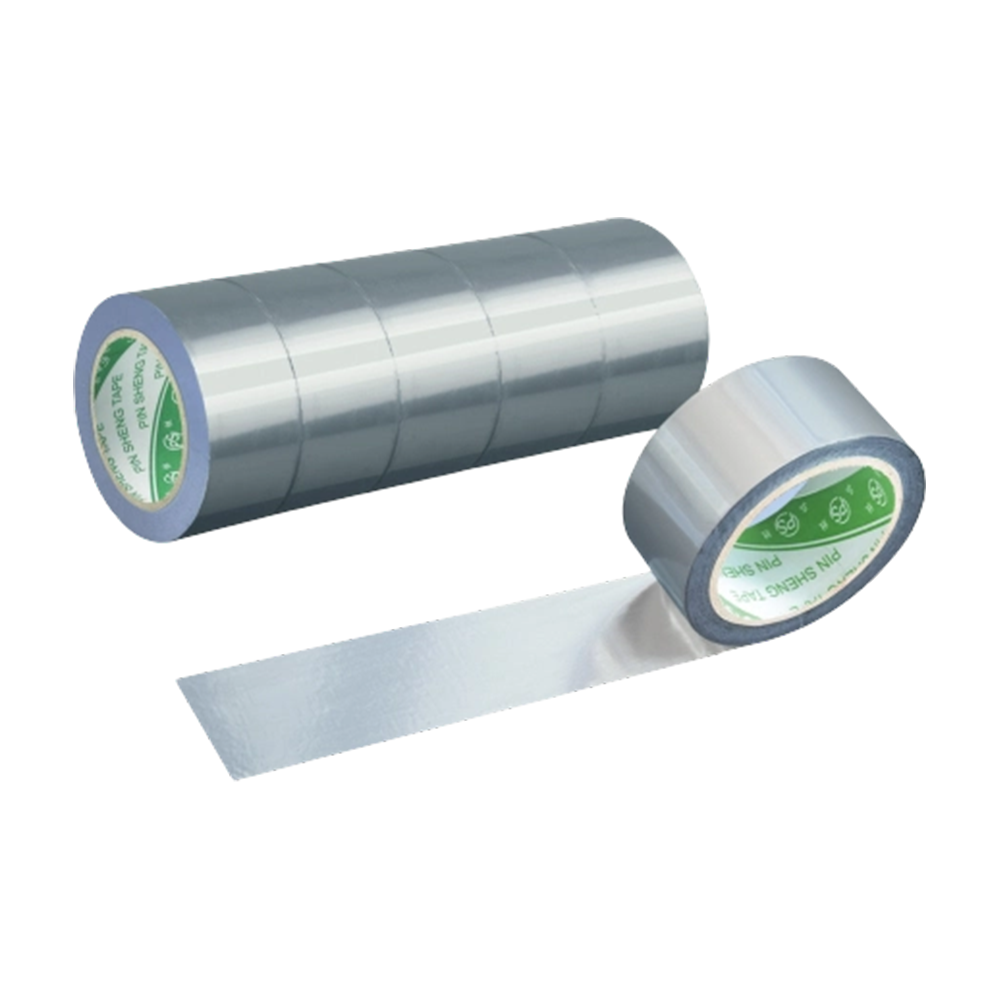
Product Overview
Aluminum foil adhesive tape is made with aluminum foil as the primary base material. Aluminum foil is valued for its reflective surface, barrier capability, temperature tolerance, and resistance to environmental stress. When combined with an adhesive backing, it becomes a practical roll-format material that can be quickly applied to seams, joints, surfaces, ducts, panels, insulation layers, containers, and equipment components.
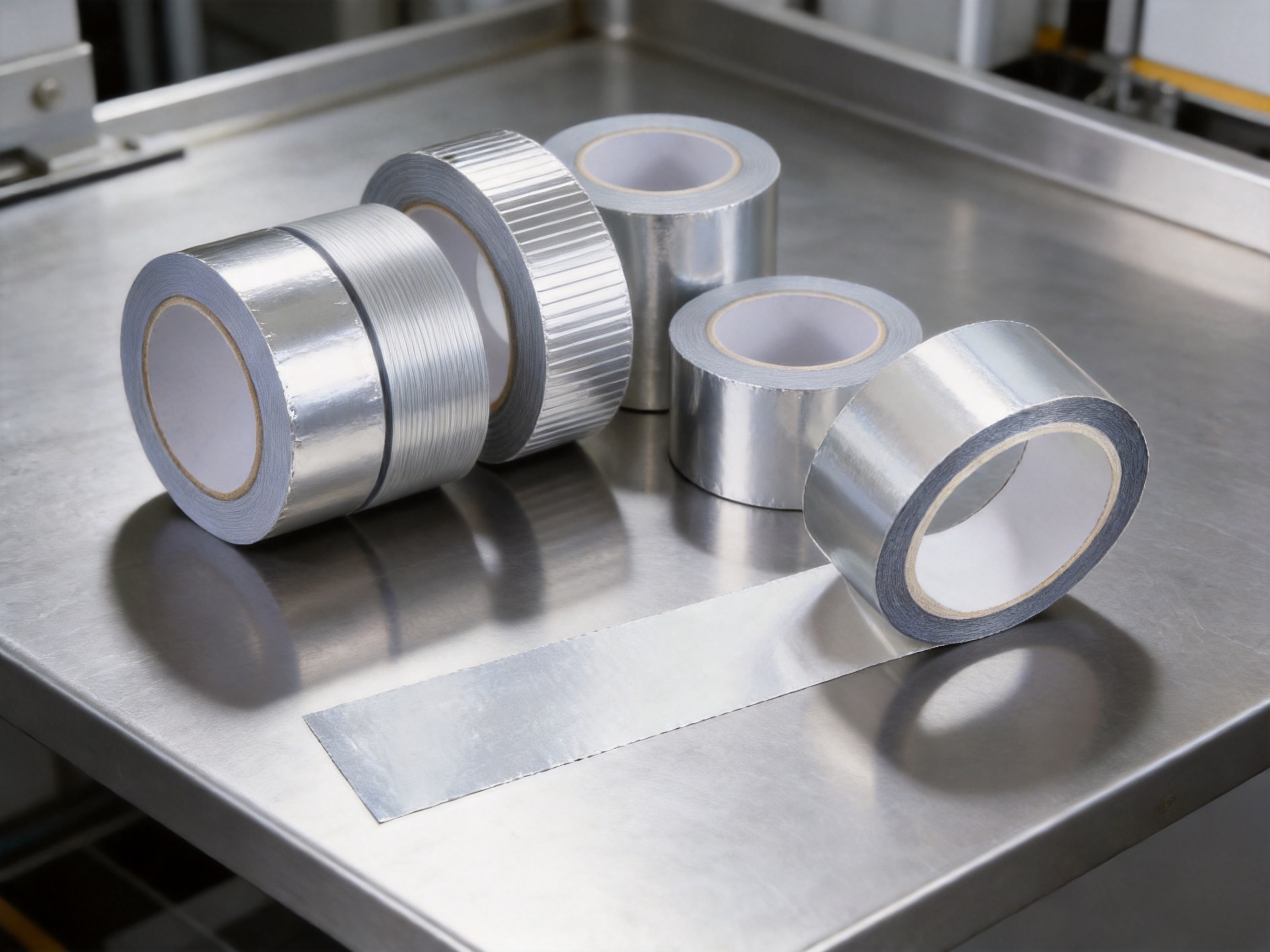
The product is available in several configurations. Lined aluminum foil adhesive tape includes a release liner that protects the adhesive before application. This format is suitable for precision work, die-cut parts, longer storage requirements, and applications where the tape may be handled before final placement. Unlined aluminum foil adhesive tape is convenient for continuous roll use and fast application, especially in workshops or production lines where speed and efficiency are important.
Pure aluminum versions emphasize the natural metallic characteristics of aluminum foil, including heat reflection, moisture resistance, and a clean metallic surface. Film-coated versions add an additional protective layer, helping improve handling performance, surface durability, and certain forms of mechanical protection. This flexibility enables users to match the tape structure with the specific demands of their operating environment.
The width range of 10 mm to 1000 mm is especially important for industrial buyers. Narrow widths are useful for sealing small seams, edging components, repairing localized areas, or reinforcing details. Medium widths suit HVAC ducts, pipe insulation, packaging seams, and general industrial maintenance. Very wide widths are useful for covering larger panels, wrapping insulation systems, or protecting broad surfaces. Custom widths make the product more adaptable than standard retail tapes and reduce unnecessary trimming, waste, and labor time.
Length options from 50 m to 200 m support different working patterns. Shorter rolls are easier to handle for mobile repair, installation crews, and small workshops. Longer rolls improve productivity in continuous use environments, reducing roll replacement frequency and supporting more efficient material management.
Key Specifications
| Item | Details |
| Product Name | Aluminum Foil Adhesive Tape |
| Base Material | Aluminum Foil |
| Available Options | Lined / Unlined, Pure Aluminum / Film-coated |
| Key Features | Wear resistance, heat insulation, and high temperature resistance |
| Width Range | 10 mm to 1000 mm, with custom widths available |
| Length Range | 50 m to 200 m |
| Common Use Areas | Packaging protection, insulation sealing, industrial manufacturing, construction and decoration, equipment maintenance, cargo protection |
Why Aluminum Foil Matters as a Base Material
The performance of an adhesive tape begins with its base material. While many general packaging tapes use plastic film, paper, or woven cloth, aluminum foil introduces a different performance profile. It is metallic, reflective, dense, and stable under demanding conditions. These characteristics give aluminum foil adhesive tape important advantages in applications involving heat, moisture, surface protection, and mechanical wear.
One of the most recognized benefits of aluminum foil is its heat reflection capability. The bright metallic surface reflects radiant heat, helping reduce heat transfer in insulation systems. This is why aluminum foil materials are widely used in thermal insulation, HVAC systems, pipe wrapping, and construction-related heat management. When the foil is converted into adhesive tape, it becomes easy to apply in strips or sheets over targeted areas.
Aluminum foil also functions as a barrier material. It helps resist moisture vapor, air movement, dust, and contaminants when properly applied over seams and gaps. This makes the tape valuable for sealing joints in insulation boards, ducts, panels, and packaging surfaces that require a protective barrier. Unlike ordinary paper tape, aluminum foil tape does not absorb moisture in the same way. Unlike many plastic tapes, it offers a metallic barrier layer and a surface that can tolerate higher temperatures.
Another advantage is surface durability. Aluminum foil provides a wear-resistant covering that can protect underlying materials from friction, abrasion, and environmental exposure. For industrial users, this can reduce maintenance frequency and improve the reliability of temporary or semi-permanent repairs. In packaging and cargo protection, the metallic layer can help reinforce vulnerable areas and shield contents from certain external influences.
Finally, aluminum foil has a professional appearance. Its clean metallic surface signals a technical, industrial-grade solution. In construction, electrical equipment, mechanical maintenance, and factory environments, appearance may not be the only concern, but a neat and consistent surface can improve workmanship quality and help users quickly identify sealed or protected areas.
Advantages Over Conventional Packaging Tapes
Many packaging operations rely on ordinary BOPP tape, paper tape, masking tape, or cloth tape. These tapes are useful in their own categories, but they may not perform well in applications requiring heat resistance, insulation support, or metallic barrier performance. Aluminum foil adhesive tape provides a more specialized solution for demanding environments.
Compared with general plastic packaging tape, aluminum foil adhesive tape offers superior temperature-related functionality. Plastic films may soften, deform, shrink, or lose performance when exposed to high temperatures. Aluminum foil is more stable under heat, making the tape suitable for use near warm equipment, insulated surfaces, ducts, and areas exposed to temperature fluctuation. This does not mean it should be used without regard to adhesive limits, but it does provide a stronger base material for heat-related applications.
Compared with paper tape, aluminum foil adhesive tape provides better moisture resistance and a stronger barrier effect. Paper-based tapes can absorb moisture, weaken, wrinkle, or lose integrity in damp environments. Aluminum foil does not behave like paper and can help maintain a continuous sealing surface. This makes it preferable for sealing insulation materials, packaging products that need improved surface protection, or reinforcing areas exposed to humidity.
Compared with ordinary cloth tape, aluminum foil adhesive tape provides better thermal reflection and a cleaner barrier layer. Cloth tape is flexible and strong, but its woven structure may not offer the same continuous metallic surface. Aluminum foil adhesive tape is more suitable where heat insulation, reflective performance, and vapor barrier characteristics are important. It also gives users a smoother and more professional metallic finish.
Compared with low-cost unknown tapes, a professionally produced aluminum foil adhesive tape offers more consistent thickness, better roll appearance, more stable adhesive coating, and more predictable use. In industrial procurement, consistency is often more valuable than the lowest unit price. A tape that performs consistently reduces rework, waste, production delays, and customer complaints. This is one of the reasons buyers increasingly prefer manufacturers with controlled production systems and quality inspection procedures.
Wear Resistance for Industrial Environments
Wear resistance is one of the key features of this aluminum foil adhesive tape. In industrial use, tape may be exposed to rubbing, handling, movement, packaging pressure, tool contact, or surface friction. If the tape surface wears quickly, the seal can weaken and the protected area may become exposed. Aluminum foil provides a protective metallic surface that can improve durability compared with many conventional tapes used in less demanding conditions.
Wear resistance is valuable in packaging protection because transported goods often experience vibration, stacking pressure, and contact with other packages. A protective strip of aluminum foil adhesive tape can reinforce areas that require extra surface strength. For example, it may be used to cover seams, protect edges, reinforce insulation packaging, or shield sensitive parts during transport.
In equipment maintenance, wear resistance helps preserve the integrity of repairs and coverings. Technicians may apply the tape to cover small gaps, protect insulation surfaces, or reinforce areas exposed to contact. A tape that tears or abrades too easily may require frequent replacement. Aluminum foil adhesive tape can improve work efficiency by extending the service life of applied sealing or protective areas.
Wear resistance also supports construction and decoration applications. During installation, materials may be handled repeatedly, cut, pressed, and adjusted. A durable tape surface can better survive jobsite conditions. It can be applied to insulation seams, panels, ducts, or temporary protection points where a stronger material is required.
Heat Insulation and Thermal Management
Heat insulation is another core advantage of aluminum foil adhesive tape. Aluminum foil reflects radiant heat and supports insulation systems by sealing joints and creating a more continuous barrier surface. In many insulation applications, the weak points are not the main insulation materials but the seams, overlaps, edges, and punctures. If these areas are not sealed properly, heat transfer can increase and overall insulation efficiency can decline.
Aluminum foil adhesive tape can be applied to insulation board seams, pipe insulation joints, duct connections, thermal blankets, and other surfaces where reflective sealing is needed. Its metallic surface helps maintain the insulation system’s reflective character. This is particularly useful in HVAC installations, industrial thermal insulation, and construction projects where energy efficiency and surface protection are important.
Compared with ordinary plastic tape, aluminum foil adhesive tape is more appropriate for thermal environments because it is designed around a metallic base material. Plastic tapes may be suitable for carton sealing or light-duty bundling, but they are not ideal for high-temperature or heat-reflective applications. Aluminum foil tape bridges the gap between adhesive convenience and thermal protection needs.
Heat insulation performance is also useful in packaging for temperature-sensitive or heat-exposed goods. While tape alone is not a complete thermal insulation system, it can support the integrity of insulated packaging by sealing joints and covering gaps. A properly sealed package can reduce unwanted air movement and protect insulating layers from damage.
For industrial buyers, the benefit is practical: better sealing, improved surface continuity, and more dependable performance in heat-related applications. These qualities can reduce energy loss, improve installation quality, and support safer working conditions around heated or insulated equipment.
High Temperature Resistance in Demanding Applications
High temperature resistance is a major reason users choose aluminum foil adhesive tape over ordinary packaging tape. Industrial environments often involve heating equipment, ventilation systems, drying processes, machinery, construction materials, and surfaces that experience temperature variation. Tape failure in these conditions can create maintenance problems, safety concerns, or product quality issues.
The aluminum foil base gives the tape a stable structure under elevated temperatures. It does not melt like many plastic films and is less likely to degrade in the same way as paper-based materials. This makes it suitable for applications where a heat-resistant surface is needed. The adhesive system also plays a critical role, and professional manufacturing helps ensure uniform adhesive coating and reliable bonding performance for intended use conditions.
In HVAC systems, tape may be exposed to warm air, cold air, humidity, and continuous airflow. High temperature resistance helps the tape remain functional on duct seams, insulation joints, and equipment surfaces. In industrial manufacturing, it may be used near process equipment or for temporary protection around heated areas. In construction, it can help seal insulation layers that face changing seasonal temperatures.
High temperature resistance also improves storage and transportation reliability in certain climates. Packages may be stored in warehouses, containers, or vehicles where temperatures rise significantly. A tape with better thermal stability can maintain appearance and function more reliably than low-grade tapes that soften or lose adhesion under heat.
It is important to select the correct product version for the application. Lined, unlined, pure aluminum, and film-coated options may perform differently depending on temperature, surface type, installation method, and environmental exposure. Working with an experienced manufacturer allows buyers to obtain suitable specifications rather than relying on generic products.
Lined and Unlined Options
The availability of both lined and unlined aluminum foil adhesive tape is an important advantage for different industrial use cases. A release liner is a protective backing that covers the adhesive until the tape is applied. This simple structural difference can significantly affect handling, storage, processing, and application methods.
Lined aluminum foil adhesive tape is well suited for applications requiring accuracy and clean handling. Because the adhesive is protected by the liner, users can cut pieces in advance, position the tape more carefully, or convert it into die-cut shapes. This is useful for manufacturers that need adhesive foil patches, parts, labels, or customized sealing shapes. The liner also helps protect the adhesive from dust and accidental contact during preparation.
Unlined aluminum foil adhesive tape is efficient for direct roll application. Users can pull, cut, and apply the tape quickly without removing a liner. This format is ideal for continuous sealing work, repair tasks, duct sealing, insulation seam sealing, and high-volume applications where speed matters. It also reduces liner waste, which can be a benefit in simple applications where precision handling is not required.
Having both options allows customers to choose based on workflow. Some buyers prioritize installation speed. Others need precision converting. Some need rolls for field crews, while others need materials for production-line assembly. A manufacturer that supplies both structures can serve a broader range of industries and reduce the need for buyers to source from multiple suppliers.
Pure Aluminum and Film-Coated Structures
Pure aluminum foil adhesive tape and film-coated aluminum foil adhesive tape each offer distinctive benefits. Pure aluminum versions emphasize the natural performance of aluminum foil, including metallic reflection, barrier properties, and heat-related stability. These tapes are often preferred when users want the direct advantages of aluminum foil and a traditional industrial metallic appearance.
Film-coated versions add another layer to the tape structure. The film coating can help improve surface protection, handling characteristics, and durability in certain environments. It may also provide a more controlled surface finish or improve resistance to specific forms of wear during use. For customers who need additional surface reinforcement, film-coated material can be an attractive choice.
The choice between pure aluminum and film-coated tape should be based on the application. If the priority is maximum direct metallic surface performance, pure aluminum may be appropriate. If the priority includes added surface protection or improved handling, film-coated material may be better. Professional consultation and sample testing can help buyers make the right selection.
This product flexibility is a competitive advantage. Many low-cost tape suppliers offer only basic specifications. By providing multiple structures, Zhejiang Geruite Packaging Materials Co., Ltd. supports a more application-driven purchasing process. This is especially important for customers in industrial manufacturing, construction, logistics, and packaging protection, where materials must match real operating conditions.
Custom Widths for Practical Efficiency
Width customization is one of the most valuable features for industrial tape users. Standard widths are convenient for general markets, but they often create inefficiencies in specialized applications. If a tape is too narrow, workers may need to apply multiple strips, increasing labor time and creating more seams. If a tape is too wide, users may waste material or spend extra time trimming. Custom widths help solve these problems.
The available width range of 10 mm to 1000 mm covers both detailed work and large-area coverage. Narrow tape can be used for edge sealing, small component protection, insulation details, or precision bonding. Medium-width tape works well for duct sealing, packaging reinforcement, and general repair. Wide tape can cover larger joints, panels, or insulation surfaces with fewer overlaps.
For production managers, custom width can improve productivity. When tape arrives in the correct size, workers can apply it faster and with fewer errors. Material waste is reduced, and finished products look more consistent. In automated or semi-automated processes, correct width is even more important because roll dimensions must match equipment requirements.
Custom width capability also reflects manufacturing strength. It requires slitting equipment, roll control, inspection procedures, and order management systems that can support varied specifications. A manufacturer that can supply customized widths demonstrates an ability to serve industrial customers rather than only standard retail demand.
Flexible Lengths for Different Workflows
Length options from 50 m to 200 m provide flexibility for different users. A maintenance technician may prefer a manageable roll that is easy to carry and store. A production facility may prefer longer rolls to reduce downtime caused by frequent roll changes. Contractors may use different lengths depending on installation scale, jobsite conditions, and labor organization.
Longer rolls are especially useful in repetitive applications such as duct sealing, insulation installation, or packaging reinforcement. Fewer roll changes mean smoother workflow and less interruption. They can also simplify inventory management, because each roll covers more work. However, shorter rolls remain useful where portability and convenience are more important than continuous use.
The ability to supply multiple lengths helps customers optimize cost and productivity. Instead of adapting their work to a fixed roll format, they can choose a format suited to their actual operating environment. This customer-centered flexibility is one of the advantages of sourcing from a manufacturer with broad production capabilities.
Manufacturing Process and Production Strength
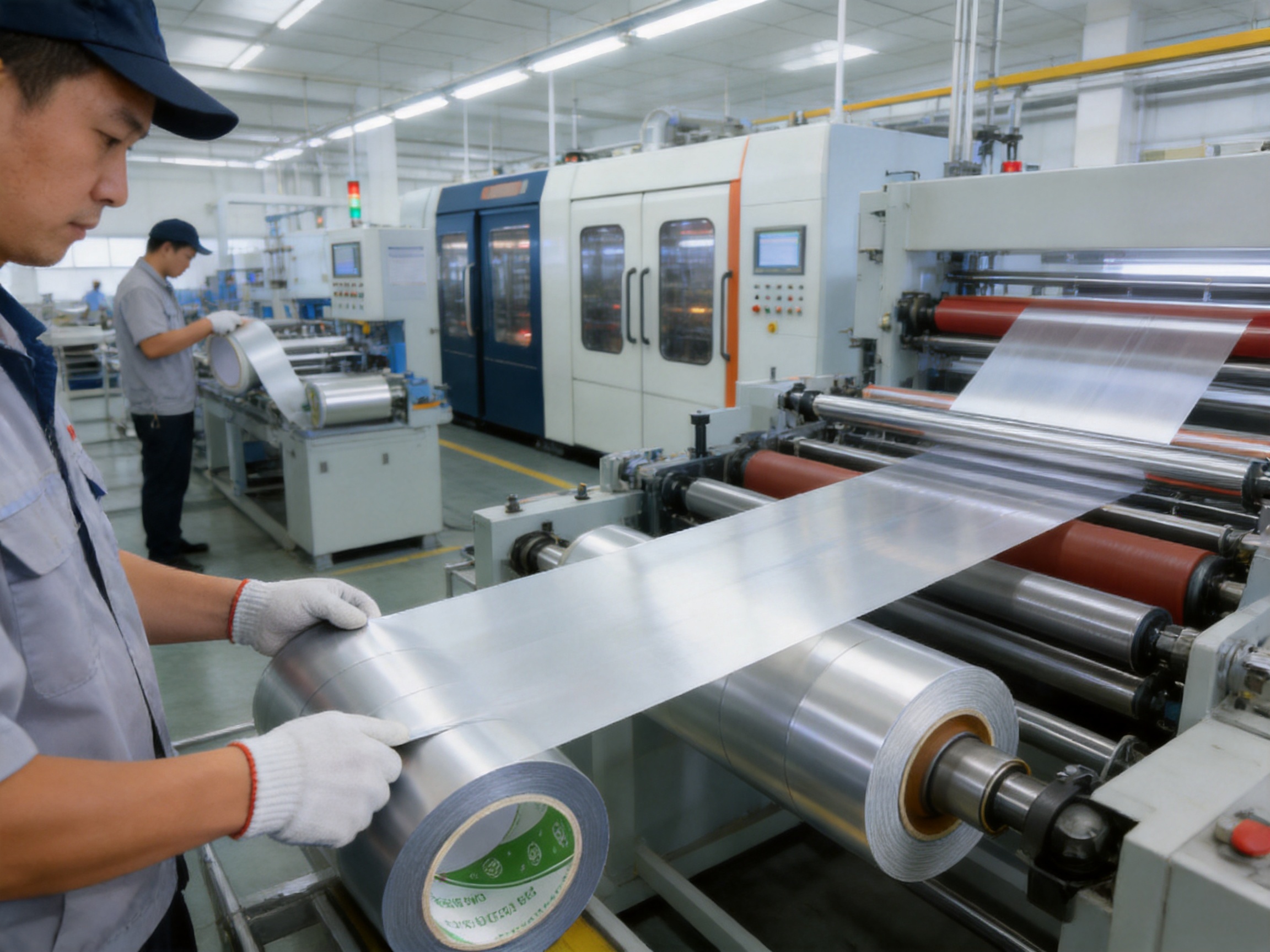
The quality of aluminum foil adhesive tape depends not only on raw materials but also on manufacturing control. Zhejiang Geruite Packaging Materials Co., Ltd. focuses on the research, development, production, and sales of high-performance tapes and packaging materials. The company’s experience with BOPP tapes, kraft paper tapes, masking tapes, high-temperature resistant tapes, metal tapes, PE stretch film, PP strapping, and PET strapping gives it a strong understanding of adhesive coating, roll materials, packaging protection, and industrial customer needs.
Production begins with careful raw material selection. Aluminum foil must be suitable for coating, slitting, rolling, and final application. The surface should support adhesive bonding and maintain stable physical properties. Adhesive materials must be selected according to the expected use of the tape, including bonding requirements, temperature exposure, surface compatibility, and storage conditions.
Surface preparation is another important step. For adhesive tape, the relationship between the backing material and the adhesive layer is critical. If the coating does not bond properly to the foil, the tape may delaminate, curl, or fail during application. Controlled production processes help ensure that the adhesive layer is evenly applied and securely anchored to the foil surface.
Adhesive coating must be uniform. Uneven coating can create weak spots, excessive adhesive bleed, inconsistent tack, or poor roll appearance. Advanced coating equipment and skilled process control help maintain consistent adhesive weight across the material. This is essential for industrial customers who expect every roll to perform predictably.
Drying or curing is also carefully managed. The adhesive layer must reach the proper condition before the tape is wound, slit, and packed. If drying is insufficient, rolls may block, adhesive may transfer, or performance may become unstable. If the process is too aggressive, the adhesive may lose desirable properties. Controlled processing helps balance productivity and performance.
Lamination may be used for lined products or film-coated structures. Release liners must separate cleanly when removed but remain stable during storage and handling. Film coatings must bond properly and maintain the desired surface properties. These layered structures require process experience, equipment precision, and quality inspection.
Slitting is a key step for width accuracy. Rolls must be cut cleanly to the requested width, whether narrow, medium, or wide. Poor slitting can cause rough edges, telescoping, loose winding, or application problems. Custom widths from 10 mm to 1000 mm require flexible slitting capability and careful roll handling.
Final winding and packaging affect user experience. A well-wound roll is easier to store, ship, and apply. Roll tension must be controlled to prevent deformation, wrinkles, or edge damage. Packaging must protect the product during transportation and storage so customers receive clean, stable, and usable material.
Quality Control from Raw Material to Final Inspection
Quality is described as the lifeline of Zhejiang Geruite Packaging Materials Co., Ltd. This philosophy is especially important for aluminum foil adhesive tape because small defects can affect performance. A roll that looks acceptable on the outside may fail if adhesive coating is uneven, if the foil is damaged, or if winding tension is poorly controlled. Therefore, quality control must be integrated into every stage.
Raw material inspection helps confirm that aluminum foil and adhesive materials meet production requirements. This may include checking appearance, thickness consistency, surface condition, and suitability for coating. Reliable incoming materials reduce variation later in the process.
During coating, production personnel monitor coating uniformity, surface appearance, and process stability. Any deviation can affect adhesion and final roll quality. Process control helps ensure that each production batch meets customer expectations.
After drying, curing, or lamination, intermediate inspection can identify issues such as bubbles, wrinkles, surface defects, adhesive transfer, or coating irregularities. Catching these problems before slitting helps reduce waste and prevents defective material from reaching customers.
Slitting inspection focuses on roll width, edge quality, winding neatness, and roll stability. For customers ordering custom widths, dimensional accuracy is essential. Even small deviations can create application problems in automated equipment or precision assembly.
Final inspection verifies that finished rolls meet order specifications and visual quality standards. Packaging inspection ensures that rolls are protected for shipment. A rigorous quality control system gives customers greater confidence, especially when ordering in bulk or using the tape in critical applications.
This quality-oriented approach gives the product a clear advantage over low-cost alternatives. Cheap tape may appear economical, but if it fails during installation, damages product appearance, or requires replacement, the total cost becomes higher. Stable quality reduces hidden costs and supports smoother production.
Applications in Logistics and Express Delivery
Although aluminum foil adhesive tape is more specialized than ordinary carton sealing tape, it can still play an important role in logistics and express delivery when enhanced protection is needed. Modern logistics systems expose packages to vibration, stacking, temperature changes, humidity, handling, and long-distance transport. Some products require additional reinforcement or environmental protection beyond standard packaging tape.
Aluminum foil adhesive tape can reinforce package seams, protect insulation layers, and provide a metallic barrier surface for special packaging formats. It may be used with thermal packaging, industrial components, equipment parts, or materials that require more robust surface protection. The wear-resistant surface helps protect vulnerable areas from abrasion during shipping.
For exporters and manufacturers, packaging consistency is important. A high-quality tape reduces the risk of package failure and improves the professional appearance of shipped goods. When used appropriately, aluminum foil adhesive tape can contribute to safer transport and better customer satisfaction.
Applications in Electronics and Industrial Manufacturing
Electronics and industrial manufacturing environments often require materials that combine precision, surface protection, and thermal stability. Aluminum foil adhesive tape can be used in selected manufacturing processes where a metallic surface, heat reflection, or protective sealing is required. Its availability in narrow custom widths makes it suitable for detailed work.
In electronics-related applications, aluminum foil tape may be used for shielding, surface protection, insulation system support, or component-related sealing depending on the technical requirements. Selection should always be based on product design and testing, but the tape’s metallic base material provides useful properties that ordinary plastic tape does not offer.
In industrial manufacturing, it can be used for machinery maintenance, insulation repair, equipment surface protection, and process-related sealing. Factories benefit from tapes that are easy to apply, available in suitable roll sizes, and stable under demanding conditions. The high temperature resistance and wear resistance of aluminum foil adhesive tape make it valuable in maintenance departments and production support teams.
Because Zhejiang Geruite Packaging Materials Co., Ltd. produces a wide range of tapes and packaging materials, it understands how different adhesive products fit into manufacturing environments. This broader product knowledge helps the company support customers who may need multiple packaging and industrial materials from one supplier.
Applications in Construction and Decoration
Construction and decoration projects frequently require sealing, joining, and protection materials that can handle changing temperatures, dust, handling, and installation stress. Aluminum foil adhesive tape is widely suitable for insulation sealing, duct work, panel seams, pipe wrapping, and temporary or semi-permanent protective applications.
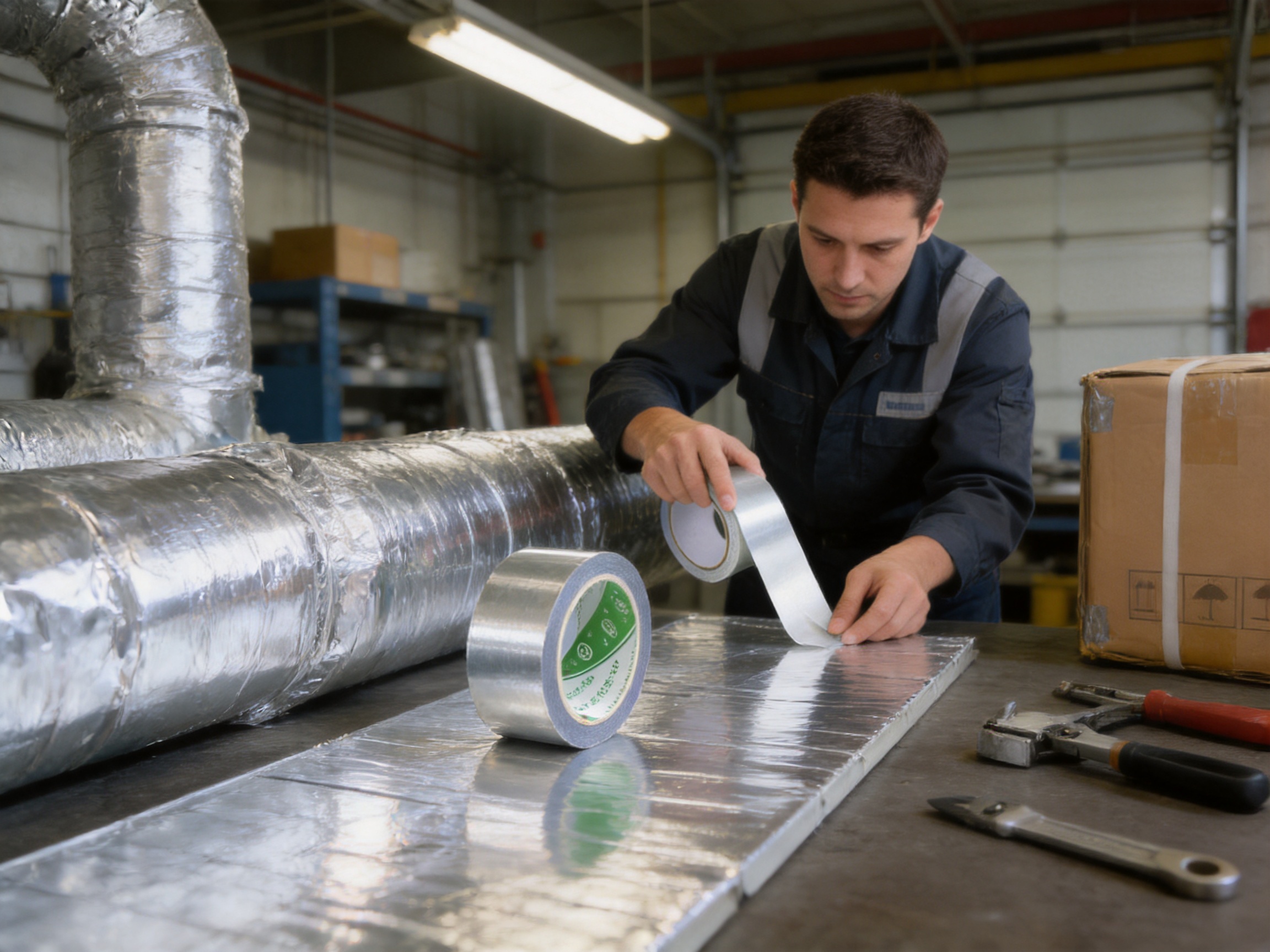
In insulation installation, seams and joints must be carefully sealed to maintain system performance. Aluminum foil adhesive tape helps create a continuous reflective and barrier surface. It can be applied to foil-faced insulation boards, reflective insulation materials, and duct insulation surfaces. Proper application improves finished appearance and supports better thermal performance.
In duct systems, the tape can seal joints and connections where air leakage may occur. While the exact application depends on project requirements and relevant standards, aluminum foil adhesive tape is commonly valued for its ability to bond to metallic and foil-faced surfaces while providing a heat-resistant metallic layer.
In decoration and finishing work, the tape can protect surfaces, reinforce hidden areas, or provide a neat metallic seal. The wide range of available widths helps contractors match tape size to the work area, reducing waste and improving installation speed.
Applications in Cargo Stabilization and Packaging Protection
Cargo stabilization often involves strapping, stretch film, protective corners, cushioning, and specialized tapes. Aluminum foil adhesive tape can be part of a broader packaging protection system when goods require heat resistance, barrier performance, or reinforced surface coverage. It works particularly well in combination with other packaging materials such as PE stretch film, PP strapping, and PET strapping, which are also within the company’s product range.
For heavy or sensitive cargo, surface protection matters. Edges, seams, and exposed areas may need reinforcement before transport. Aluminum foil adhesive tape can provide a durable protective covering and reduce the risk of damage from friction or environmental exposure. It can also support packaging systems designed for insulation or moisture protection.
Because the company offers multiple packaging product categories, customers can source complementary materials from one supplier. This can simplify procurement, improve specification matching, and reduce communication costs. A packaging supplier with knowledge of tapes, films, and strapping can better understand complete packaging systems rather than treating each product separately.
Comparison with Competing Products
When comparing aluminum foil adhesive tape with competing products, buyers should consider performance, consistency, customization, and supplier capability. The lowest-priced tape may not provide the best value if it lacks durability, fails in heat, or creates rework. A high-performance tape should reduce risk and improve application efficiency.
Compared with generic aluminum foil tapes from unknown sources, this product benefits from controlled manufacturing, custom width availability, multiple structural options, and a manufacturer with a strong packaging materials background. These factors are important for industrial buyers who require repeatable quality across orders.
Compared with ordinary cloth tape, aluminum foil adhesive tape offers stronger thermal and barrier advantages. Cloth tape may be flexible and tough, but it is not designed to provide the same reflective metallic surface or heat insulation support. For insulation and high-temperature related use, aluminum foil tape is often the more appropriate choice.
Compared with BOPP packaging tape, aluminum foil adhesive tape is more specialized. BOPP tape is excellent for carton sealing and everyday packaging, but it is not intended for heat insulation or metallic barrier functions. Aluminum foil tape fills a higher-performance role where protection, temperature resistance, and sealing quality are more important than simple box closure.
Compared with paper tape, aluminum foil adhesive tape provides superior moisture resistance and surface durability. Paper tape may be environmentally attractive and useful for certain packaging tasks, but it can be limited in damp or high-temperature environments. Aluminum foil tape is better suited to demanding industrial and construction applications.
Compared with low-grade film tape, aluminum foil adhesive tape offers greater heat resistance and a more robust protective surface. Film tapes can be useful for wrapping or sealing, but they may stretch, deform, or lose stability under heat. Aluminum foil delivers a metallic layer that improves performance in more challenging conditions.
Company Strength and Industrial Experience
Zhejiang Geruite Packaging Materials Co., Ltd. is located in Zhejiang Province, China, an area known for developed manufacturing capabilities and an active industrial economy. The company has focused on research and innovation in packaging materials since its establishment, building a reputation as a packaging solution provider with professional service and reliable product quality.
The company’s main business covers research, development, production, and sales of high-performance tapes and packaging materials. Its product portfolio includes BOPP tapes, kraft paper tapes, masking tapes, high-temperature resistant tapes, metal tapes, PE stretch film, PP strapping, and high-strength PET strapping. This broad experience gives the company a strong understanding of adhesive performance, roll material processing, packaging protection, and industrial customer expectations.
Advanced production equipment supports stable and efficient manufacturing. In adhesive tape production, equipment capability directly affects coating quality, roll appearance, slitting accuracy, and production consistency. The company’s investment in production capability helps ensure that customers receive products with stable performance from batch to batch.
A rigorous quality control system is another major strength. From raw material procurement to production and final inspection, the company emphasizes careful control at each stage. This systematic approach helps reduce defects, improve consistency, and meet the diverse needs of customers in logistics, manufacturing, construction, and industrial packaging.
The company’s annual output value has reached over RMB 60 million, reflecting production scale and market recognition. For customers, scale matters because it indicates the ability to support ongoing supply, bulk orders, and stable cooperation. A supplier with both manufacturing capability and quality awareness can become a long-term packaging material partner.
Looking ahead, the company continues to uphold an enterprising spirit and craftsmanship, increasing investment in technological research and development, optimizing product structure, and improving service levels. This forward-looking approach supports customers who need not only current products but also future improvements in packaging performance and material efficiency.
How to Select the Right Aluminum Foil Adhesive Tape
Selecting the right aluminum foil adhesive tape begins with understanding the application. Buyers should consider temperature conditions, surface material, required width, roll length, lined or unlined format, pure aluminum or film-coated structure, and whether the tape will be used manually or in a production process.
For high-speed installation or general sealing, unlined tape may be the most efficient choice. For precision parts, pre-cut shapes, or applications requiring clean adhesive protection before use, lined tape may be better. If the application requires direct metallic performance, pure aluminum may be preferred. If extra surface protection or enhanced handling is needed, film-coated tape may be appropriate.
Width should be selected based on the area to be covered. A tape that is slightly wider than the seam or joint can create better coverage and reduce the risk of edge lifting. However, excessively wide tape can waste material. Custom width options help users avoid this compromise.
Length should be selected based on usage volume and handling requirements. Longer rolls support production efficiency, while shorter rolls are convenient for field use and maintenance. Storage space, worker comfort, and application method should all be considered.
Surface preparation is also important. Most adhesive tapes perform best on clean, dry, and stable surfaces. Dust, oil, moisture, rust, or loose particles can reduce adhesion. Before application, users should clean the surface and apply firm pressure to help the adhesive make full contact. For critical applications, testing under actual conditions is recommended.
Installation and Handling Guidelines
Correct application improves tape performance. Users should begin by checking that the surface is suitable for bonding. The surface should be clean, dry, and free from oil, dust, and loose material. If the tape is applied over a contaminated surface, even a high-quality product may not perform as expected.
The tape should be applied with firm and even pressure. Pressure helps the adhesive flow into the surface texture and form stronger contact. For seams and joints, users should ensure adequate overlap and avoid wrinkles or trapped air. Smooth application improves appearance and sealing performance.
When applying wide tape, it may be helpful to use a roller or smoothing tool. This reduces bubbles and ensures consistent adhesion across the full width. For narrow tape, careful hand pressure may be sufficient. In all cases, avoiding excessive stretching or distortion helps maintain stability.
Storage also affects performance. Rolls should be kept in a clean, dry environment away from unnecessary heat, moisture, and contamination. Proper storage helps preserve adhesive quality and roll appearance. Lined products should remain protected until use, and unlined rolls should be handled carefully to avoid edge damage or contamination.
For demanding applications, users should conduct trial installation before full-scale use. Testing helps confirm adhesion, temperature suitability, surface compatibility, and long-term performance. This is especially important in industrial production, construction projects, and export packaging where failure costs may be high.
Environmental and Cost Efficiency Considerations
Industrial buyers increasingly evaluate materials not only by purchase price but also by total cost of use. A tape that is cheaper per roll may become more expensive if it requires multiple layers, fails prematurely, causes rework, or generates excessive waste. Aluminum foil adhesive tape can improve cost efficiency by providing stronger performance in suitable applications.
Custom widths reduce waste by matching the tape to the application. Instead of trimming oversized rolls or applying multiple narrow strips, users can select an appropriate width. This saves material and labor. Longer roll options can also reduce downtime and packaging waste associated with frequent roll changes.
Durability contributes to resource efficiency. If the tape lasts longer and protects surfaces more effectively, fewer replacements are needed. In insulation systems, better sealing can support energy efficiency by reducing air leakage and heat loss. While tape is only one part of the system, proper sealing materials contribute to overall performance.
Using the right product for the right application is a practical sustainability principle. Aluminum foil adhesive tape should not replace ordinary tape where ordinary tape is sufficient, but it is highly valuable where heat resistance, barrier performance, and wear resistance are required. Correct material selection reduces waste, improves reliability, and supports responsible purchasing.
Why Choose a Professional Packaging Materials Manufacturer
A professional manufacturer provides more than a roll of tape. It offers material knowledge, production capability, quality control, customization, and supply stability. These advantages are important for industrial buyers who need consistent products and reliable cooperation.
Zhejiang Geruite Packaging Materials Co., Ltd. has experience across multiple packaging material categories. This allows the company to understand how tapes interact with films, strapping, cartons, insulation materials, and industrial surfaces. Customers can benefit from a supplier that sees the complete packaging and protection system rather than a single isolated product.
Manufacturing strength also supports customization. Width range, length options, lined and unlined structures, and pure or film-coated materials all require production flexibility. Buyers with special requirements can communicate their needs and obtain more suitable product specifications.
Quality control helps protect customers from inconsistent supply. In industrial purchasing, repeated performance matters. A roll that works today must work again in the next batch. Controlled production and inspection procedures improve this consistency and reduce procurement risk.
Service capability is equally important. A responsive supplier can help customers choose specifications, arrange production, manage orders, and solve practical application issues. For international customers, professional communication and stable supply are essential for long-term cooperation.
Frequently Asked Questions
What is aluminum foil adhesive tape mainly used for?
Aluminum foil adhesive tape is mainly used for sealing, insulation support, heat reflection, surface protection, repair, packaging reinforcement, duct sealing, construction applications, and industrial maintenance. It is suitable where ordinary tape may not provide enough heat resistance, barrier performance, or wear resistance.
What is the base material of this tape?
The base material is aluminum foil. This metallic base gives the tape its reflective surface, barrier characteristics, heat-related stability, and wear-resistant performance.
What options are available?
The tape is available in lined or unlined versions, and in pure aluminum or film-coated structures. These options allow customers to select the most suitable format for precision handling, fast application, direct metallic performance, or enhanced surface protection.
What widths can be supplied?
The tape can be supplied in widths from 10 mm to 1000 mm. Custom widths are also available, allowing buyers to match the tape size to specific seams, surfaces, production equipment, or installation requirements.
What roll lengths are available?
Available lengths range from 50 m to 200 m. Shorter rolls are convenient for maintenance and field use, while longer rolls improve efficiency in continuous production or large-scale installation work.
How does aluminum foil adhesive tape compare with ordinary packaging tape?
Ordinary packaging tape is mainly designed for carton sealing and general packaging. Aluminum foil adhesive tape offers additional heat insulation, high temperature resistance, wear resistance, and metallic barrier performance, making it better suited for industrial, construction, and specialized packaging applications.
Is lined or unlined tape better?
Neither is universally better. Lined tape is better for precision handling, die-cutting, and applications where the adhesive must remain protected before placement. Unlined tape is better for fast, continuous application and general sealing work.
When should film-coated aluminum foil tape be selected?
Film-coated aluminum foil tape may be selected when the application requires added surface protection, improved handling, or enhanced durability. Pure aluminum tape may be preferred when direct metallic surface characteristics are the main priority.
Can the tape be used for insulation systems?
Yes, aluminum foil adhesive tape is commonly suitable for sealing insulation seams, foil-faced materials, ducts, and pipe insulation joints. It helps create a more continuous reflective and barrier surface.
Why is manufacturer quality important for this product?
Manufacturer quality affects adhesive coating uniformity, foil condition, roll winding, slitting accuracy, and batch consistency. A professional manufacturer with advanced equipment and rigorous quality control can provide more reliable tape for industrial use.
Conclusion
Aluminum foil adhesive tape is a practical, high-performance material for users who need more than standard packaging tape. With aluminum foil as the base material, it provides wear resistance, heat insulation, and high temperature resistance. Its metallic surface supports thermal management, barrier sealing, surface protection, and industrial repair applications across logistics, manufacturing, construction, decoration, cargo protection, and packaging systems.
The product’s availability in lined and unlined versions, pure aluminum and film-coated structures, widths from 10 mm to 1000 mm, custom widths, and lengths from 50 m to 200 m gives customers substantial flexibility. This makes it suitable for detailed work, large-area coverage, manual installation, production processes, maintenance tasks, and specialized packaging needs.
Compared with conventional plastic tape, paper tape, cloth tape, and low-grade generic products, aluminum foil adhesive tape offers clear advantages in heat-related performance, durability, moisture resistance, surface protection, and professional appearance. When produced by a capable manufacturer, it also provides the consistency and customization required by industrial buyers.
Zhejiang Geruite Packaging Materials Co., Ltd. supports this product with advanced production equipment, rigorous quality control, broad packaging material experience, and a commitment to research and innovation. From raw material procurement to coating, drying, lamination, slitting, final inspection, and packaging, manufacturing control helps ensure stable performance and reliable supply. For customers seeking a dependable packaging material partner, aluminum foil adhesive tape represents a strong solution for demanding industrial and packaging applications.
References
1. Handbook of Pressure-Sensitive Adhesive Technology, edited by Donatas Satas.
2. Adhesion Science and Engineering: Surfaces, Chemistry and Applications, edited by D. A. Dillard and A. V. Pocius.
3. Industrial Tape Applications and Performance Guidelines, Packaging Materials Technical Review.
4. Aluminum Foil in Industrial Barrier and Insulation Applications, Materials Engineering Reference Series.
5. Packaging Materials: Properties, Performance and Manufacturing Methods, Industrial Packaging Studies.
Product: Aluminum Foil Adhesive Tape

CONTACT DETAILS
- Address:No. 241, Yaojiafan, Zhangpanqiao, Shushan Street, Xiaoshan District, Hangzhou City, Zhejiang Province, China
- TEL:+86-0571-83175630
- Phone:+86-13336160217
- Email:anqiaocun@163.com
PRODUCTS
NEWS CENTER
MOBILE TERMINAL
Copyright© Zhejiang Geruite Packaging Materials Co., Ltd. All Rights Reserved.
Privacy Wholesale industrial packaging tape Manufacturers