


 English
 Español
 عربى

PE Hand-Held Stretch Wrap: A Practical Guide to Secure, Flexible, and Efficient Packaging
Content
- 1 Understanding PE Hand-Held Stretch Wrap
- 2 Core Performance Advantages
- 3 Product Construction and Available Specifications
- 4 How the Film Compares with Alternative Packaging Methods
- 5 Advantages of a Professionally Manufactured Film
- 6 Manufacturing Process from Material to Finished Roll
- 7 Applications across Multiple Industries
- 8 Correct Application Method
- 9 Storage, Handling, and Safety Recommendations
- 10 How to Select the Right Specification
- 11 Operational and Economic Benefits
- 12 Why Choose an Experienced Packaging Manufacturer
- 13 Q&A: Frequently Asked Questions
- 13.1 What is PE hand-held stretch wrap used for?
- 13.2 Does the film require a dispenser or machine?
- 13.3 Can it be used for irregularly shaped products?
- 13.4 What widths are available?
- 13.5 What thickness should be selected?
- 13.6 Is the stretch wrap waterproof?
- 13.7 Can the film replace strapping?
- 13.8 Can it replace carton-sealing tape?
- 13.9 How should unused rolls be stored?
- 13.10 Can roll length and weight be customized?
- 13.11 Is transparent film better than colored film?
- 13.12 What makes professionally manufactured film more reliable?
- 14 Conclusion
- 15 References
- 16 Product: PE Hand-held stretch wrap
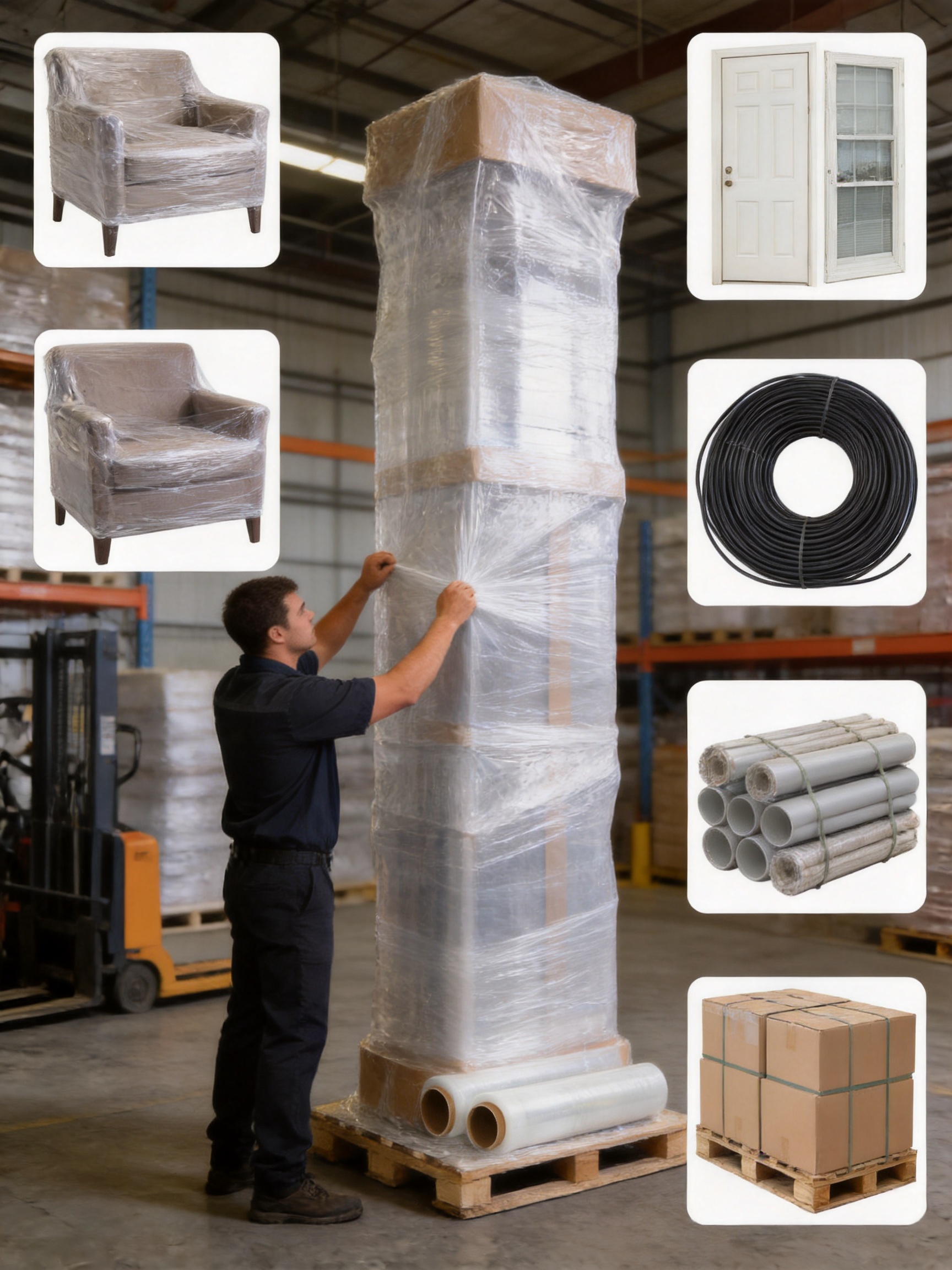
Hand-held stretch wrap is one of the most versatile packaging materials used in logistics, warehousing, industrial production, construction, and commercial handling. Designed for manual application, it allows operators to stabilize cartons, pallets, components, and irregularly shaped products without relying on powered wrapping equipment. Its flexibility, stretchability, surface cling, and transparent appearance make it a practical solution for securing loads while preserving visibility and reducing exposure to dust, moisture, and oil.
Among the available packaging films, polyethylene hand-held stretch wrap offers a useful balance of performance, convenience, and adaptability. It can be wrapped around objects of different sizes and shapes, conforms closely to corners and contours, and creates a unified load that is easier to move, store, and transport. It is particularly suitable for businesses that require flexible packaging operations, frequent product changes, or a packaging solution that can be used immediately without special machinery.
This article examines the construction, performance, applications, manufacturing strengths, selection considerations, and operating methods associated with PE hand-held stretch wrap. It also explains how a professionally manufactured film can provide advantages over less consistent alternatives and how Zhejiang Geruite Packaging Materials Co., Ltd. supports packaging users through material research, controlled production, inspection, and customized supply.
Understanding PE Hand-Held Stretch Wrap
PE hand-held stretch wrap is a thin packaging film made from polyethylene. The film is supplied in rolls and applied manually by an operator who pulls, stretches, and overlaps the material around a product or load. The elastic behavior of the film allows it to contract around the wrapped item, creating holding force and helping maintain load stability.
Unlike rigid packaging materials, stretch wrap does not require a fixed box size or a perfectly regular product shape. It can be used around cartons, bundles, pipes, cables, doors, windows, metal parts, furniture, and many other goods. This flexibility makes it useful when products vary from one order to another or when a load cannot be easily placed inside a standard container.
The film is designed to cling to itself during application. This self-clinging behavior helps layers remain in position without requiring separate adhesive tape for every turn. The operator can control the amount of overlap and tension according to the size, weight, and fragility of the load. Once wrapping is complete, the end of the film can generally be pressed against a previous layer or cut manually.
The transparent appearance of the film provides an additional operational advantage. Workers can often identify the packaged contents, labels, and general condition of the load without removing the wrapping. This is useful in warehouses, distribution centers, production areas, and shipping departments where rapid identification reduces unnecessary handling.
Core Performance Advantages
Reliable Load Stabilization
The primary purpose of hand stretch wrap is to keep packaged items together. When cartons are wrapped with sufficient overlap and suitable tension, the film helps reduce movement, scattering, and shifting during transportation or storage. This is especially important for palletized cartons, mixed loads, and bundles that may experience vibration, turning, lifting, or repeated handling.
By creating a continuous outer layer around the load, the film contributes to unitization. Individual cartons or components become easier to handle as a group, reducing the risk that separate pieces will fall away from the main load. A well-wrapped pallet is also easier to inspect and prepare for movement with a forklift, pallet truck, or other handling equipment.
Stretch wrap does not replace proper pallet design or internal load support. Heavy, unstable, or unusually shaped products may still require corner boards, strapping, blocking, cushioning, or other packaging materials. However, PE hand-held stretch wrap is a valuable outer layer that complements these methods and helps maintain overall load integrity.
Protection from Dust, Moisture, and Oil
The film forms a covering around the packaged products, helping limit contact with airborne dust and common surface contaminants. In warehouses and production environments, this can help preserve the appearance of goods during storage and handling. The film also provides a basic barrier against splashes, humidity, and oily residue, depending on the exposure conditions and the completeness of the wrap.
This protective function is particularly beneficial for building materials, finished surfaces, electronics packaging, furniture, doors, windows, spare parts, and industrial components. When goods must remain in storage for a period of time before installation or shipment, a layer of stretch film can help reduce unnecessary cleaning and surface contamination.
Stretch film should not be regarded as a substitute for waterproof packaging in severe weather, immersion, condensation-prone environments, or long-term outdoor storage. Its effectiveness depends on correct wrapping, film thickness, overlap, environmental conditions, and the shape of the wrapped load. For ordinary dust and light moisture protection, however, it offers a convenient and economical solution.
Surface-Friendly Packaging
Polyethylene film is flexible and lightweight. When applied correctly, it conforms to the surface of the item without introducing the hard edges associated with rigid straps, wire, or certain types of rough protective materials. This makes it suitable for products that require temporary surface protection or that have finished surfaces vulnerable to scuffing.
The film can be used around doors, windows, furniture, pipes, cables, and other products with exposed surfaces. Its smooth structure helps reduce the risk of direct abrasion during normal wrapping. Operators should still avoid excessive tension on delicate items and should remove sharp projections or cover them before wrapping. A protective film works best when the packaging process is matched to the sensitivity of the product.
Adaptability to Irregular Shapes
Many packaging materials are optimized for rectangular cartons or standardized loads. Hand stretch wrap is more flexible because it can follow curves, gaps, corners, and changing dimensions. This makes it effective for products such as pipe bundles, cable coils, long components, doors, windows, metal profiles, and mixed industrial parts.
The operator can change the wrapping direction, overlap, and tension as the shape changes. Additional passes can be applied to corners, ends, or areas that require extra stability. This adaptability reduces the need to create a unique rigid package for every item and can simplify day-to-day packaging operations.
Simple Manual Operation
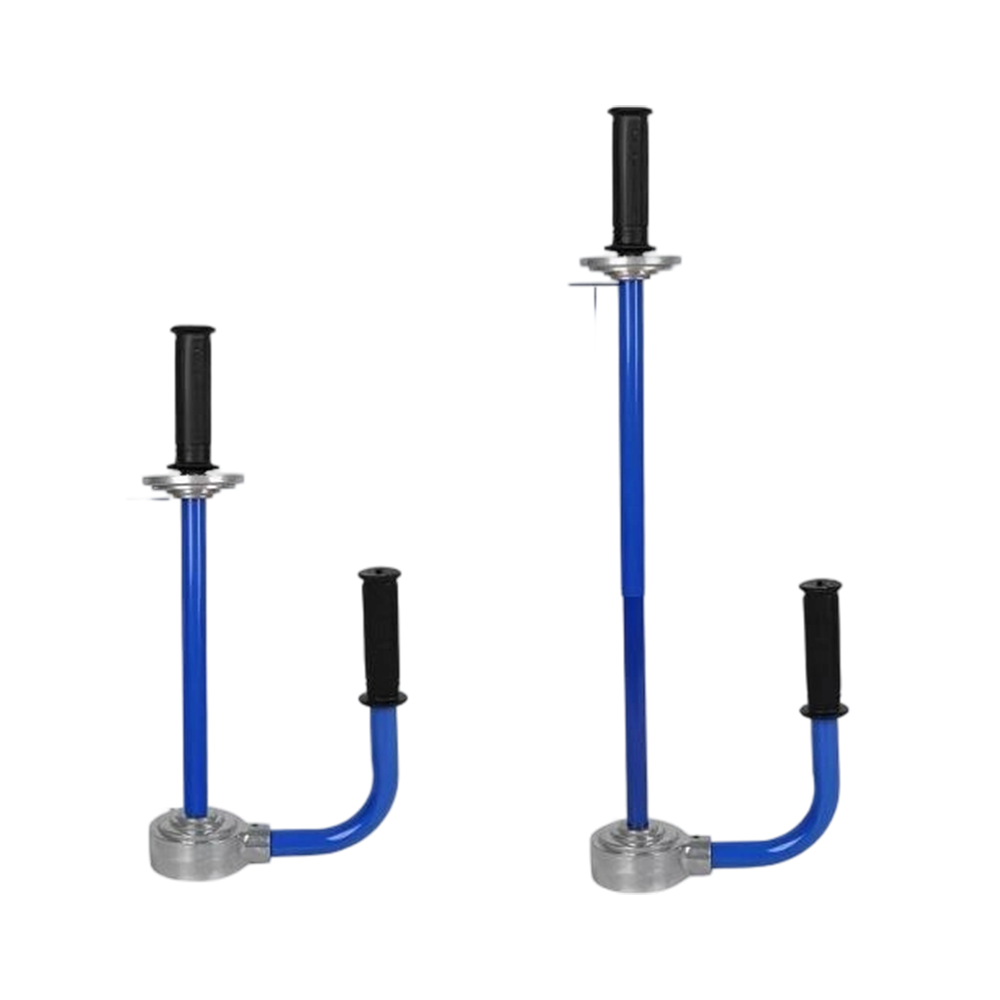
One of the main benefits of this product is that it can be used without a powered wrapping machine. A worker can hold the roll, stretch the film, and wrap the product directly. This is valuable for small warehouses, workshops, retail operations, loading areas, and production lines where investment in automated equipment may not be practical.
Manual operation also supports short production runs and changing packaging requirements. Operators can wrap a single carton, a partial pallet, or an unusual item without adjusting a machine. The film is therefore suitable for businesses that value flexibility as much as speed.
For larger operations, hand-held stretch wrap can be used alongside machine stretch film. It is useful for repair wrapping, spot reinforcement, small shipments, emergency packaging, and loads that cannot be placed on a turntable or conveyor. This complementary role allows a facility to use the right packaging method for each load rather than depending on one system for every situation.
Product Construction and Available Specifications
The product is manufactured from pure polyethylene, selected for its flexibility, stretchability, and cling characteristics. Polyethylene is widely used in packaging because it can be formed into thin, continuous film while maintaining useful mechanical performance. The final behavior of the film depends on the resin, processing conditions, thickness, roll design, and quality controls used during production.
| Parameter | Available Value or Description |
|---|---|
| Material | Pure polyethylene, or PE |
| Width or height options | Common options include 30 cm, 45 cm, and 50 cm; listed product options include 45 cm and 50 cm |
| Thickness | Approximately 0.015 mm to 0.045 mm, depending on the application |
| Length and roll weight | Customizable according to the customer’s usage scenario |
| Color | Transparent, with light shades available for suitable applications |
| Application method | Manual stretch, tear, overlap, and secure operation |
| Primary functions | Load stabilization, bundling, temporary protection, and surface covering |
Width selection affects both coverage and handling. A wider roll can cover more surface area with each pass and may be helpful for large cartons, pallets, doors, windows, and broad furniture surfaces. A narrower roll can be easier to control around small products, narrow bundles, corners, and irregular components. The most suitable width depends on the product dimensions, operator strength, wrapping speed, and desired overlap.
Thickness selection should be based on load weight, product shape, handling conditions, and the number of layers required. Thin film can be appropriate for light products, temporary covering, and simple dust protection. Thicker film can provide additional resistance and holding force for heavier or more demanding loads. Choosing a suitable thickness helps balance packaging performance with material efficiency.
Length and roll weight can be customized according to usage requirements. A high-volume warehouse may prefer longer rolls to reduce roll changes, while a smaller workstation may prefer lighter rolls that are easier to carry and control. Customization can also help customers align the film with existing packaging procedures, storage space, and shipping practices.
Transparent film is the standard option because it preserves visibility. Operators can see labels, colors, barcodes, and the general condition of a product through the wrapping. Light-colored options may be considered for identification or handling purposes, subject to the customer’s application requirements.
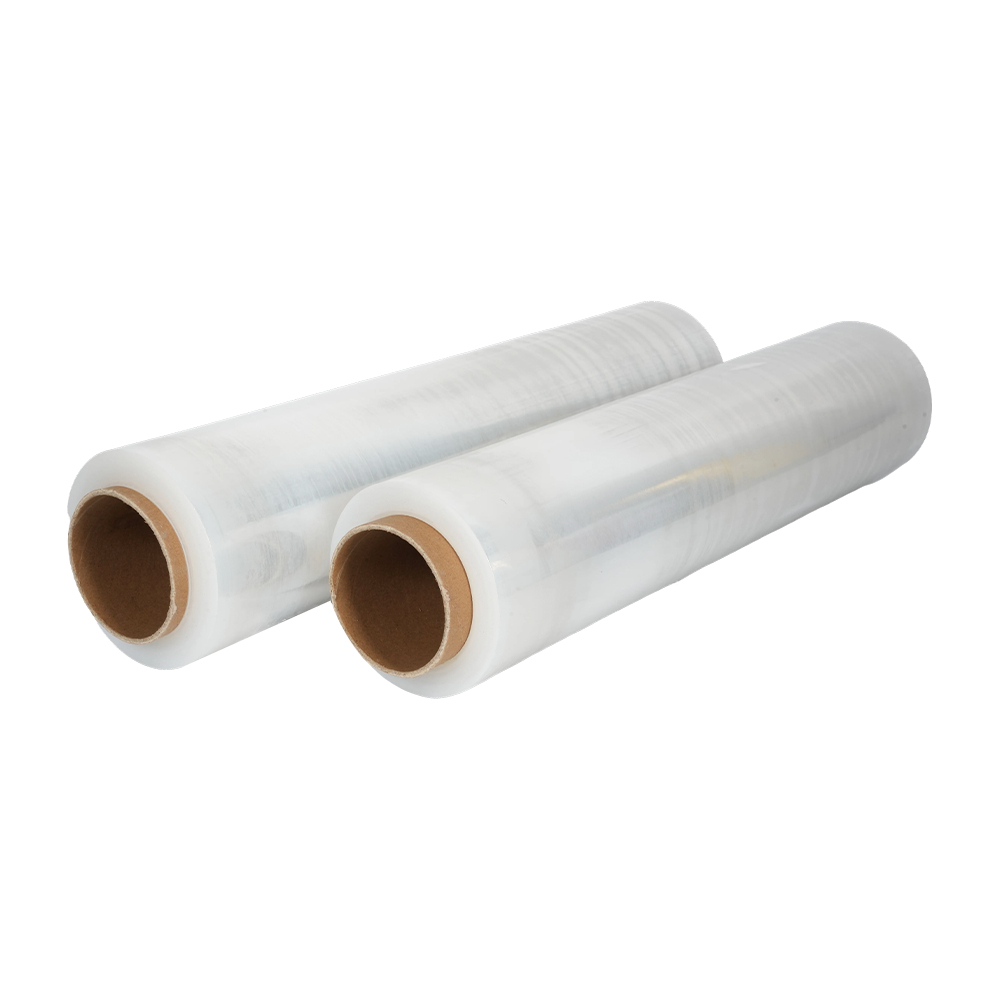
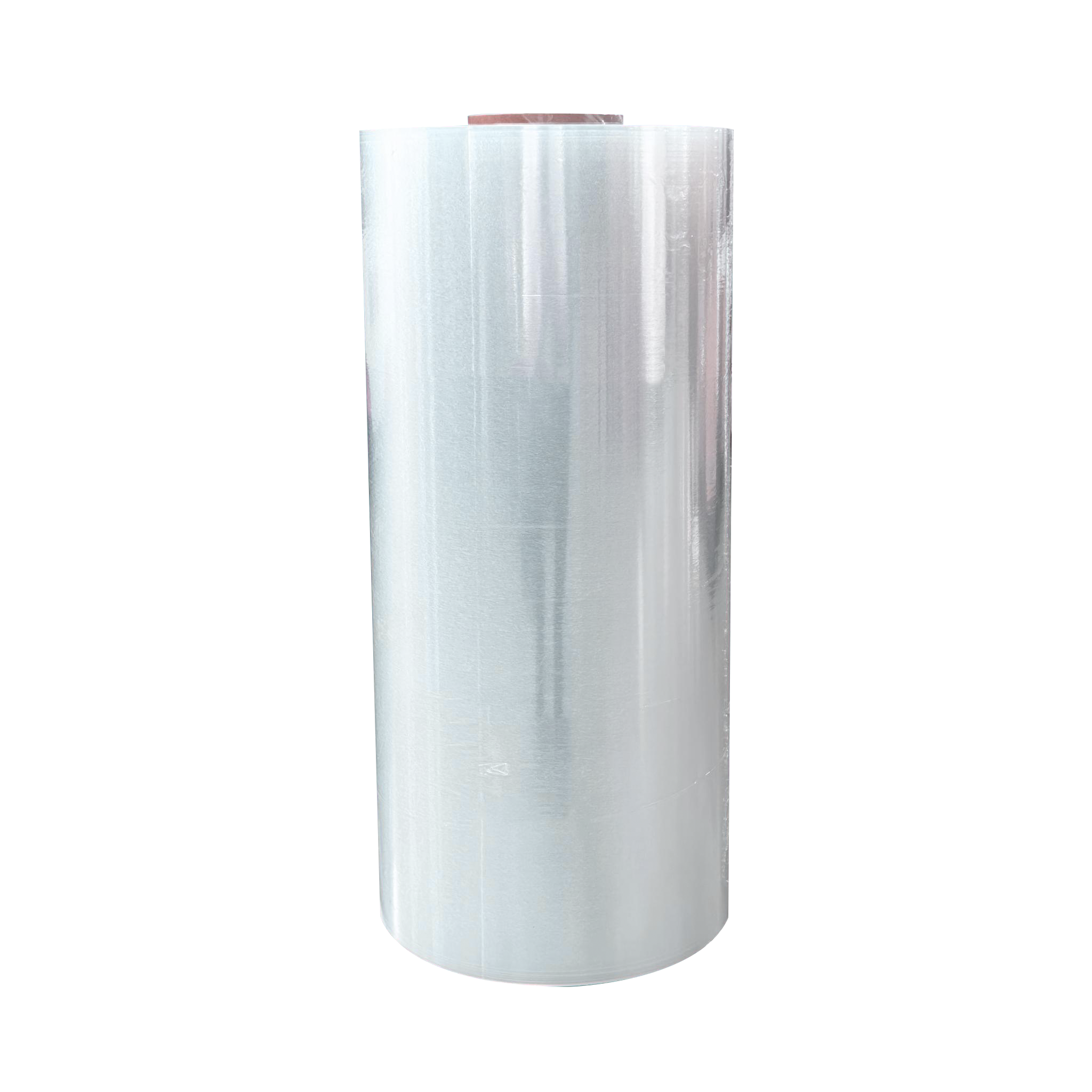
PE Hand-held stretch wrap
How the Film Compares with Alternative Packaging Methods
Compared with Adhesive Tape
Adhesive tape is useful for closing cartons, sealing joints, attaching labels, and performing localized repairs. However, tape alone is not always efficient for stabilizing a complete pallet or bundling large irregular products. It may require repeated application, and removing it from certain surfaces can leave adhesive residue or create surface concerns.
PE hand-held stretch wrap is better suited to creating a continuous outer layer around a load. It distributes holding force across multiple wraps and can secure several cartons at the same time. Tape and stretch wrap therefore serve different functions. Tape closes or joins specific areas, while stretch film unifies and protects the external load.
Compared with Strapping
Strapping provides strong linear compression and is often used for heavy cartons, rigid bundles, construction materials, and pallet loads. It is particularly valuable when high directional strength is required. However, straps can concentrate pressure along narrow lines and may require tensioning tools, buckles, seals, or heat welding equipment.
Stretch film spreads contact over a larger surface area and can provide a gentler outer covering for products that may be marked by concentrated strap pressure. It is also quicker to apply for many light and medium-duty applications. For demanding heavy-duty loads, stretch film may be used together with PP or PET strapping to combine surface coverage with high tensile restraint.
Compared with Shrink Film
Shrink film is applied with heat so that it contracts around a product or load. It can create a tight package and is often used for retail multipacks, industrial products, and specialized packaging lines. However, shrink wrapping requires heating equipment, electrical energy, controlled operating procedures, and attention to heat-sensitive products.
Hand-held stretch wrap does not require a heat source. It can be applied in a warehouse, loading area, or outdoor-adjacent work zone where heating equipment would be inconvenient. Its manual application makes it more accessible for small batches, maintenance work, and irregular products. Shrink film may offer a more uniform appearance in automated production, while stretch film offers greater operational simplicity and flexibility.
Compared with Rigid Containers
Boxes, crates, and plastic containers provide structural protection and can be essential for fragile or high-value goods. Nevertheless, they take up storage space, add packaging weight, and may require specific dimensions. Hand stretch wrap is not intended to replace a rigid container where impact protection or load-bearing strength is essential.
It is instead a complementary material that can hold cartons together, protect the outside of a container, or cover a product that does not need a complete rigid enclosure. Its low-profile form and adaptable coverage can help reduce unnecessary secondary packaging in suitable applications.
Advantages of a Professionally Manufactured Film
The performance of hand stretch wrap depends not only on the general material category but also on manufacturing consistency. Film that varies significantly in thickness, contains defects, tears unpredictably, or has unstable cling can increase material consumption and labor time. Professional production is therefore important for customers who need repeatable packaging results.
Controlled Raw Material Selection
Pure polyethylene is the stated base material for this product. Consistent raw material selection supports predictable film behavior, including flexibility, elongation, cling, transparency, and tear response. A professional supplier can evaluate incoming materials and maintain production specifications that correspond with the intended application.
Stable raw material management is especially important when customers reorder the same product over time. Warehouses and factories often develop standard wrapping procedures based on a particular film’s behavior. Consistency helps operators maintain familiar tension, overlap, and usage rates rather than adjusting their methods for every shipment.
Advanced Production Equipment
Zhejiang Geruite Packaging Materials Co., Ltd. operates with advanced production equipment for packaging materials. Modern equipment supports more precise film formation, thickness control, winding, and roll conversion. These factors affect whether the film unwinds smoothly and whether the operator can apply consistent tension during manual wrapping.
Production equipment alone does not determine product quality, but it provides an important foundation for stable manufacturing. Controlled processing can help reduce uneven areas, inconsistent edges, winding problems, and other defects that may interfere with packaging efficiency.
Process-Based Quality Control
The company emphasizes quality control from raw material procurement through production and final inspection. This process-based approach recognizes that quality must be built into every stage rather than checked only after the finished roll has been produced.
Incoming material management helps establish a stable starting point. Production controls help maintain the intended film characteristics while the material is formed and converted. Final inspection provides an additional opportunity to identify issues before products are shipped. Together, these measures support dependable supply for customers using the film in routine logistics and industrial packaging operations.
Product Development and Application Knowledge
The company focuses on research, development, production, and sales of packaging materials, including PE stretch film, BOPP tape, kraft paper tape, masking tape, high-temperature tape, metal tape, PP strapping, and high-strength PET strapping. This broader product knowledge is useful because customers often require more than one packaging component.
A supplier familiar with tapes, films, and strapping can better understand how different materials work together. For example, a customer may use stretch film for dust protection and load coverage, PP strapping for bundled cartons, and adhesive tape for carton closure. A packaging supplier with multiple product categories can help customers consider the complete packaging process rather than evaluating one item in isolation.
Production Capacity and Supply Support
The company reports an annual output value of more than RMB 60 million. This indicates an established manufacturing operation with experience serving a range of packaging material requirements. Production capacity is important for customers that need regular replenishment, customized dimensions, or coordinated supply across several product types.
A capable manufacturer can also provide greater continuity than a small, irregular source. Reliable supply helps warehouses avoid interruptions, reduces the need to change film specifications unexpectedly, and supports stable packaging procedures. For industrial customers, supply continuity can be as important as the initial product quotation.
Customization for Different Usage Scenarios
Hand stretch wrap is not used in one universal way. A small retail warehouse may need light rolls for occasional carton wrapping. A distribution center may require longer rolls and higher-volume supply. A furniture or building-materials company may need wider film for large surfaces. An industrial workshop may require a particular thickness for metal parts, cables, or pipe bundles.
The product’s length, weight, width, and thickness can be discussed according to the customer’s usage scenario. This creates an advantage over generic products that are available only in one fixed size. Customization can help align roll handling, packaging speed, film consumption, and storage arrangements with actual operating conditions.
Manufacturing Process from Material to Finished Roll
Material Preparation
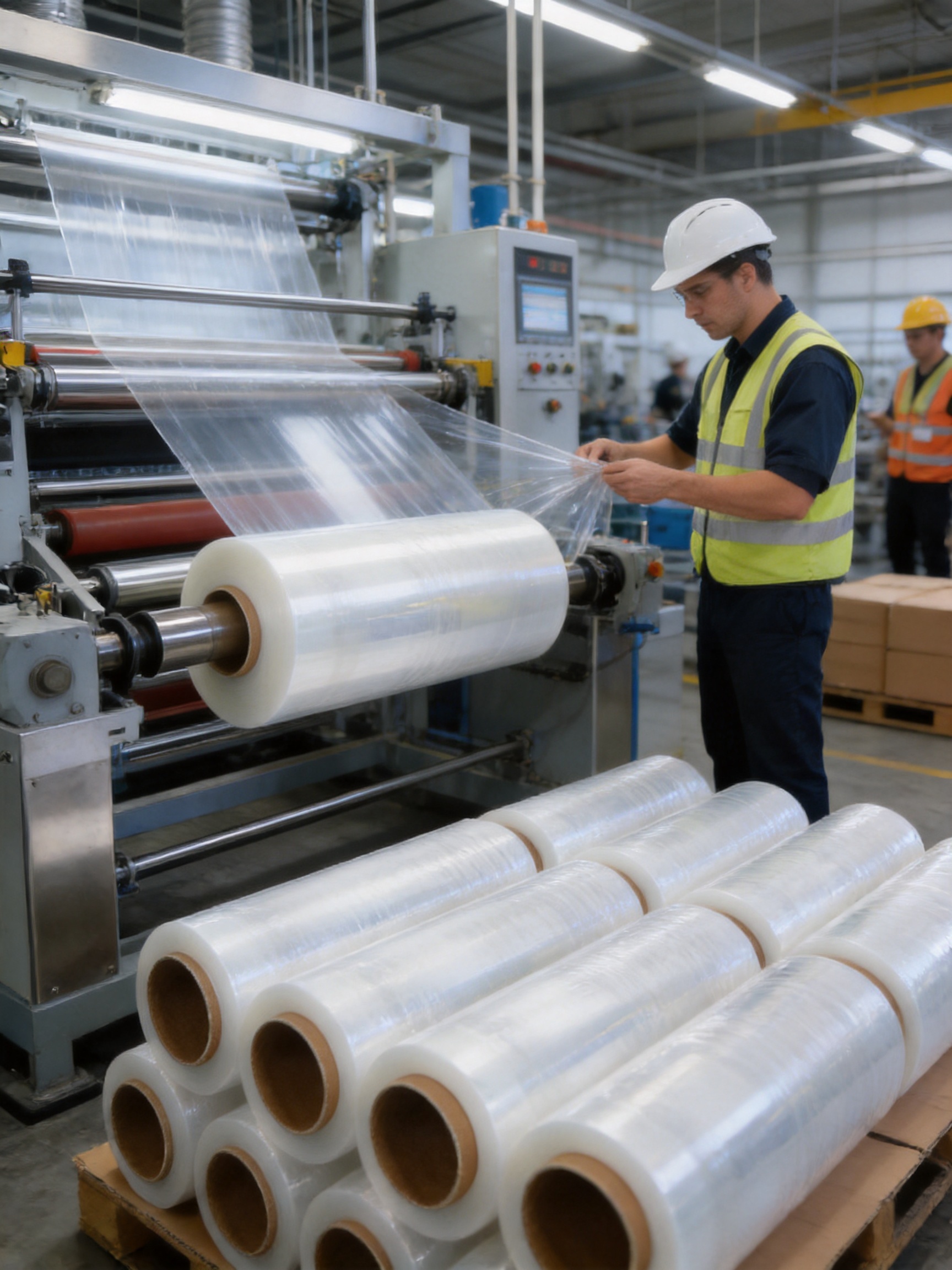
The production process begins with polyethylene raw material preparation. Materials are selected and organized according to the required product specification. The target thickness, width, transparency, flexibility, and application must be considered before processing begins.
Careful preparation helps establish consistency between production batches. It also supports the supplier’s ability to produce different thicknesses and roll configurations for different customers. Proper handling and storage of raw materials are important for maintaining cleanliness and reducing the possibility of contamination.
Film Formation
Polyethylene is processed into a continuous film through specialized film-forming equipment. During this stage, processing conditions influence the thickness and physical behavior of the final material. The film must be sufficiently uniform to unwind and stretch smoothly during manual use.
Film formation is one of the stages where advanced equipment and operating discipline are especially valuable. Uneven thickness can cause weak points, inconsistent stretching, or unexpected tearing. Controlled production helps the film provide a more predictable experience for operators.
Cooling and Stabilization
After formation, the film is cooled and stabilized. This stage supports the development of a consistent film structure before the material is wound. Proper stabilization can help maintain dimensional uniformity and reduce handling problems during later conversion.
The film’s surface behavior is also important. Hand stretch wrap must cling effectively to itself while remaining manageable for the operator. The balance between cling and release affects both load security and ease of application.
Slitting and Roll Conversion
Large film rolls may be converted into the widths required by customers. Slitting and winding must be controlled so that edges remain clean and the rolls are properly formed. A well-converted roll should be easy to hold, unwind, and apply without excessive telescoping or edge damage.
Roll weight and length influence manual ergonomics. If a roll is too heavy for the intended operator or work area, application may become tiring and inconsistent. If a roll is too short, frequent replacement may slow the packaging process. This is why roll conversion and customization are meaningful parts of product design rather than minor finishing details.
Inspection and Packaging
Finished rolls are inspected before shipment. Inspection may include visual checks for appearance, winding condition, edge quality, and obvious defects, together with specification verification appropriate to the customer’s requirements. The finished rolls are then packaged for transport and storage.
Keeping the product properly packaged helps protect it from dust and contamination before use. Customers should also maintain the original packaging or reseal unused rolls whenever possible. Good storage practices preserve the film’s surface condition and help maintain consistent performance.
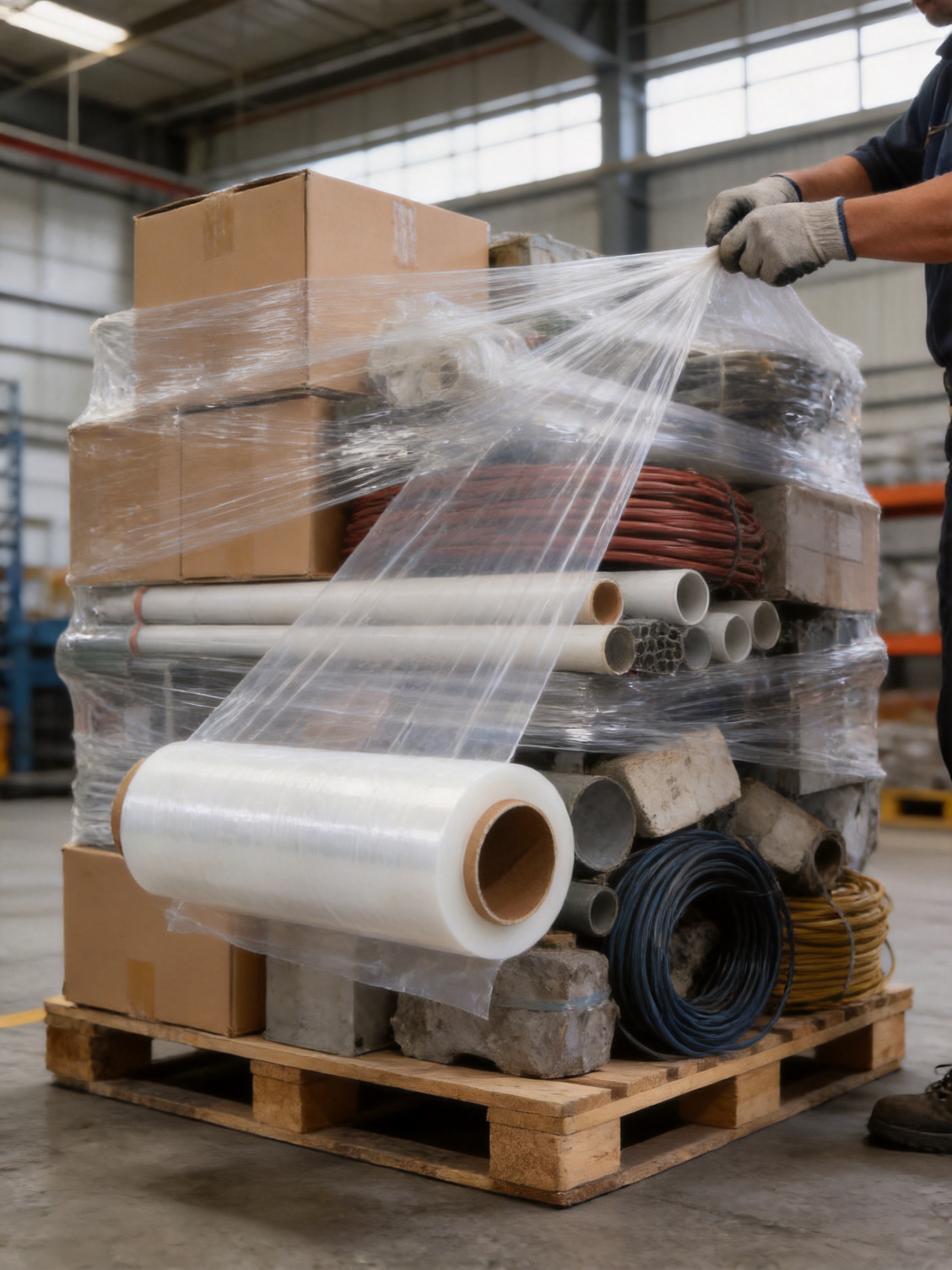
Applications across Multiple Industries
Logistics and Distribution
Logistics operations use hand stretch wrap to stabilize cartons before loading, transfer, and delivery. It can hold groups of boxes together, cover partial pallets, reinforce damaged outer packaging, and secure mixed loads. Transparent film allows warehouse staff to identify shipment contents without removing the protective layer.
For smaller logistics facilities, manual wrapping can be more practical than installing a machine. For larger distribution centers, hand film remains useful for exception handling, irregular shipments, pallet repairs, and loads that do not meet machine-wrapping dimensions.
Warehousing and Inventory Storage
In a warehouse, products may remain stationary for days or months. Dust, humidity, oil, and repeated handling can affect the appearance and condition of stored goods. Stretch film provides a simple additional layer that helps cover cartons and bundles during the storage period.
It can also help keep partially opened cases together. When a pallet is broken down for order fulfillment, the remaining cartons may need temporary re-stabilization. Hand-held film enables workers to secure the remaining units without rebuilding the entire pallet configuration.
Industrial Manufacturing
Industrial manufacturers use stretch wrap for components, semifinished goods, spare parts, and completed products. It is suitable for grouping metal parts, covering equipment, protecting cable coils, and stabilizing long materials. The film can be applied directly in a workshop or near a production line.
Because the film is lightweight and easy to tear, it supports quick changes in packaging requirements. A production team can wrap a single assembly or a small batch without waiting for a dedicated packaging setup.
Building Materials and Installation Products
Doors, windows, profiles, pipes, cables, and other building-related products often have dimensions or shapes that are inconvenient for standard cartons. Hand stretch wrap can cover exposed surfaces, hold accessories in place, and bundle multiple items for transport to a construction site or installation location.
Operators should protect sharp corners and delicate finished surfaces before wrapping. When applied with suitable tension, the film can provide a temporary outer covering while preserving visibility of labels and product identification.
Furniture and Commercial Goods
Furniture and large commercial goods may require temporary surface protection during movement, storage, showroom changes, or delivery. Stretch wrap can help keep doors, drawers, cushions, panels, and loose components together. Its transparent form makes it possible to inspect the item without fully unpacking it.
For finished surfaces, users should test compatibility and avoid prolonged exposure under high heat or direct sunlight. The product is most effective when used as part of a complete handling procedure that includes padding, corner protection, and appropriate lifting methods.
Correct Application Method
Prepare the Product and Work Area
Before wrapping, inspect the product and remove loose debris from the surface. Clean surfaces allow the film to contact the load more effectively. Sharp protrusions, exposed nails, rough edges, and pointed components should be removed, covered, or repositioned to reduce the risk of puncture.
The load should be arranged as securely as possible before film is applied. Cartons should be aligned, heavy items should be placed at the bottom, and unstable gaps should be reduced. Stretch film improves a prepared load, but it cannot fully correct poor stacking or severe imbalance.
Anchor the First Layers
Begin near the lower portion of the load and create several secure overlapping turns. The first layers are important because they establish the connection between the film and the load. Wrapping too loosely at the base can allow the film to slide upward during handling.
When wrapping a pallet, include the lower portion of the load and, where appropriate, part of the pallet structure. The exact method depends on the load design and whether access to the pallet is required. The objective is to create a stable relationship between the cartons and the base without obstructing handling equipment.
Maintain Consistent Tension
Pull the film with controlled tension as the roll moves around the load. Too little tension can result in a loose package that does not stabilize the cartons. Excessive tension may deform cartons, damage delicate products, or cause the film to break during application.
Operators should develop a steady walking pace and keep the roll at a consistent height. For tall loads, gradually move upward while maintaining overlap. For irregular products, change direction carefully and add extra passes where the shape requires more support.
Use Suitable Overlap
Each turn should overlap the previous turn sufficiently to create continuous coverage. Overlap requirements vary with the load, film thickness, and desired protection. More overlap may be needed at corners, joints, ends, or areas exposed to movement.
Using excessive overlap everywhere may increase material consumption without producing a proportional improvement in stability. Efficient wrapping uses additional film where it provides meaningful support and avoids unnecessary layers on already secure areas.
Finish and Secure the Wrap
After the upper section is covered, complete several final turns and press the film against a previous layer. The film should be cut or torn cleanly. The finished load should be checked for loose sections, exposed sharp edges, damaged film, and adequate base coverage.
If the load will be transported over long distances or handled frequently, users should inspect the package again before dispatch. Additional stretch film, tape, corner protection, or strapping may be added when the shipment requires greater restraint.
Storage, Handling, and Safety Recommendations
Unused stretch film should be stored in a cool, dry place away from direct sunlight and high heat sources. A recommended storage temperature is approximately 15°C to 25°C. Keeping the product away from excessive heat helps preserve its intended physical behavior.
Rolls should remain in their original packaging or be covered when not in use. This reduces exposure to dust, dirt, moisture, and accidental surface damage. Rolls should be placed on a stable surface rather than dropped, dragged, or stacked in a way that can deform the edges.
Operators should use safe lifting techniques when moving heavier rolls. Work areas should be kept clear so that the operator can walk around the load without tripping. When wrapping tall or heavy products, additional personnel or equipment may be needed to prevent the load from falling during preparation.
Stretch film is not designed to support a person, replace a safety restraint, or serve as a lifting sling. It should not be used to secure a load that requires certified transport restraints. Its role is packaging stabilization and surface coverage within the limits of the selected specification.
Users should evaluate product compatibility when wrapping painted, polished, coated, or heat-sensitive surfaces. A small test area can help determine whether the film is suitable for temporary contact. Prolonged storage in high temperatures should be avoided unless the application has been specifically evaluated.
How to Select the Right Specification
Consider the Load Weight
Heavier loads generally require stronger stabilization, more layers, a suitable thickness, or a combination of stretch film and strapping. Light cartons may need only a few passes, while dense industrial components may require additional reinforcement. The correct selection should reflect not only the static weight but also the vibration and handling expected during transportation.
Evaluate Shape and Surface
Regular cartons are usually easier to wrap than long, curved, pointed, or mixed-shape products. Irregular loads may need a more flexible film and extra attention at corners and transitions. Products with delicate finishes require controlled tension and may need additional protective materials beneath the film.
Match Width to the Workstation
Wider film can increase coverage and reduce the number of turns around a large load, but it may be less convenient for small products. Narrower rolls offer improved control in compact spaces and around narrow bundles. Common product widths include 30 cm, 45 cm, and 50 cm, with 45 cm and 50 cm listed as important available options.
Balance Thickness and Material Use
Thicknesses from approximately 0.015 mm to 0.045 mm cover a range of packaging requirements. The thinnest suitable specification may help reduce material use for light applications, while thicker film may be more appropriate for heavy or demanding loads. The objective is not simply to choose the thickest film, but to select the specification that provides reliable performance without unnecessary consumption.
Consider Roll Length and Weight
Long rolls can reduce interruptions in high-volume operations. However, the roll must remain comfortable for manual handling. A lighter roll may be more appropriate for occasional use, narrow workspaces, or operators who wrap products at different heights. Customizable length and weight allow the packaging format to be adapted to the customer’s actual workflow.
Operational and Economic Benefits
Hand-held stretch wrap can reduce packaging complexity because it performs several functions at once. It helps stabilize, cover, bundle, and identify products. A single roll can often be used for different load sizes and shapes, which reduces the need to maintain many specialized packaging formats.
Its manual application also limits equipment requirements. Small and medium-sized users can begin wrapping without purchasing a powered machine, installing a dedicated line, or training operators on complex controls. This can be particularly valuable for businesses with changing shipment volumes or multiple packaging locations.
The film’s low weight makes it relatively easy to transport and store. Its transparent form supports fast visual inspection, while its conformability can reduce empty space around irregular products. When the correct thickness and wrapping technique are used, the material can provide effective load control with a practical amount of film.
Economic performance should be measured by total packaging results rather than by roll price alone. Important factors include film consumption per load, breakage rate, labor time, load damage, storage protection, and the reliability of supply. A consistent film can deliver better overall value if it reduces rewrapping, interruptions, and packaging failures.
Why Choose an Experienced Packaging Manufacturer
Customers purchasing stretch film often need more than a product that meets a basic description. They need consistent dimensions, dependable unwinding, stable supply, responsive communication, and support in matching the film to their applications. An experienced packaging manufacturer is better positioned to address these practical requirements.
Zhejiang Geruite Packaging Materials Co., Ltd. is located in Zhejiang Province, China, an area known for its developed manufacturing industry. The company has focused on packaging materials research, development, production, and sales since its establishment. Its product portfolio includes multiple tape, film, and strapping categories, allowing it to serve customers with varied packaging requirements.
The company’s manufacturing strengths include advanced production equipment and a quality control system covering raw materials, production, and final inspection. This systematic approach supports the stable performance expected by logistics companies, industrial manufacturers, warehouses, construction-related businesses, and commercial packaging users.
The company also emphasizes product innovation, service improvement, and the optimization of its packaging material structure. These priorities are relevant to customers seeking customized dimensions, coordinated product supply, and packaging solutions that can evolve with their operations.
With reported annual output value exceeding RMB 60 million, the company has an established base for serving domestic and international customers. Its broader range of BOPP tapes, kraft paper tapes, masking tapes, high-temperature tapes, metal tapes, PE stretch film, PP strapping, and PET strapping can support customers who want to consolidate packaging purchases through one specialized supplier.
Q&A: Frequently Asked Questions
What is PE hand-held stretch wrap used for?
It is used to stabilize cartons, pallets, bundles, and irregular products during storage, transportation, and handling. It also provides a temporary outer layer that helps protect products from dust, light moisture, and oil contamination.
Does the film require a dispenser or machine?
No. The film is designed for manual operation and can be applied directly from the roll. A dispenser may improve comfort and speed in some workplaces, but the basic product does not require powered equipment.
Can it be used for irregularly shaped products?
Yes. Its flexibility allows it to conform to products such as pipes, cables, doors, windows, metal parts, and mixed bundles. Sharp projections should be covered or removed before wrapping.
What widths are available?
Common widths include 30 cm, 45 cm, and 50 cm. The listed product information identifies 45 cm and 50 cm as available height options. The most suitable width depends on the size of the load and the operator’s preferred handling method.
What thickness should be selected?
Available thicknesses range from approximately 0.015 mm to 0.045 mm. Light loads and temporary covering may use thinner film, while heavier or more demanding loads may require thicker film or additional layers. Final selection should consider load weight, shape, handling conditions, and transport distance.
Is the stretch wrap waterproof?
It provides basic protection against moisture and splashes when applied correctly, but it should not be treated as a guarantee of waterproof or weatherproof packaging. Severe exposure, condensation, immersion, and outdoor storage may require additional protective packaging.
Can the film replace strapping?
It can replace strapping for some light and medium-duty bundling applications, but not for every load. Heavy, rigid, or high-risk shipments may benefit from combining stretch film with PP or PET strapping for additional restraint.
Can it replace carton-sealing tape?
Stretch film and carton-sealing tape have different functions. Tape is generally used to close carton flaps and seal joints, while stretch film stabilizes and covers the outside of a load. They can be used together as part of a complete packaging process.
How should unused rolls be stored?
Store them in a cool, dry place away from direct sunlight and high heat. A recommended storage temperature is approximately 15°C to 25°C. Keep rolls sealed or covered when not in use to reduce dust contamination and preserve their surface condition.
Can roll length and weight be customized?
Yes. Length and weight can be customized according to the customer’s usage scenario. Customization should consider wrapping volume, operator comfort, storage capacity, and the desired frequency of roll replacement.
Is transparent film better than colored film?
Transparent film is useful when product visibility and label identification are important. Light-colored film may be selected for specific identification or handling needs. The best option depends on the customer’s operational and visual requirements.
What makes professionally manufactured film more reliable?
Professional manufacturing supports consistent raw material management, controlled film formation, stable roll conversion, and inspection before shipment. These factors can reduce variation in thickness, unwinding, cling, and tear behavior, helping operators achieve more predictable packaging results.
Conclusion
PE hand-held stretch wrap is a flexible and practical packaging material for stabilizing, bundling, and protecting a wide range of products. Its main advantages include manual operation, strong adaptability, transparent visibility, self-clinging layers, surface-friendly flexibility, and protection against common warehouse contaminants. It is useful for carton pallets as well as irregular products that are difficult to package with rigid materials.
The product offers particular value when packaging requirements change frequently or when a business needs an efficient solution without powered wrapping machinery. By selecting an appropriate width, thickness, length, and roll weight, users can match the film to their load characteristics and operating environment.
Product performance also depends on manufacturing discipline. Controlled polyethylene material selection, advanced production equipment, process-based quality control, accurate roll conversion, and final inspection contribute to stable film behavior. Zhejiang Geruite Packaging Materials Co., Ltd. combines these manufacturing strengths with experience across tapes, stretch film, and strapping products, providing a foundation for customized and coordinated packaging supply.
For logistics companies, warehouses, industrial manufacturers, construction-material suppliers, furniture businesses, and commercial users, PE hand-held stretch wrap can serve as an efficient outer packaging layer. When applied with suitable tension, overlap, storage, and safety practices, it helps reduce load movement, simplify handling, protect product surfaces, and support more dependable packaging operations.
References
1. ASTM International. General principles for evaluating plastic packaging films and flexible packaging materials.
2. International Organization for Standardization. Packaging and distribution considerations for unit loads and transport packaging.
3. Plastics Industry Association. Technical background on polyethylene materials used in flexible packaging.
4. Packaging Machinery Manufacturers Institute. Practical guidance on load stabilization and stretch film application.
5. Company product information supplied for PE hand-held stretch wrap, including material, dimensions, applications, storage recommendations, and customization options.
6. Company manufacturing information supplied for Zhejiang Geruite Packaging Materials Co., Ltd., including product categories, quality control practices, production capabilities, and packaging material development.
Product: PE Hand-held stretch wrap

LATEST POST
Let’s create something amazing together
contact us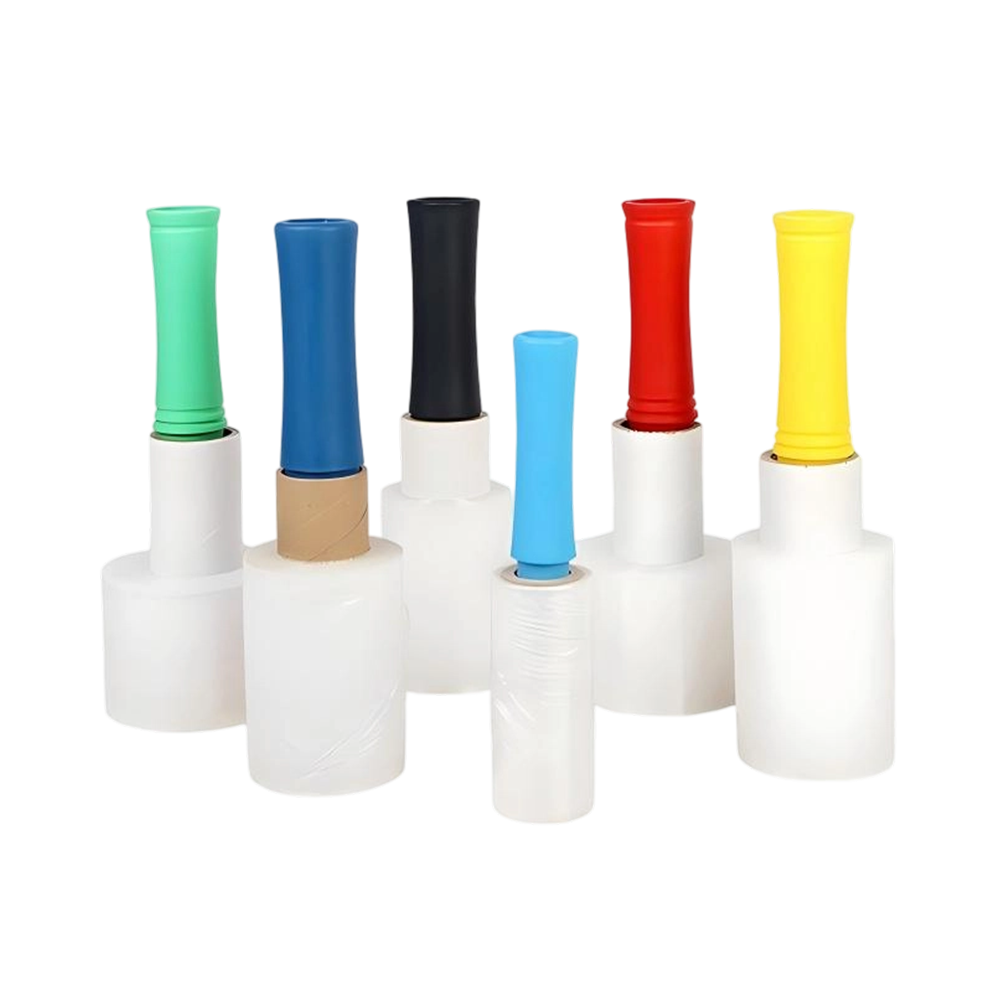
CONTACT DETAILS
- Address:No. 241, Yaojiafan, Zhangpanqiao, Shushan Street, Xiaoshan District, Hangzhou City, Zhejiang Province, China
- TEL:+86-0571-83175630
- Phone:+86-13336160217
- Email:jeffrey@grtpk.com
- WeChat/WhatsApp:+86-18058115265
PRODUCTS
NEWS CENTER
MOBILE TERMINAL
Copyright© Zhejiang Geruite Packaging Materials Co., Ltd. All Rights Reserved.
Privacy Wholesale industrial packaging tape Manufacturers