


 English
 Español
 عربى

High-Temperature Resistant Masking Tape for Professional Painting and Industrial Protection
Content
- 1 What Is High-Temperature Resistant Masking Tape?
- 2 Core Product Characteristics
- 3 Advantages Over Conventional Masking Solutions
- 4 Applications in Automotive Spraying
- 5 Applications in Paintwork Protection
- 6 Use on Paint Curing and Drying Production Lines
- 7 Manufacturing Strengths and Production Capabilities
- 8 Material Selection and Process Control
- 9 Application Guidelines for Best Results
- 10 Storage and Handling Recommendations
- 11 Why Choose a Manufacturer with a Broad Packaging Portfolio?
- 12 Comparison with Other Masking Tape Types
- 13 Quality, Efficiency, and Total Cost of Use
- 14 Customisation for Industrial and Wholesale Buyers
- 15 Environmental and Operational Considerations
- 16 Frequently Asked Questions
- 16.1 What is high-temperature resistant masking tape used for?
- 16.2 What is the backing material?
- 16.3 What adhesive does the tape use?
- 16.4 What thickness is available?
- 16.5 What widths can be supplied?
- 16.6 Can the tape be used in every high-temperature process?
- 16.7 Will the tape leave adhesive residue?
- 16.8 Can it be used on freshly painted surfaces?
- 16.9 How should the tape be removed?
- 16.10 What makes this product different from ordinary painter’s tape?
- 16.11 Who manufactures the tape?
- 16.12 Can distributors order customised sizes?
- 17 Conclusion
- 18 References
- 19 Product: High-Temperature Resistant Masking Tape
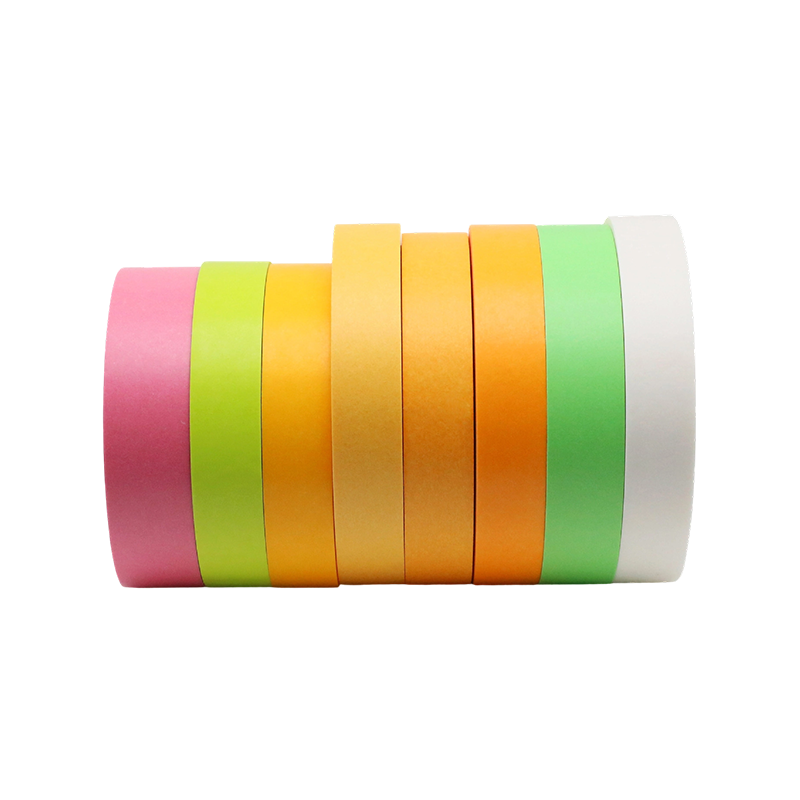
High-temperature resistant masking tape is an essential protection material for automotive refinishing, industrial painting, decorative coating, and production environments where surfaces must remain clean and sharply defined during heat exposure. Designed with a specialised crinkled paper backing and acrylic adhesive, this type of masking tape combines reliable temporary adhesion with controlled removal. It helps protect painted and unpainted areas from overspray, dust, coating migration, and accidental contact while allowing workers to complete painting and curing operations efficiently.
Unlike ordinary household masking tape, high-temperature resistant masking tape is developed for demanding work conditions. Professional users often need a tape that can remain stable during spraying, drying, and curing without leaving excessive adhesive residue or tearing during removal. The product described in this article is available in a thickness of 0.14 millimetres and can be supplied in widths from 5 millimetres to 500 millimetres. Custom sizing makes it suitable for narrow edges, broad panels, curved surfaces, production-line masking, and many other applications.
The tape is manufactured by Zhejiang Geruite Packaging Materials Co., Ltd., a Chinese packaging-material producer focused on research, development, production, and sales of adhesive tapes and related packaging products. With advanced production equipment, a structured quality-control system, and experience across several packaging-material categories, the company is positioned to serve distributors, industrial users, converters, wholesalers, and original equipment manufacturers requiring stable product performance.
What Is High-Temperature Resistant Masking Tape?
High-temperature resistant masking tape is a pressure-sensitive adhesive tape designed to protect selected areas during painting, coating, spraying, drying, or heat-related production processes. Its primary function is temporary masking. The tape is applied to a surface before a coating operation and removed after the protected area is no longer at risk of contamination or unwanted paint coverage.
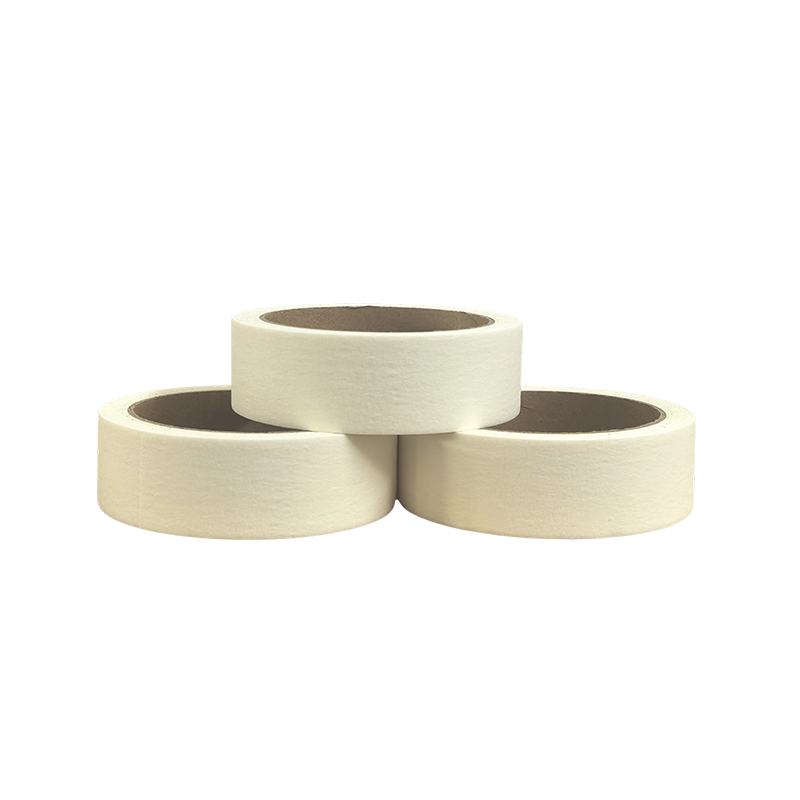
The product uses a specialised crinkled paper backing. This paper structure provides a practical balance between flexibility, conformability, handling strength, and controlled tearability. It can follow edges and moderate curves more effectively than a rigid film backing, while its textured surface gives the user a familiar grip during application and removal.
An acrylic adhesive is applied to the paper backing. Acrylic adhesive systems are widely used in industrial tapes because they can provide dependable bonding, clean removal, and useful resistance to ageing under suitable operating conditions. The performance of the finished tape depends on the combination of paper quality, adhesive formulation, coating uniformity, drying conditions, slitting accuracy, winding tension, and storage management.
The high-temperature-resistant design is particularly useful in automotive spraying and paintwork protection. It can also be used on paint curing and drying production lines where masking materials must tolerate elevated temperatures for a defined process period. The exact temperature capability depends on the manufacturing formulation, process conditions, surface type, exposure time, and application environment. For this reason, users should confirm technical requirements with the supplier before selecting a tape for a specific curing cycle.
Core Product Characteristics
Specialised Crinkled Paper Backing
The crinkled paper backing is one of the most important features of the tape. A backing that is too stiff may lift at edges or fail to conform to shaped components. A backing that is too weak may tear during application, painting, or removal. The specialised paper construction is intended to provide a practical balance between flexibility and handling strength.
During automotive and industrial painting, operators frequently work around corners, trim lines, seams, edges, recesses, and irregular component shapes. A flexible paper backing can be pressed into position along these areas and cut to the required length. Its surface can also be written on in many work environments, helping operators identify masked sections, production stages, or handling instructions when appropriate.
Acrylic Adhesive
The acrylic adhesive provides the bond between the tape and the work surface. It is designed to hold the masking tape in place while the surface is sprayed, coated, moved, or exposed to a controlled drying or curing process. At the same time, the tape is intended to be easy to peel off once the operation is complete.
Clean removal is a major requirement in professional masking. If a tape leaves a heavy adhesive deposit, the protected area may require additional cleaning. If it bonds too aggressively, removing the tape may damage a coating, lift a weak paint layer, or increase labour time. The product’s easy-peel characteristic supports more efficient finishing work, although users should always test the tape on the actual substrate and coating system before large-scale use.
0.14 Millimetre Thickness
The available 0.14 millimetre thickness gives the tape a defined physical profile suitable for general industrial masking and painting protection. Thickness influences handling, edge coverage, conformability, tear behaviour, and the ability of the tape to withstand normal application forces.
A relatively controlled thickness also helps manufacturers maintain consistency between production batches. For distributors and industrial buyers, consistent thickness can simplify purchasing specifications, packaging decisions, application procedures, and quality checks. Where a project requires a different construction, customers can discuss customised specifications with the manufacturer.
Wide Range of Width Options
The tape can be produced in widths ranging from 5 millimetres to 500 millimetres. Narrow widths are useful for fine edge definition, small components, trim protection, and detailed painting work. Medium widths can cover rails, frames, mouldings, panels, and equipment sections. Wider rolls can protect broad surfaces and reduce the number of parallel strips required during preparation.
Custom width capability is valuable because masking work varies significantly between industries. A vehicle refinishing workshop may require several narrow and medium widths, while a coating line may prefer wide rolls for rapid application. A distributor may also request specific roll dimensions to match local market preferences, packaging formats, or dispenser systems.
| Product Feature | Specification or Characteristic | Practical Value |
|---|---|---|
| Backing | Specialised crinkled paper | Flexible handling and useful conformability around edges and shaped areas |
| Adhesive | Acrylic adhesive | Temporary bonding with an emphasis on controlled, easy removal |
| Thickness | 0.14 millimetres | Balanced handling and coverage for painting and protection applications |
| Available width | 5 millimetres to 500 millimetres | Supports both detailed masking and broad-area protection |
| Customisation | Width and related specifications can be discussed | Allows alignment with equipment, production processes, and customer requirements |
| Main applications | Automotive spraying, paintwork protection, curing and drying lines | Helps control overspray and protect selected surfaces during production |
| Removal characteristic | Designed to be easy to peel off | Can reduce cleanup time and support efficient finishing operations |
Advantages Over Conventional Masking Solutions
More Suitable for Professional Painting Work
General-purpose masking tape may be adequate for light household tasks, but professional painting environments impose greater demands. Industrial users need predictable adhesion, clean edges, stable application, and manageable removal. High-temperature resistant masking tape is developed with these needs in mind.
In automotive spraying, for example, the tape must help separate areas that receive different colours or coatings. It should remain in position while the spray operation is carried out and should not create unnecessary disruption when the vehicle or component moves to the drying stage. Compared with basic low-cost masking products, a purpose-designed industrial tape can provide a more dependable balance of adhesion, flexibility, and removability.
Improved Edge Protection
Paint overspray can create rework, colour contamination, and additional cleaning requirements. A properly applied masking tape forms a temporary barrier that helps prevent coating materials from reaching protected areas. The crinkled paper backing can be positioned along edges and pressed into contact with the substrate, supporting cleaner separation between coated and uncoated sections.
The result depends on correct application. Surfaces should be clean, dry, and free from oil, dust, loose particles, and moisture. The tape should be applied with sufficient pressure, especially along the edge that must resist paint migration. The quality of the final line is influenced not only by the tape but also by surface preparation, spray technique, paint viscosity, pressure, and drying conditions.
Controlled Removal
Easy removal is one of the product’s most important advantages. In a production environment, every additional cleaning step affects labour cost and throughput. A masking tape that can be removed smoothly after the relevant process may help reduce interruptions and simplify final inspection.
Controlled removal is also important for finished surfaces. Excessively aggressive tape can pull at coatings or leave adhesive residue, while an insufficiently adhesive tape may lift prematurely. The acrylic adhesive is intended to provide a useful middle ground: enough holding power for the masking task and a practical peel-off characteristic when the operation has finished.
Useful Performance During Heat-Related Processes
Many painting systems include drying or curing stages that expose the masking material to elevated temperatures. Ordinary paper tape may lose dimensional stability, soften, release adhesive, or become difficult to remove under these conditions. A high-temperature-resistant construction is selected to offer greater suitability for these environments than standard decorative masking tape.
It is important to understand that heat resistance is process-specific rather than unlimited. Exposure temperature, duration, airflow, substrate material, coating chemistry, and tape width can all affect performance. A professional supplier should provide the relevant technical information for a particular application, and users should carry out a trial before full production.
Broad Customisation Potential
Some competing products are available only in a small selection of standard widths. This can force operators to overlap several strips, trim rolls manually, or accept inefficient material usage. The availability of widths from 5 millimetres to 500 millimetres gives buyers greater freedom when planning their masking procedures.
Customisation can also help distributors create a more focused product range. A wholesaler serving automotive repair shops may request popular narrow and medium widths, while an industrial customer may require a specific wide roll that fits an application tool. Custom production can reduce the need for improvised conversions and improve consistency in repeated operations.
Applications in Automotive Spraying
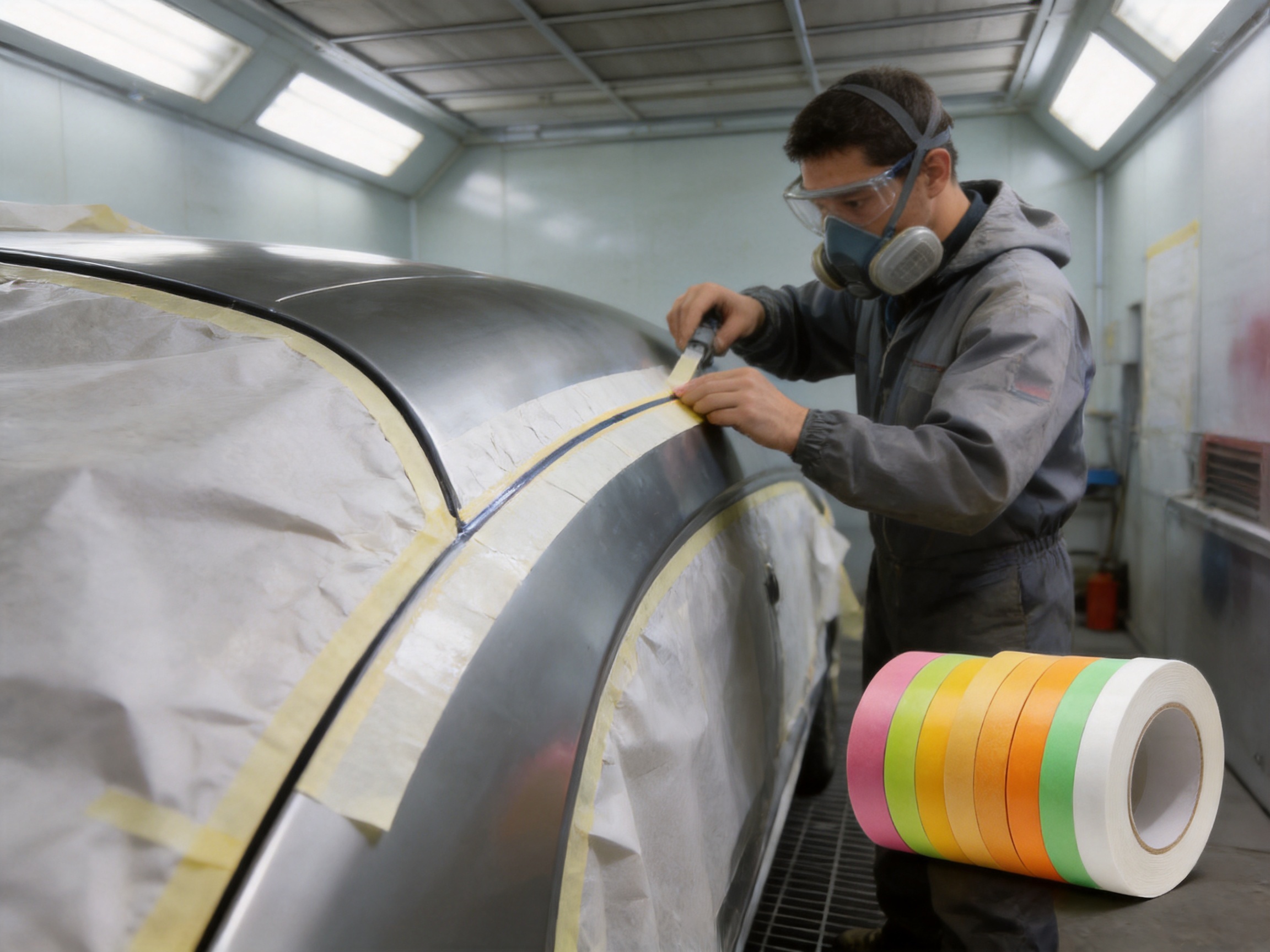
Automotive refinishing is one of the most common environments for high-temperature resistant masking tape. During repair or repainting, technicians may need to protect windows, trim, lamps, handles, mouldings, tyres, interior areas, adjacent panels, and previously finished surfaces. The tape can be applied alone or together with masking paper, plastic sheeting, protective film, and other preparation materials.
For edge work, the tape should be aligned carefully with the boundary of the repair area. The operator can then apply additional protective material to cover the larger surrounding surface. A correctly prepared edge helps prevent overspray from reaching areas that should remain unchanged. After spraying and drying, the tape can be peeled away in a controlled manner.
Automotive workshops often value speed and repeatability. A tape that is difficult to tear, hard to position, or prone to premature lifting can slow the preparation stage. The flexible paper backing and available width selection allow the product to support different vehicle shapes and repair sizes. It can be incorporated into both small repair jobs and higher-volume refinishing workflows.
When removing the tape from a freshly coated area, the operator should consider the condition of the coating. Removal may be performed after the coating has reached an appropriate stage of drying or curing, according to the paint manufacturer’s instructions. Pulling the tape at a controlled angle and at a steady speed can help reduce the risk of damaging a fragile coating or leaving an uneven edge.
Applications in Paintwork Protection
Paintwork protection includes temporary coverage of surfaces before, during, and after painting. The tape can protect panels, frames, equipment, architectural components, furniture parts, metal products, and other items that require a clean separation between treated and untreated areas.
In industrial manufacturing, a product may pass through several stages before final inspection. Some surfaces may receive a coating while others must remain exposed for electrical connection, assembly, sealing, identification, or later processing. Masking tape can provide a temporary boundary that is easy to see during production and easy to remove at the appropriate stage.
In construction and decoration, the tape may be used around trim, frames, fixtures, edges, and painted surfaces. Although the product is designed for professional use, the correct selection depends on the substrate and the coating. Porous, freshly painted, powdery, damp, or weak surfaces may require a lower-adhesion solution or a different application method.
The product is especially useful when the work requires a temporary protective layer rather than a permanent bonding solution. Once the painting or curing operation is complete, the masking material can be removed and discarded or managed according to the user’s waste procedures.
Use on Paint Curing and Drying Production Lines
Paint curing and drying lines require coordinated material performance. Components may move through spray booths, flash-off zones, heated chambers, inspection stations, and assembly areas. Masking materials used on these lines need to remain in place for the required process period without creating unnecessary defects.
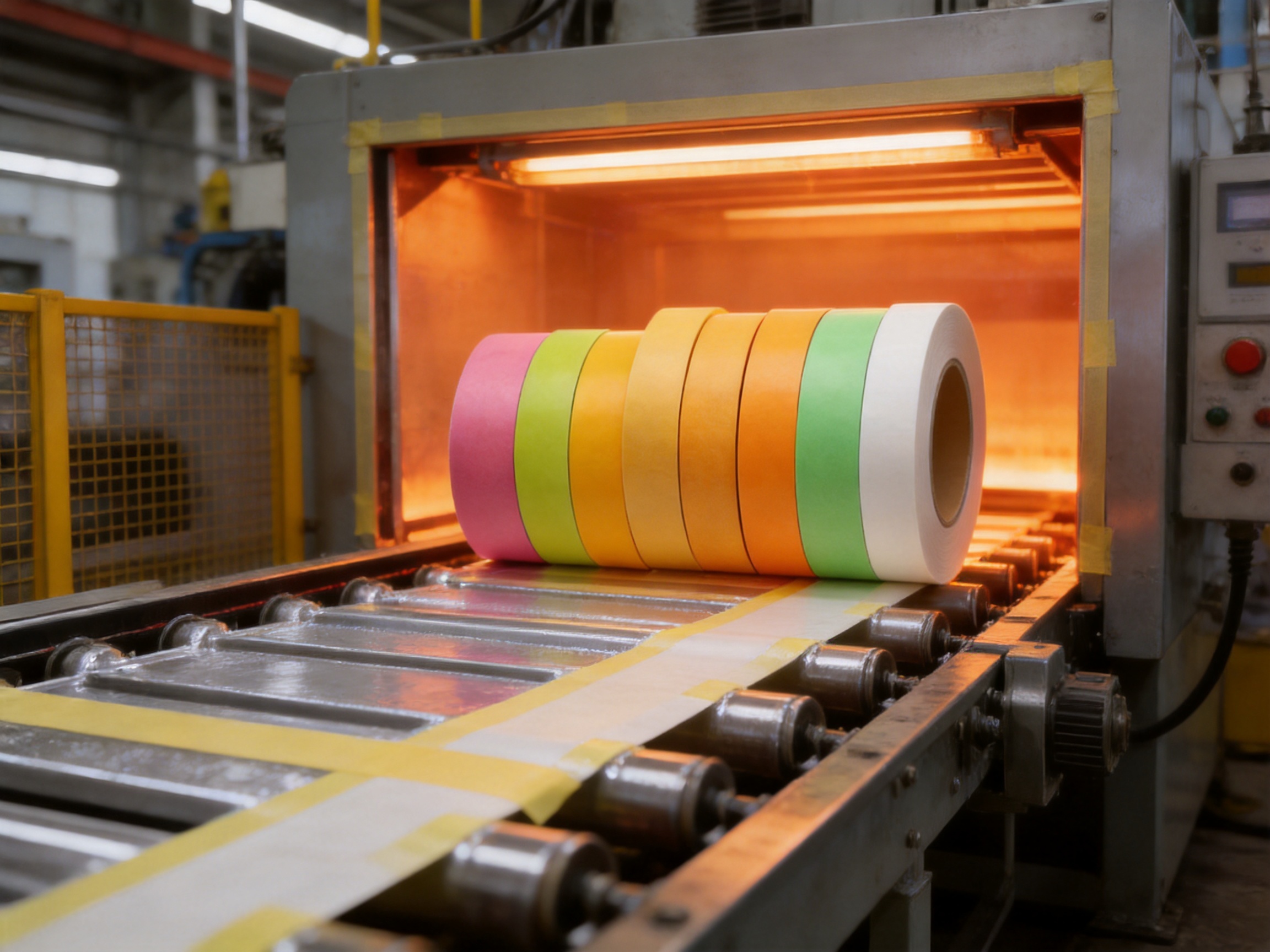
High-temperature resistant masking tape can be selected for sections where the process includes elevated heat. The tape helps maintain the boundary between protected and coated areas while the workpiece passes through the production system. Its usefulness is greatest when the tape specification is matched to the actual temperature profile and dwell time.
Production engineers and purchasing teams should evaluate several factors before approving the tape for a curing line. These include maximum process temperature, exposure duration, surface energy, coating type, required peel timing, line speed, tape width, roll length, and storage conditions. A sample trial can reveal whether the tape remains attached, whether the edge stays clean, and whether removal leaves residue.
For repeated production, process documentation can improve consistency. The operator may record the approved tape width, application pressure, overlap method, removal timing, storage period, and inspection criteria. This approach reduces variation between shifts and makes it easier to identify the cause of any masking-related defect.
High-Temperature Resistant Masking Tape
Manufacturing Strengths and Production Capabilities
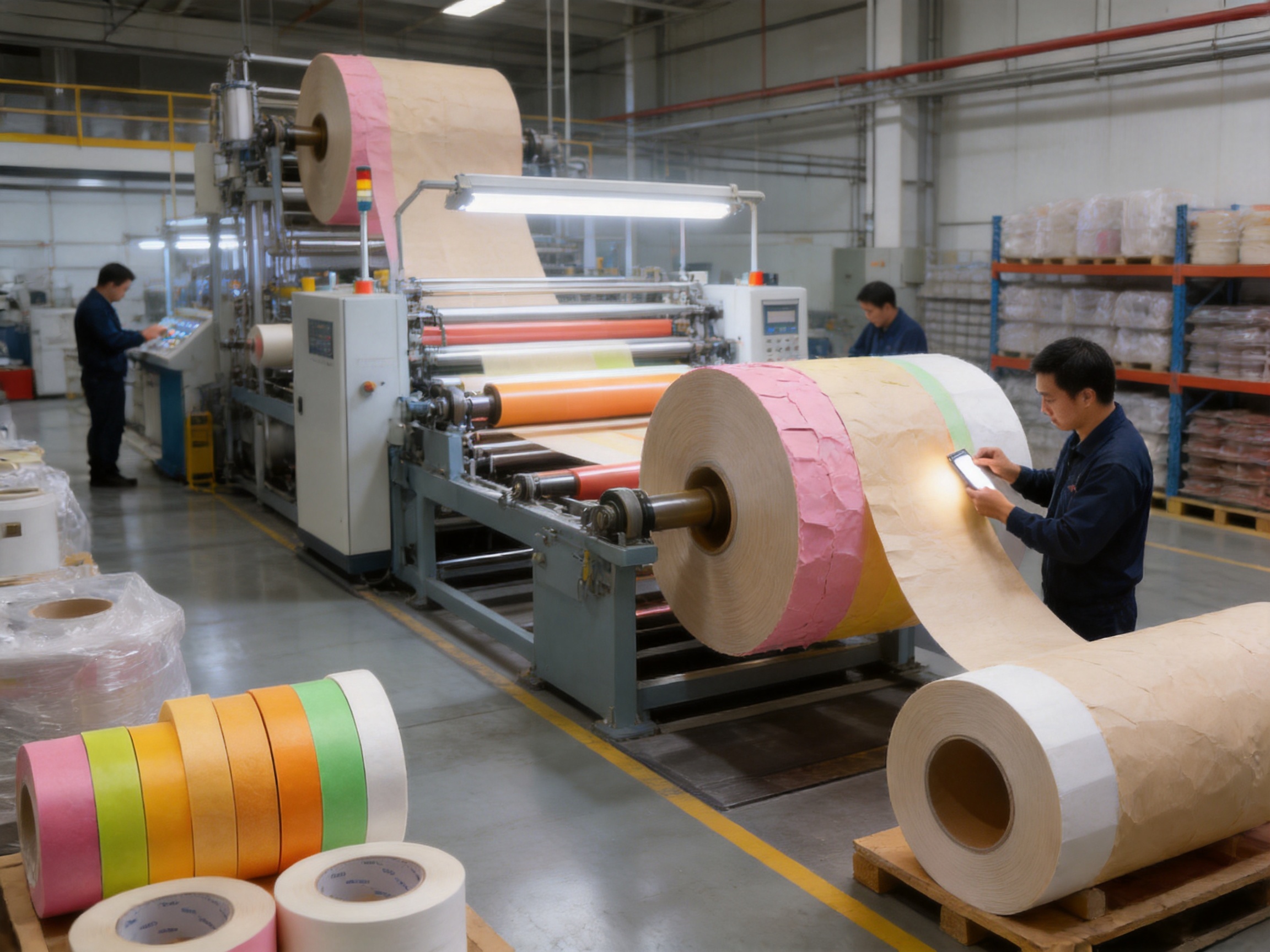
The performance of an adhesive tape is determined by more than its visible paper backing. Manufacturing control is required across material selection, adhesive preparation, coating, drying, rewinding, slitting, inspection, and packing. Zhejiang Geruite Packaging Materials Co., Ltd. operates as a packaging-material manufacturer with a product portfolio that includes BOPP tapes, kraft paper tapes, masking tapes, high-temperature resistant tapes, metal tapes, PE stretch film, PP strapping, and high-strength PET strapping.
This broader production experience is valuable because different packaging materials require an understanding of film behaviour, paper properties, adhesive systems, tension control, winding, cutting, and finished-roll protection. Knowledge developed across several product categories can support more systematic manufacturing practices and help the company respond to varied customer requirements.
Research and Development Focus
The company states that it focuses on research, development, and innovation in packaging materials. For high-temperature resistant masking tape, research may involve the relationship between paper backing, acrylic adhesive, coating weight, drying conditions, roll construction, and removal performance.
Product development is not limited to increasing adhesion. A successful masking tape must balance holding power with clean removal, flexibility with strength, and heat resistance with practical handling. Improving one characteristic without considering the others can create problems in application. A tape with extremely high adhesion may be difficult to remove, while a tape with very low adhesion may lift during spraying or heating.
Research and development also supports customisation. Different customers may require specific widths, roll diameters, packaging styles, or performance priorities. By maintaining technical capability in the production process, the manufacturer can discuss these requirements more effectively with industrial buyers and distributors.
Advanced Production Equipment
The company is equipped with advanced production equipment and applies quality controls from raw-material procurement through final inspection. In adhesive tape manufacturing, suitable equipment helps regulate coating, drying, rewinding, slitting, and packaging operations. Equipment stability is important because small variations in adhesive distribution or roll tension can affect the user experience.
Uniform coating is particularly important. If the adhesive layer is uneven, the tape may exhibit inconsistent adhesion across its width or along its length. Accurate slitting is also essential because uneven edges can complicate application, create loose strands, or reduce the precision of a masked boundary. Controlled rewinding helps produce rolls that unwind smoothly and remain structurally stable during transportation and use.
Advanced equipment does not replace skilled production management. Operators and quality personnel must understand the relationship between machine settings, environmental conditions, raw-material properties, and finished-product performance. The combination of equipment, process discipline, and technical experience supports reliable manufacturing outcomes.
Quality Control from Raw Materials to Finished Goods
The company describes a rigorous quality-control system covering raw-material procurement, production, and final inspection. This full-process approach is important for masking tape because problems can originate at any stage. Paper variation may affect flexibility or tear behaviour. Adhesive variation may affect tack and removal. Coating or drying variation may cause inconsistent bonding. Slitting or winding problems may affect roll usability.
Incoming materials can be reviewed against purchasing specifications before being released to production. During manufacturing, operators can monitor process conditions and examine the tape for visible defects, coating consistency, edge quality, and roll formation. Finished rolls can then be inspected and packed to protect them from contamination, crushing, moisture, and unnecessary exposure during storage and transport.
Quality control is particularly valuable for export and wholesale customers. Buyers need confidence that repeat orders will remain consistent with approved samples. Stable specifications simplify production planning, customer qualification, inventory management, and technical support. They also help end users establish reliable application procedures.
Production Scale and Business Experience
Zhejiang Geruite Packaging Materials Co., Ltd. has developed a substantial packaging-material business and reports an annual output value exceeding RMB 60 million. This scale indicates experience in serving a range of customers and managing production across multiple product categories.
Scale can provide practical advantages in raw-material coordination, production scheduling, equipment investment, technical development, and order fulfilment. It may also allow the manufacturer to support both standard products and customised orders. For buyers, the ability to communicate with a manufacturer that understands industrial packaging requirements can be important when specifications, lead times, packaging formats, or repeat supply need to be coordinated.
Material Selection and Process Control
The selection of the paper backing affects the tape’s flexibility, surface texture, tear characteristics, and ability to conform to the application. A specialised crinkled paper structure is selected for the requirements of temporary masking. The paper must be capable of being handled efficiently by operators while providing sufficient integrity during spraying and heat-related processing.
The acrylic adhesive must be matched to the backing and target application. Adhesive formulation influences initial tack, holding power, peel behaviour, residue potential, and response to temperature. The adhesive coating process must distribute the material consistently across the paper. After coating, controlled drying or curing helps establish the intended adhesive properties.
Rewinding is another important stage. A roll that is wound too loosely may telescope, deform, or unwind unpredictably. A roll that is wound too tightly may create excessive pressure and affect removal. Correct tension management supports roll stability and helps the tape run smoothly during manual or semi-automated application.
Slitting converts wider master rolls into customer-required widths. Precise slitting helps maintain clean edges and consistent dimensions. Since this product can be supplied from 5 millimetres to 500 millimetres, production planning must accommodate both narrow and wide formats while maintaining roll quality. Packaging protects the finished product during handling and shipment.
Application Guidelines for Best Results
Prepare the Surface
The surface should be clean, dry, and free from dust, grease, oil, loose paint, and other contaminants. Contamination can reduce adhesion and allow paint or coating material to migrate under the edge. Moisture may also affect bonding and removal.
Newly coated, porous, rough, powdery, or fragile surfaces should be tested before general application. Some surfaces may require a different adhesive strength or a lower-adhesion product. A small test area can help determine whether the tape bonds adequately and whether it can be removed without damaging the substrate.
Apply Firm and Even Pressure
After positioning the tape, press it firmly onto the surface. Particular attention should be paid to the edge that will face the spray or coating direction. An application tool, clean cloth, or gloved finger can be used where appropriate, provided the method does not contaminate or damage the surface.
Air pockets, wrinkles, loose corners, and unsealed overlaps can create pathways for overspray. The tape should be applied smoothly, especially around corners and transitions. When wide tape is used, the operator should ensure that the full width is in contact with the surface.
Match the Width to the Task
Narrow tape is appropriate for detailed lines, small parts, and narrow trim. Wider tape can save time when covering broad edges or protecting larger surfaces. In some situations, a narrow tape may be combined with masking paper or protective film to create a clean edge and a larger coverage area.
Using the correct width can reduce overlapping strips and improve material efficiency. It can also make removal easier because fewer separate pieces need to be peeled away. Customers should select widths based on the geometry of the workpiece, the required edge precision, and the available application tools.
Remove at the Appropriate Time
Removal timing depends on the coating system, surface condition, temperature, and production process. The tape should be removed according to the approved work instructions or after confirming that the coating has reached a suitable stage. Leaving tape in place for too long may make removal more difficult in some conditions, while removing it too early may disturb the coating edge.
Peel the tape steadily rather than jerking it away. A controlled angle can help maintain a clean boundary. If resistance or coating lifting occurs, stop and review the surface condition, coating cure, tape selection, and removal direction before continuing.
Storage and Handling Recommendations
Adhesive tape should be stored in a clean, dry environment away from direct sunlight, excessive heat, moisture, dust, and chemical vapours. Rolls should remain in their original packaging until needed. They should not be crushed, thrown, or stored under heavy loads that could deform the roll.
Stable storage conditions help preserve adhesive performance and roll integrity. Large temperature changes may affect the tape before use, so the product should be allowed to reach the working environment when necessary. Inventory should be managed on a first-in, first-out basis where appropriate, especially when products are stored for extended periods.
During transportation, rolls should be packed to prevent impact and edge damage. Damaged edges can make the tape difficult to apply and may cause irregular masking lines. Distributors should inspect incoming shipments and keep cartons protected until the product is released for sale or production.
Why Choose a Manufacturer with a Broad Packaging Portfolio?
A manufacturer that supplies several packaging-material categories can offer a more coordinated purchasing experience. Zhejiang Geruite Packaging Materials Co., Ltd. produces adhesive tapes as well as stretch film, strapping, and other packaging products. This portfolio covers many stages of logistics, cargo stabilization, surface protection, and industrial packaging.
For a distributor, purchasing several related products from one source may simplify communication, sampling, documentation, packaging coordination, and shipment planning. For an industrial user, it may create an opportunity to review masking tape alongside stretch film, strapping, or other materials used in the same warehouse or production environment.
Product breadth also reflects familiarity with different material technologies. BOPP tape, kraft paper tape, masking tape, metal tape, PE stretch film, PP strapping, and PET strapping each require different approaches to raw materials and processing. Experience across these categories supports a broader understanding of packaging performance and customer needs.
The company’s stated commitment to quality, research, process improvement, and customer service is relevant to buyers seeking a long-term packaging partner rather than a one-time commodity purchase. Stable supply, responsive communication, and the ability to discuss custom requirements can be as important as the basic product specification.
Comparison with Other Masking Tape Types
Standard painter’s tape is often intended for general decorative work at room temperature. It may be suitable for walls, trim, and short-term painting tasks, but it is not automatically appropriate for heated curing or industrial spray environments. High-temperature resistant masking tape is selected when the process requires a more specialised balance of temperature tolerance, holding power, and removability.
Plastic-film masking tapes may provide different advantages, such as moisture resistance or higher tensile strength, but they may not offer the same paper-like handling or controlled tear behaviour. The best choice depends on the process. The crinkled paper construction of this product is especially relevant where conformability, manual application, and easy peeling are important.
High-adhesion industrial tapes may bond strongly to difficult surfaces, but they can be unnecessarily aggressive for temporary paint masking. A masking tape must be judged by the complete application rather than by adhesion alone. The objective is to protect the surface during the process and then leave with minimal disruption.
Compared with low-cost general-purpose tapes, a specialised product may provide greater consistency when supplied by a manufacturer with controlled production and inspection procedures. The buyer should compare actual technical data, test results, roll quality, application performance, and total labour cost rather than considering only the purchase price per roll.
Quality, Efficiency, and Total Cost of Use
The purchase price of masking tape is only one part of the total cost. Labour time, surface cleaning, overspray correction, rejected components, rework, and production delays can all increase the effective cost of an unsuitable tape. A product that costs slightly more per roll may be more economical if it reduces application problems and cleanup requirements.
Easy-peel performance can support faster removal. Suitable heat resistance can help reduce premature lifting during a curing process. Consistent width and roll formation can make application more predictable. Reliable edge contact can reduce the chance of overspray reaching protected areas. These benefits contribute to production efficiency when they are matched to the right application.
For high-volume users, a structured trial can measure performance objectively. The evaluation may include application time, removal time, residue, edge quality, tape breakage, roll unwinding, performance after heating, and the amount of rework required. Results can then be compared with the current tape or competing products.
Purchasers should also evaluate supply reliability. A technically suitable tape is less useful if repeat orders are inconsistent or custom sizes cannot be maintained. The manufacturer’s production experience, equipment, inspection system, and ability to manage different packaging-material categories can support a more dependable supply relationship.
Customisation for Industrial and Wholesale Buyers
Customisation is useful when a standard roll does not fit the customer’s equipment or workflow. Width is the clearest customisation option for this product, with available sizes from 5 millimetres to 500 millimetres. Other requirements may be discussed according to production capability, order volume, application conditions, and packaging needs.
Industrial buyers may request specific roll dimensions to fit dispensers, masking tools, storage racks, or automated processes. Distributors may require private packaging, carton quantities, label formats, or product combinations for different market segments. Before confirming an order, the buyer and supplier should agree on the product specification, tolerance, packaging, inspection method, sample approval, and delivery conditions.
Customisation should be supported by clear technical communication. Important information includes the substrate, coating type, process temperature, exposure time, required removal timing, target width, roll length, storage environment, and expected production volume. These details help the manufacturer understand the actual use case rather than producing a nominal specification without application context.
Environmental and Operational Considerations
The paper backing of the tape may be convenient for temporary masking, but users should manage used tape according to local waste requirements and the substances it has contacted. Tape covered with paint, solvent, or other industrial materials may require handling as process waste rather than ordinary paper waste.
Efficient tape selection can reduce waste by minimising unnecessary overlaps, premature replacement, and rejected workpieces. Choosing the correct width and applying only the required amount can improve material utilisation. Proper storage can also reduce product damage before use.
Operational safety remains important. Users should follow the instructions for the paint, coating, curing equipment, and work area. Adequate ventilation and suitable personal protective equipment are necessary where paints, solvents, or heated processes are involved. Masking tape is a process aid and does not replace established industrial safety procedures.
Frequently Asked Questions
What is high-temperature resistant masking tape used for?
It is commonly used for automotive spraying, paintwork protection, and masking on paint curing and drying production lines. It helps protect selected surfaces from overspray and coating contact while remaining suitable for temporary application and removal.
What is the backing material?
The tape uses a specialised crinkled paper backing. This construction provides flexibility, practical handling, and useful conformability around edges and shaped surfaces.
What adhesive does the tape use?
The product uses an acrylic adhesive. The adhesive is designed to hold the tape in place during the masking process while supporting easy peeling after the relevant operation is complete.
What thickness is available?
The stated available thickness is 0.14 millimetres. Buyers requiring a different construction should discuss their requirements with the manufacturer before ordering.
What widths can be supplied?
Widths from 5 millimetres to 500 millimetres can be supplied, and widths can be customised according to customer requirements and production feasibility.
Can the tape be used in every high-temperature process?
No tape should be assumed to be suitable for every temperature, exposure time, substrate, or coating system. The product is intended for high-temperature-related masking applications, but users should confirm the actual process conditions and carry out a trial before production use.
Will the tape leave adhesive residue?
The product is characterised as easy to peel off, but residue performance can vary with surface type, temperature, application duration, coating condition, and removal timing. Testing on the actual substrate is recommended.
Can it be used on freshly painted surfaces?
Freshly painted surfaces require special care because the coating may not yet have sufficient strength. Users should follow the coating manufacturer’s curing guidance and test the tape on a small area before applying it broadly.
How should the tape be removed?
Remove it steadily and at a controlled angle when the masking operation is complete and the coating is at a suitable stage. Avoid sudden pulling, and stop if the coating lifts or excessive resistance occurs.
What makes this product different from ordinary painter’s tape?
It is designed for more demanding painting and production environments, including automotive spraying and heat-related curing or drying lines. Its specialised paper backing, acrylic adhesive, easy-peel characteristic, and available width range support professional applications beyond basic room-temperature decorating.
Who manufactures the tape?
The product is manufactured by Zhejiang Geruite Packaging Materials Co., Ltd., a packaging-material company based in Hangzhou, Zhejiang Province, China. The company produces a range of adhesive tapes, stretch films, strapping products, and related packaging materials.
Can distributors order customised sizes?
Yes. Width customisation is available from 5 millimetres to 500 millimetres, subject to the confirmed product specification, order quantity, and manufacturing requirements. Distributors should contact the manufacturer to discuss packaging and delivery details.
Conclusion
High-temperature resistant masking tape is a practical solution for professional painting, automotive refinishing, paintwork protection, and controlled curing or drying processes. Its specialised crinkled paper backing supports flexible application, while the acrylic adhesive provides temporary bonding with an emphasis on easy removal. The 0.14 millimetre thickness and width range from 5 millimetres to 500 millimetres make the product suitable for both detailed masking and broad-area protection.
Its advantages over ordinary masking tape include greater suitability for industrial painting conditions, better alignment with heat-related processes, controlled removal, flexible handling, and a wider range of customisation possibilities. These characteristics can help reduce overspray, cleanup, labour time, and rework when the tape is correctly selected and applied.
The manufacturing strengths of Zhejiang Geruite Packaging Materials Co., Ltd. further support the product. The company combines packaging-material research and development with advanced production equipment, process-wide quality control, and experience across adhesive tapes, stretch films, and strapping products. Its reported annual output value of more than RMB 60 million reflects an established production operation capable of serving different customer groups.
For the best results, users should match the tape to the substrate, coating, temperature, exposure duration, and removal schedule. Proper surface preparation, firm application, suitable storage, and controlled peeling are essential. With these practices, high-temperature resistant masking tape can become an important part of a reliable and efficient industrial painting and surface-protection process.
References
1. Zhejiang Geruite Packaging Materials Co., Ltd. Product information for High-Temperature Resistant Masking Tape.
2. Zhejiang Geruite Packaging Materials Co., Ltd. Corporate information and packaging-material product portfolio.
3. General industrial guidance on pressure-sensitive adhesive tape selection, application, storage, and removal.
4. General automotive refinishing practice for surface preparation, masking, spraying, drying, curing, and coating protection.
5. General quality-control principles for coated tapes, adhesive products, roll slitting, rewinding, inspection, and packaging.
Product: High-Temperature Resistant Masking Tape

CONTACT DETAILS
- Address:No. 241, Yaojiafan, Zhangpanqiao, Shushan Street, Xiaoshan District, Hangzhou City, Zhejiang Province, China
- TEL:+86-0571-83175630
- Phone:+86-13336160217
- Email:jeffrey@grtpk.com
- WeChat/WhatsApp:+86-18058115265
PRODUCTS
NEWS CENTER
MOBILE TERMINAL
Copyright© Zhejiang Geruite Packaging Materials Co., Ltd. All Rights Reserved.
Privacy Wholesale industrial packaging tape Manufacturers