


 English
  Español
  عربى
عربى 
Low-Residue Fiberglass Tape for Clean, High-Strength Industrial Assembly
Content
- 1 Product Overview
- 2 Key Product Advantages
- 3 Technical Performance Table
- 4 How the Tape Outperforms Ordinary Industrial Tapes
- 5 Applications in Household Appliance Manufacturing
- 6 Applications in Electronics and Electrical Assembly
- 7 Applications in General Industrial Assembly
- 8 Manufacturing Strength Behind the Product
- 9 Why Low Residue Matters in Industrial Production
- 10 Surface Compatibility and Application Guidance
- 11 Storage and Handling Recommendations
- 12 Design Value for Production Engineers
- 13 Economic Advantages Over Competitors
- 14 Role in Clean Manufacturing
- 15 Product Selection Considerations
- 16 Practical Use Cases
- 17 Company Capability and Customer Support
- 18 Quality Control Across the Product Lifecycle
- 19 Best Practices for Removal
- 20 Environmental and Operational Efficiency
- 21 Why This Tape Is a Strong Choice for Industrial Buyers
- 22 Frequently Asked Questions
- 22.1 Q1: What is low-residue fiberglass tape used for?
- 22.2 Q2: Why is fiberglass backing better than ordinary film or paper backing?
- 22.3 Q3: Does the tape leave no residue at all?
- 22.4 Q4: What materials can the tape adhere to?
- 22.5 Q5: Is the tape suitable for household appliance manufacturing?
- 22.6 Q6: What is the typical thickness of the tape?
- 22.7 Q7: What is the peel strength of the tape?
- 22.8 Q8: How strong is the tape?
- 22.9 Q9: How should the tape be stored?
- 22.10 Q10: Why should users test the tape before full production?
- 23 Conclusion
- 24 References
- 25 Product: 317G Low-residue fiberglass tape
In modern industrial assembly, a tape is rarely just a simple temporary fastener. It must hold components securely, protect surfaces, resist deformation, maintain performance during production, and release cleanly when its job is complete. Low-residue fiberglass tape is designed for exactly this demanding environment. The 317G low-residue fiberglass tape combines a high-strength fiberglass cloth backing with a specially formulated acrylic pressure-sensitive adhesive, creating a product that offers strong adhesion, excellent dimensional stability, and reduced adhesive transfer after removal.
This tape is especially valuable in household appliance manufacturing, electronics assembly, electrical insulation, industrial bundling, and temporary positioning tasks. In these applications, ordinary tapes may leave glue marks, stretch under load, tear during removal, or fail to adhere consistently to different materials. By contrast, low-residue fiberglass tape is engineered to provide reliable holding power while helping manufacturers maintain clean surfaces and reduce rework.
The product belongs to the fiberglass tape category within the broader industrial adhesive tape market. It is suitable for production lines where performance, cleanliness, and efficiency matter. With a total thickness of approximately 0.155 mm, 180-degree peel strength of 17.8 N/25 mm, tensile strength of 978 N/in, and elongation at break of 7%, it offers a balanced combination of adhesion, strength, and controlled flexibility.
317G Low-residue fiberglass tape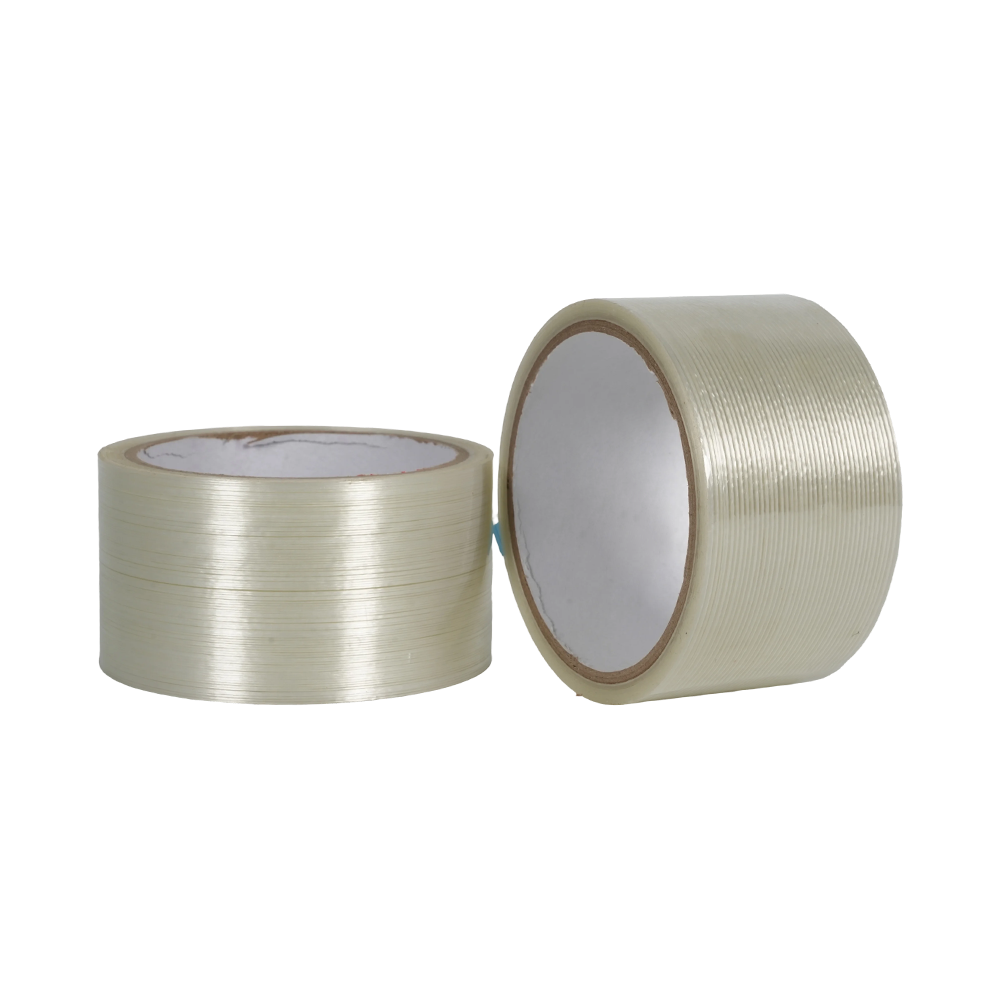
Product Overview
Low-residue fiberglass tape is made with a fiberglass cloth backing and a low-residue acrylic pressure-sensitive adhesive. The backing gives the tape high tensile strength, resistance to puncture and tearing, and excellent dimensional stability. The adhesive is designed to bond effectively to a broad range of surfaces while reducing residue after removal from most common substrates.
The tape is typically white, allowing easy visibility during assembly, inspection, and removal. Its clean appearance also supports organized production workflows, especially in environments where temporary fixing or protection must be clearly identified. The fiberglass structure helps the tape retain shape under stress, making it more reliable than many conventional film tapes or paper-based tapes in demanding industrial applications.
One of the main reasons manufacturers choose this product is its low-residue performance. During appliance manufacturing or electronics assembly, tapes are frequently used to position parts, bundle wires, mask components, or protect surfaces temporarily. If a tape leaves adhesive behind, workers must spend additional time cleaning the surface. This increases labor cost, slows production, and may affect the final appearance or functionality of the product. Low-residue fiberglass tape helps reduce these risks.
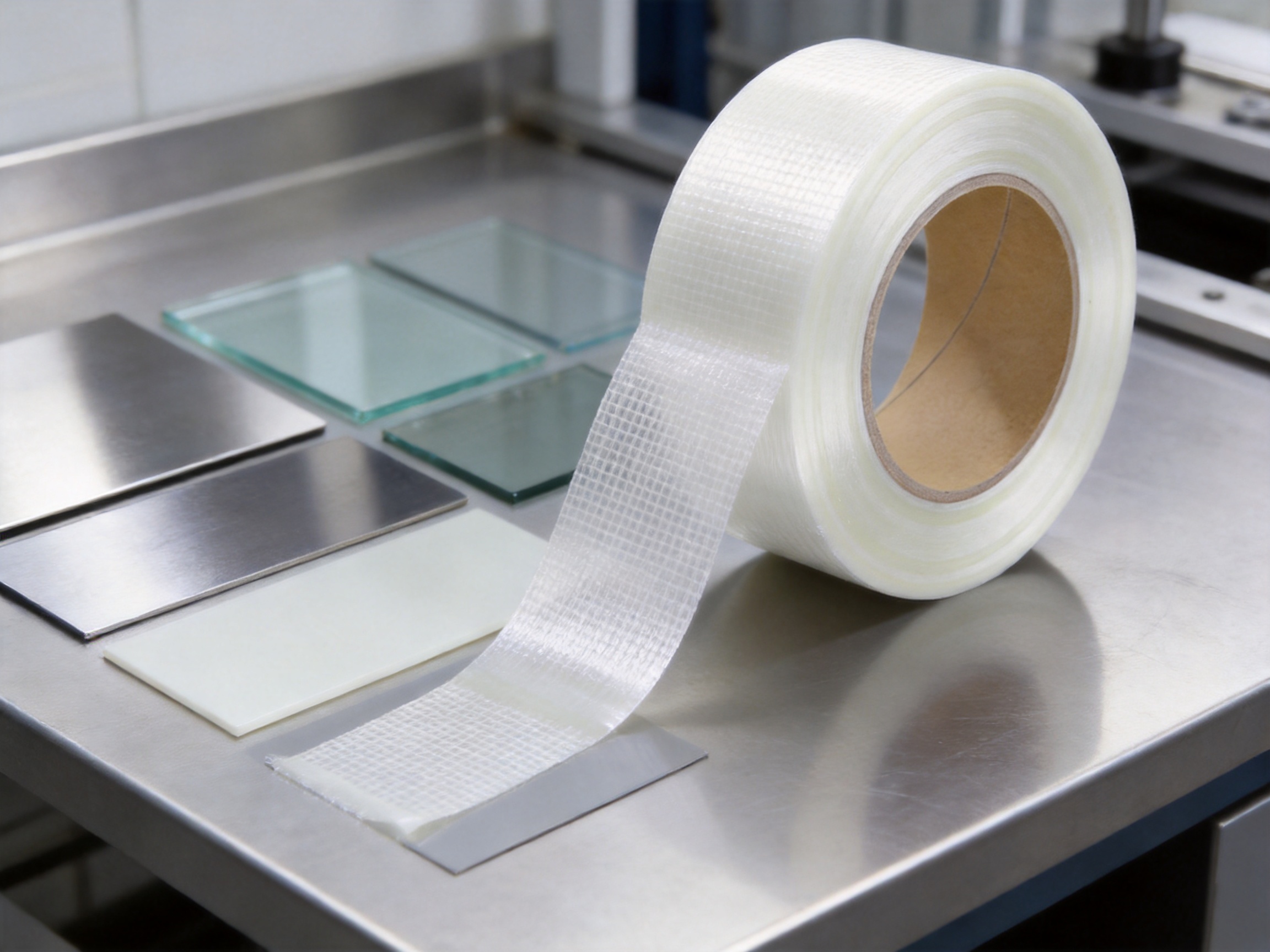
Its adhesive is also compatible with several high surface energy materials, such as stainless steel, aluminum alloy, and glass, as well as selected lower surface energy plastics, including PC and ABS. This broad compatibility may help factories reduce the number of tape types used on a production line, simplifying inventory and improving operational consistency.
Key Product Advantages
Low Residue After Removal
The tape’s most important advantage is its ability to reduce adhesive transfer after removal. Many industrial tapes perform well during bonding but create problems when removed. Residue may remain on stainless steel panels, painted appliance housings, plastic parts, insulation sheets, or electronic assemblies. Cleaning this residue requires solvents, manual wiping, inspection, and sometimes rework.
The acrylic pressure-sensitive adhesive used in this tape is formulated to deliver practical holding power while minimizing glue transfer. This makes it especially useful for temporary fixing, temporary masking, surface protection, and positioning applications. In many production environments, a cleaner removal process can directly improve efficiency and reduce the risk of cosmetic defects.
High Tensile Strength and Dimensional Stability
The fiberglass cloth backing gives the tape a tensile strength of approximately 978 N/in. This is a major advantage over many ordinary packaging tapes, masking tapes, and some film-based tapes. High tensile strength allows the tape to resist breaking when used for bundling, fastening, or holding components under mechanical stress.
The tape also has a relatively low elongation at break of 7%. Low elongation means the tape does not stretch excessively during application or under load. This is important when components must remain accurately positioned. A tape that stretches too much may allow parts to shift, especially during transportation between production steps or during thermal exposure. Fiberglass reinforcement helps maintain dimensional stability and improves reliability.
Broad Material Compatibility
Industrial production lines commonly involve a mixture of materials. A household appliance may contain stainless steel, aluminum alloy, ABS, PC, insulation materials, wire harnesses, circuit boards, coated metal panels, and polymer components. A tape that works on only one type of surface forces manufacturers to maintain multiple tape inventories.
Low-residue fiberglass tape adheres effectively to many high surface energy materials and selected lower surface energy plastics. This gives it practical flexibility in assembly plants. Although adhesion testing is still recommended before full-scale use, the tape can often serve multiple functions across different workstations.
Resistance to Tearing, Puncture, and Deformation
The woven fiberglass backing provides excellent resistance to tearing and puncture. In industrial environments, tapes may come into contact with sharp component edges, metal brackets, screws, wire harnesses, and textured surfaces. Paper tapes may tear, and some films may stretch or puncture. Fiberglass tape offers better mechanical integrity, helping it survive demanding handling conditions.
This strength also improves removal. A weak tape can break into fragments during peeling, forcing workers to remove pieces one by one. The reinforced structure of fiberglass tape helps the strip remain intact, supporting faster and cleaner removal.
Practical Temperature Resistance and Electrical Insulation
Fiberglass backing is naturally suited for applications where heat resistance and insulation are important. While exact temperature performance should be confirmed according to the specific grade and working conditions, the material structure makes this tape suitable for many industrial assembly tasks involving moderate heat exposure or electrical fixing requirements.
In electronics and electrical applications, the tape may be used for medium-strength insulation and temporary or semi-permanent fixing. In appliance production, it can help position insulation materials, hold wiring, or protect components during assembly.
Technical Performance Table
| Test Item | Reference Standard | Typical Value |
| Total Thickness | GB/T 7125-2014 | 0.155 mm |
| Initial Tack | GB/T 4852-2002 | No. 12 steel ball |
| 180-Degree Peel Strength | GB/T 2792-2014 | 17.8 N/25 mm |
| Tensile Strength | GB/T 7753-87 | 978 N/in |
| Elongation at Break | GB/T 7753-87 | 7% |
These values show that the tape is designed for strong holding, controlled elongation, and clean industrial performance. The peel strength of 17.8 N/25 mm gives dependable adhesion for temporary and medium-strength fixing. The tensile strength of 978 N/in demonstrates the mechanical advantage of fiberglass reinforcement. The 7% elongation at break indicates that the tape remains stable and does not stretch excessively during use.
How the Tape Outperforms Ordinary Industrial Tapes
Many tapes can bond. Fewer tapes can bond strongly, resist deformation, and remove cleanly. Low-residue fiberglass tape provides a combination of properties that distinguishes it from general-purpose alternatives.
Compared with Ordinary BOPP Packaging Tape
BOPP packaging tape is widely used for carton sealing and general packaging. It is economical and convenient, but it is not designed for high-strength industrial fixing or low-residue removal from appliance panels and electronic components. BOPP tape may stretch, tear, or leave adhesive residue when used outside its intended packaging role.
Fiberglass tape is more suitable when higher tensile strength, puncture resistance, and dimensional stability are needed. It is also better suited for applications where the tape must be removed without significant glue transfer.
Compared with Masking Tape
Masking tape is useful for painting, light-duty holding, and temporary labeling. However, paper-based masking tapes may tear under load or lose strength in demanding industrial conditions. Some masking tapes also leave residue if exposed to heat, pressure, or long dwell times.
Low-residue fiberglass tape provides much higher tensile strength and better tear resistance. It is more reliable for bundling, insulation fixing, temporary component positioning, and appliance assembly tasks where ordinary masking tape may fail.
Compared with Standard Fiberglass Tape
Standard fiberglass tapes often emphasize strength but may not be optimized for residue control. In appliance and electronics manufacturing, this can create cleaning issues after temporary use. The low-residue adhesive formulation of 317G fiberglass tape addresses this problem by balancing strong adhesion with cleaner removal.
This is a key competitive advantage. A tape that is strong but difficult to remove may create extra work. A tape that removes cleanly but lacks strength may fail during production. Low-residue fiberglass tape is designed to solve both problems at the same time.
Compared with PET Film Tape
PET film tapes may offer smooth surfaces and good temperature performance, but they may not match the tensile strength and puncture resistance of fiberglass cloth-backed tape. Film tapes can also stretch or split under certain mechanical loads. Fiberglass tape provides a more reinforced structure for holding, bundling, and protection tasks.
For applications involving wire harnesses, insulation materials, sharp edges, or heavier components, fiberglass backing offers a practical mechanical advantage.
Applications in Household Appliance Manufacturing
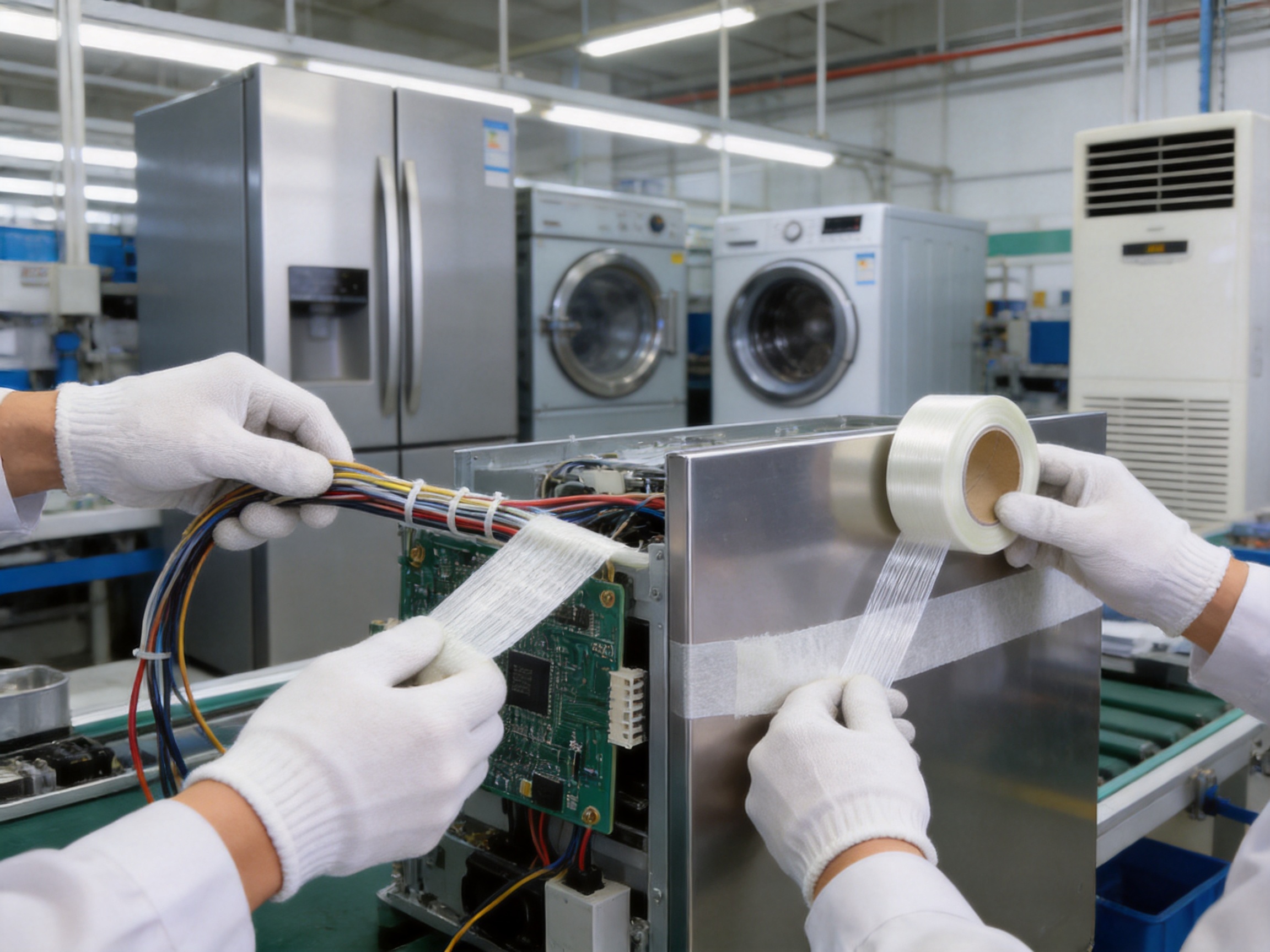
Household appliance production is one of the most important application areas for low-residue fiberglass tape. Refrigerators, washing machines, air conditioners, ovens, dishwashers, and small appliances all involve multi-material assembly and strict cleanliness requirements. Temporary tapes are commonly used throughout production, but they must not create final-surface contamination.
Wire Harness Bundling
Appliances contain complex wire harnesses that must be routed safely and consistently. During assembly, wires may need to be temporarily bundled or fixed before final clips, covers, or fasteners are installed. Fiberglass tape provides the strength required to hold wire groups securely while resisting tearing and stretching.
The low-residue adhesive is useful when temporary tape must be removed after routing or inspection. It helps prevent sticky deposits on wires, panels, or plastic channels.
Temporary PCB Positioning
Printed circuit boards may require temporary positioning during assembly, testing, or transport between workstations. The tape’s initial tack and holding power make it suitable for controlled positioning. Its reinforced backing supports stable placement, while reduced residue helps protect sensitive surfaces from contamination.
For electronics manufacturers, residue control is especially important. Adhesive contamination may interfere with visual inspection, electrical contact, or downstream processes. A cleaner tape can therefore contribute to both quality and production efficiency.
Fixing Insulation Materials
Appliances often use insulation materials for thermal management, noise reduction, or electrical safety. These materials may need to be held in place during assembly before final enclosure or fastening. Fiberglass tape provides strong and stable fixing without excessive elongation.
Its insulation-related properties also make it suitable for many electrical and thermal assembly environments, subject to grade-specific verification.
Temporary Masking and Surface Protection
During appliance assembly, metal housings, decorative panels, plastic covers, and finished surfaces may require temporary protection. Conventional tapes can leave marks or residue, especially if exposed to pressure or heat. Low-residue fiberglass tape helps protect components while reducing post-removal cleaning work.
This benefit is particularly valuable for visible parts. A stainless steel refrigerator panel or painted washing machine surface must remain clean and attractive. Any adhesive mark can cause rejection, rework, or customer dissatisfaction.
Applications in Electronics and Electrical Assembly
The electronics and electrical industries require tapes that can hold components precisely, provide insulation support, and remain stable under processing conditions. Low-residue fiberglass tape can be used for medium-strength insulation, temporary fixing, bundling, and process protection.
Its fiberglass backing supports mechanical durability, while its adhesive formulation contributes to cleaner removal. It can be applied to metals, selected plastics, and electrical components after appropriate compatibility testing.
Electrical assembly often requires materials with predictable behavior. A tape that stretches, creeps, or leaves residue may interfere with process control. Fiberglass reinforcement helps maintain dimensional stability, and the acrylic adhesive provides dependable tack and peel performance.
Applications in General Industrial Assembly
Beyond appliances and electronics, low-residue fiberglass tape can be used in many industrial assembly situations. It is suitable for temporary holding, masking, labeling, surface protection, bundling, and process fixing. Its balanced performance makes it a valuable material for factories that need more strength than ordinary tape and cleaner removal than many conventional reinforced tapes.
For example, during metal fabrication or component assembly, parts may need to be held temporarily before mechanical fastening. In plastic product manufacturing, components may require temporary positioning during inspection or packaging. In equipment manufacturing, cables, insulation pads, and small parts may need temporary stabilization. The tape provides a practical solution for these scenarios.
Manufacturing Strength Behind the Product
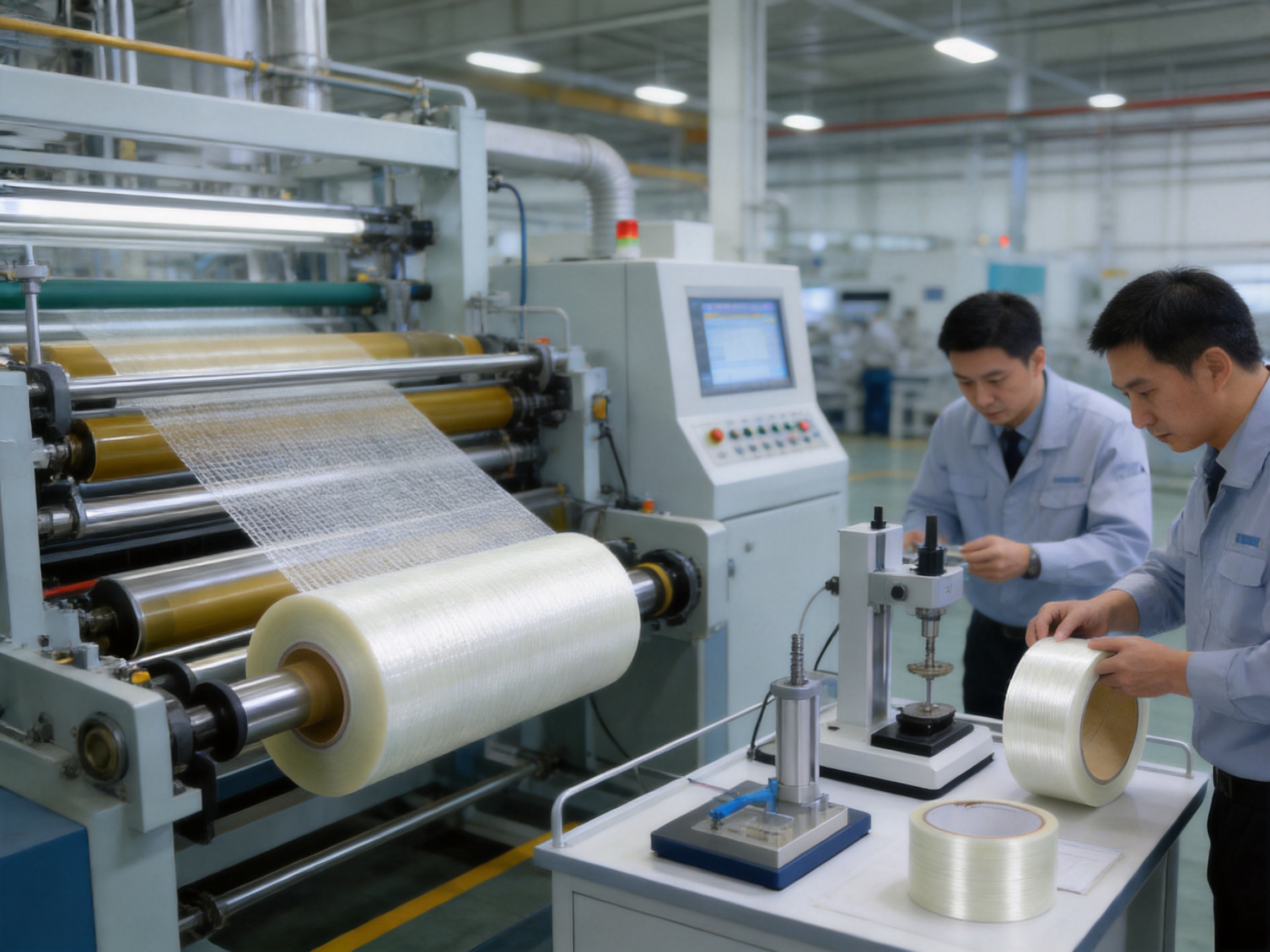
A high-performance industrial tape depends not only on raw materials but also on manufacturing precision. The performance of low-residue fiberglass tape is influenced by adhesive formulation, coating uniformity, drying control, tension management, lamination quality, slitting accuracy, and final inspection. Zhejiang Geruite Packaging Materials Co., Ltd. focuses on the research, development, production, and sales of high-performance tapes and packaging materials, supporting consistent product quality through advanced production equipment and a rigorous quality control system.
The company is located in Zhejiang Province, China, a region known for its developed manufacturing industry and strong supply-chain base. This location supports access to raw materials, technical talent, logistics resources, and industrial cooperation. The company’s business covers BOPP tapes, kraft paper tapes, masking tapes, high-temperature resistant tapes, metal tapes, PE stretch film, PP strapping, and high-strength PET strapping, giving it broad experience in adhesive coating, film processing, packaging performance, and industrial material control.
Its annual output value has reached over RMB 60 million, reflecting production capability and market recognition. For customers, this means the supplier is not only able to provide a single product but also has comprehensive experience across industrial packaging and adhesive material categories.
Raw Material Selection
The performance of fiberglass tape begins with the selection of fiberglass cloth and adhesive raw materials. The backing must have appropriate weave density, tensile strength, surface consistency, and compatibility with coating processes. Poor backing quality can cause uneven thickness, weak points, fiber shedding, or unstable tensile performance.
The adhesive must be designed to balance initial tack, peel strength, holding power, and low-residue removal. If the adhesive is too aggressive, it may leave glue behind. If it is too weak, the tape may fail during assembly. The low-residue acrylic system is therefore a central part of the product’s value.
Adhesive Formulation and Mixing
Adhesive formulation requires control of viscosity, solid content, bonding characteristics, and compatibility with the fiberglass backing. During production, uniform mixing helps ensure that the adhesive performs consistently across the entire coating batch. Inconsistent adhesive preparation can cause variations in tack, peel strength, or residue behavior.
Professional manufacturing processes aim to control these variables carefully. For industrial users, consistency is critical because a tape must perform the same way from roll to roll and batch to batch.
Precision Coating
Coating is one of the most important steps in tape production. The adhesive must be applied evenly across the fiberglass cloth. Uneven coating may cause weak adhesion in some areas and excessive residue in others. Precision coating equipment supports stable adhesive thickness and consistent bonding performance.
For low-residue tape, coating control is especially important. The adhesive layer must be sufficient to provide reliable holding power, but not so excessive that removal becomes difficult or residue increases. Advanced coating control helps achieve this balance.
Drying and Curing Control
After coating, the adhesive layer must be dried or cured under controlled conditions. Temperature, airflow, line speed, and dwell time can all affect final adhesive properties. Under-drying may lead to poor cohesion or residue. Overheating may affect backing stability or adhesive behavior.
A controlled drying process helps stabilize the adhesive layer, improve cohesive strength, and support reliable low-residue performance. This manufacturing discipline is essential for tapes used in quality-sensitive industries such as appliances and electronics.
Tension Management
Fiberglass cloth must be handled with controlled tension during coating, drying, rewinding, and slitting. Excessive tension may deform the backing or create internal stress. Insufficient tension may cause wrinkles, uneven coating, or poor roll formation.
Good tension management helps maintain flatness, dimensional stability, and consistent roll quality. For end users, this means easier unwinding, smoother application, and more predictable performance on production lines.
Slitting and Roll Finishing
After coating and curing, the tape must be slit into the required widths and wound into finished rolls. Clean slitting is important because rough edges may cause fiber fraying, poor unwinding, or uneven application. Accurate roll width supports automated or semi-automated production processes.
Professional roll finishing also affects storage and handling. Well-wound rolls are easier to package, transport, and use. They reduce waste and improve production efficiency for customers.
Quality Inspection
Quality inspection should cover thickness, tack, peel strength, tensile strength, elongation, appearance, roll formation, and residue behavior. The listed reference standards, including GB/T 7125-2014, GB/T 4852-2002, GB/T 2792-2014, and GB/T 7753-87, provide structured methods for evaluating key tape properties.
By maintaining inspection from raw material procurement through production and final testing, the manufacturer helps ensure stable product performance. This quality-focused approach is especially valuable for customers who use tape in high-volume production, where small inconsistencies can become costly.
Why Low Residue Matters in Industrial Production
Residue is more than a cosmetic issue. In many manufacturing environments, adhesive residue can affect function, cleanliness, assembly speed, inspection results, and customer satisfaction. A tape that leaves glue behind can create hidden costs.
First, residue requires cleaning. Cleaning consumes labor, solvents, wipes, and time. It may also introduce new risks, such as surface scratches or chemical incompatibility. Second, residue can interfere with assembly. If a component must be bonded, painted, welded, labeled, or inspected later, adhesive contamination may cause process problems. Third, residue affects appearance. Finished appliance panels, electronic housings, and visible components must remain clean.
Low-residue fiberglass tape helps reduce these issues. It supports cleaner production, faster workflow, and lower rework rates. While no tape can guarantee residue-free removal under every condition, a low-residue adhesive formulation provides a clear advantage over ordinary industrial tapes when used correctly.
Surface Compatibility and Application Guidance
The tape adheres well to many materials, including stainless steel, aluminum alloy, PC, and ABS. However, adhesion depends on surface condition, pressure, temperature, dwell time, and material chemistry. For best performance, surfaces should be clean, dry, and free from oil, dust, release agents, and other contaminants.
Before full-scale use, manufacturers should conduct adhesion tests on actual materials under real production conditions. This is especially important for plastics, coated metals, textured surfaces, and surfaces exposed to heat or chemical treatment. Low surface energy materials can be more difficult to bond, and performance may vary among different grades of plastic.
Application pressure is also important. Pressure-sensitive adhesives require firm contact with the surface to develop adhesion. Workers should apply sufficient pressure across the tape surface, especially on uneven or textured substrates. If the tape is used for temporary holding, removal timing should be considered. Longer dwell times, higher temperatures, and heavier pressure may increase adhesion and affect residue behavior.
Storage and Handling Recommendations
Proper storage helps preserve tape performance. The tape should be stored in a cool, dry place away from direct sunlight, high temperature, and humidity. Recommended storage temperature is between 15 degrees Celsius and 30 degrees Celsius. Rolls should be kept in original packaging until use to reduce dust exposure and moisture absorption.
Storage conditions can influence adhesive behavior. Excessive heat may accelerate aging or change unwind characteristics. High humidity may affect packaging and roll condition. Direct sunlight may damage materials over time. Good storage discipline helps maintain consistent application performance.
During handling, rolls should be protected from impact, deformation, and contamination. Operators should avoid touching the adhesive surface unnecessarily, as skin oils or dust may reduce bonding quality. Clean cutting tools should be used to prevent frayed edges and uneven application.
Design Value for Production Engineers
Production engineers often evaluate tapes based on more than unit price. A lower-cost tape may create higher total cost if it breaks, leaves residue, requires cleaning, or causes rework. Low-residue fiberglass tape offers value through process reliability.
Its high tensile strength reduces breakage risk. Its low elongation supports accurate positioning. Its low-residue adhesive helps reduce cleaning. Its broad material compatibility can simplify tape selection. Its reinforced backing allows use in demanding assembly steps. These benefits can improve line efficiency and reduce quality risks.
For engineers responsible for appliance production, electronics assembly, or industrial manufacturing, the tape can be considered a process aid that supports cleaner, faster, and more controlled assembly. It may also help standardize temporary fixing methods across different workstations.
Economic Advantages Over Competitors
The economic advantage of low-residue fiberglass tape comes from performance, not simply material cost. In many factories, the cost of tape itself is small compared with the cost of labor, downtime, rework, cleaning, and product rejection. A tape that prevents these problems can deliver strong overall value.
Compared with lower-grade tapes, this product offers stronger backing, better dimensional stability, cleaner removal, and wider application flexibility. These features may reduce the need to stock multiple tape types. They may also reduce production interruptions caused by tape breakage or removal difficulties.
In high-volume manufacturing, even small time savings per unit can create significant annual benefits. If workers spend less time cleaning residue or reapplying failed tape, the production line becomes more efficient. If fewer parts are rejected due to adhesive marks, material waste decreases. If tape performance remains consistent across batches, quality management becomes easier.
Role in Clean Manufacturing
Clean manufacturing is not limited to cleanrooms. It also includes reducing unnecessary contamination, rework, and waste in standard industrial production. Low-residue fiberglass tape supports this goal by helping keep components cleaner during temporary fixing and protection.
Cleaner removal can reduce solvent use and wiping materials. Stronger backing can reduce tape fragments and waste. Reliable adhesion can reduce repeated application. These improvements support more efficient and responsible manufacturing practices.
For manufacturers exporting appliances or electronics, cleanliness and appearance are essential. International customers expect finished products to arrive without glue marks, surface stains, or assembly contamination. Using a tape designed for low residue helps support these expectations.
Product Selection Considerations
When selecting low-residue fiberglass tape, users should consider several factors. The first is substrate type. Stainless steel, aluminum alloy, PC, ABS, painted surfaces, and insulation materials may each interact differently with adhesive. The second is dwell time. A tape removed after a few minutes may behave differently from one removed after several days. The third is temperature exposure. Higher temperatures can increase adhesive flow and bonding strength. The fourth is removal angle and speed. Controlled peeling can reduce stress and residue.
Users should also consider whether the tape will be applied manually or by equipment. Manual application requires easy handling and tear resistance. Equipment application may require precise roll dimensions and stable unwind. For high-volume production, roll quality and batch consistency are particularly important.
Finally, users should verify whether flame retardancy or special electrical insulation requirements are needed. The tape may have flame-retardant performance subject to specific grade, so requirements should be confirmed before purchase.
Practical Use Cases
Refrigerator Assembly
During refrigerator production, wire harnesses, insulation pads, evaporator-related components, and protective sheets may need temporary fixing. Low-residue fiberglass tape can hold these materials securely while reducing adhesive marks on metal or plastic parts. Its strength helps maintain position through assembly steps.
Washing Machine Production
Washing machines contain metal panels, plastic housings, wiring, insulation, and vibration-related components. The tape can help bundle wires, secure temporary protective materials, and position internal parts. Clean removal is valuable for visible panels and inspection areas.
Air Conditioner Manufacturing
Air conditioners require organized wiring, insulation placement, and component protection. Fiberglass tape can support temporary fixing during indoor and outdoor unit assembly. Its dimensional stability helps keep materials aligned.
Electronics Assembly
For electronic devices, the tape may be used for temporary PCB positioning, insulation fixing, and controlled bundling. Its low-residue behavior helps reduce contamination risk, while its reinforced backing provides reliable handling.
Industrial Equipment Assembly
In machinery and equipment production, the tape can be used to hold wires, labels, panels, or protective materials during assembly and shipment preparation. Its mechanical strength makes it suitable for heavier-duty tasks than ordinary tapes.
Company Capability and Customer Support
Zhejiang Geruite Packaging Materials Co., Ltd. has developed a product portfolio covering adhesive tapes, strapping materials, and films. This broad manufacturing base helps the company understand the full packaging and industrial material environment. Customers who require adhesive tape, PE stretch film, PP strapping, PET strapping, or other packaging materials can benefit from integrated product knowledge.
The company emphasizes quality as a core principle. From raw material procurement to production and final inspection, it applies quality control measures to support stable product performance. This is particularly important for industrial customers who need repeatable tape behavior in continuous production.
Professional service is another important strength. Industrial tape selection often requires understanding application conditions, substrate types, removal requirements, storage conditions, and production workflow. A supplier with experience in multiple tape categories can help customers choose suitable products and reduce trial-and-error costs.
Quality Control Across the Product Lifecycle
Quality control begins before production. Raw materials must be checked for consistency, appearance, and compliance with internal requirements. During adhesive preparation, formula control and batch records help maintain repeatability. During coating, operators monitor adhesive application, backing behavior, drying conditions, and visual quality. During slitting, roll edge quality and dimensions are checked.
Final inspection verifies key properties such as thickness, tack, peel strength, tensile strength, and elongation. Appearance, roll winding, packaging, and labeling are also important. For customers, this lifecycle approach reduces the risk of receiving inconsistent or defective material.
In industrial production, reliable tape is not accidental. It is the result of controlled materials, controlled processes, and controlled inspection. The 317G low-residue fiberglass tape reflects this principle by combining engineered material design with disciplined manufacturing.
Best Practices for Removal
Although the tape is designed for low residue, removal method still matters. Operators should peel the tape at a steady speed and a suitable angle. Extremely fast peeling may increase stress on the adhesive and substrate. Very slow peeling after long dwell time may also affect removal behavior. A moderate, controlled peel is generally preferred.
If the tape has been exposed to heat, pressure, or long storage on the substrate, removal testing should be performed before mass production. For delicate surfaces, workers should verify that the surface coating is strong enough to withstand peel force. Low-residue tape reduces glue transfer but does not replace the need to confirm substrate durability.
Environmental and Operational Efficiency
Operational efficiency and environmental responsibility are increasingly connected. Reducing residue can reduce cleaning solvents and disposable wipes. Reducing tape breakage can reduce waste. Improving first-pass quality can reduce scrap parts. While the main purpose of the tape is industrial performance, its clean-removal and durable structure can support more efficient resource use.
Factories seeking lean manufacturing improvements often examine small process materials such as tapes, labels, films, and strapping. These materials can have an outsized effect on workflow. Selecting a better tape can reduce hidden waste and improve production stability.
Why This Tape Is a Strong Choice for Industrial Buyers
Industrial buyers need products that solve real production problems. Low-residue fiberglass tape offers a strong combination of properties: high tensile strength, low elongation, reliable tack, broad material compatibility, clean removal, and durable fiberglass reinforcement. These characteristics make it suitable for appliance manufacturing, electronics assembly, electrical fixing, and general industrial use.
The product also benefits from manufacturing expertise in adhesive tapes and packaging materials. A supplier with advanced equipment, quality systems, and broad material knowledge can provide more consistent products and better application support. This is an important advantage for manufacturers who depend on stable performance in high-volume production.
Frequently Asked Questions
Q1: What is low-residue fiberglass tape used for?
Low-residue fiberglass tape is used for temporary fixing, wire harness bundling, insulation material positioning, PCB holding, masking, protection, and industrial assembly tasks where strong adhesion and cleaner removal are required.
Q2: Why is fiberglass backing better than ordinary film or paper backing?
Fiberglass backing provides higher tensile strength, better puncture resistance, improved tear resistance, and stronger dimensional stability. It is less likely to stretch or break under load compared with many ordinary film or paper tapes.
Q3: Does the tape leave no residue at all?
The tape is designed to minimize adhesive residue on most suitable surfaces, but performance depends on substrate type, surface condition, dwell time, temperature, pressure, and removal method. Testing under actual conditions is recommended.
Q4: What materials can the tape adhere to?
It can adhere to many high surface energy materials such as stainless steel, aluminum alloy, and glass, as well as selected plastics such as PC and ABS. Compatibility should be confirmed before full-scale application.
Q5: Is the tape suitable for household appliance manufacturing?
Yes. It is especially suitable for appliance production tasks such as wire harness bundling, temporary PCB positioning, insulation fixing, temporary masking, and surface protection during assembly.
Q6: What is the typical thickness of the tape?
The typical total thickness is approximately 0.155 mm according to GB/T 7125-2014.
Q7: What is the peel strength of the tape?
The typical 180-degree peel strength is 17.8 N/25 mm according to GB/T 2792-2014.
Q8: How strong is the tape?
The typical tensile strength is 978 N/in according to GB/T 7753-87, showing strong reinforcement from the fiberglass cloth backing.
Q9: How should the tape be stored?
It should be stored in a cool, dry place away from direct sunlight, high temperatures, and humidity. The recommended storage temperature is between 15 degrees Celsius and 30 degrees Celsius.
Q10: Why should users test the tape before full production?
Testing confirms adhesion, residue behavior, removal performance, and substrate compatibility under actual production conditions. This helps prevent unexpected issues during mass application.
Conclusion
Low-residue fiberglass tape is a high-value industrial material designed for manufacturers that need strength, cleanliness, and process reliability. Its fiberglass cloth backing provides excellent tensile strength, tear resistance, puncture resistance, and dimensional stability. Its low-residue acrylic pressure-sensitive adhesive provides dependable bonding while helping reduce adhesive transfer after removal.
Compared with ordinary packaging tapes, masking tapes, film tapes, and standard reinforced tapes, this product offers a more balanced solution for demanding assembly environments. It is especially useful in household appliance manufacturing, electronics assembly, electrical insulation, and general industrial production.
With controlled manufacturing processes, quality inspection, and experience in adhesive tape and packaging material production, Zhejiang Geruite Packaging Materials Co., Ltd. supports the product with strong production capability and technical understanding. For industrial buyers seeking a cleaner, stronger, and more reliable tape, 317G low-residue fiberglass tape is a practical and competitive choice.
References
GB/T 7125-2014, Test Method for Thickness of Pressure-Sensitive Adhesive Tapes.
GB/T 4852-2002, Test Method for Initial Tack of Pressure-Sensitive Adhesive Tapes by Rolling Ball.
GB/T 2792-2014, Test Method for Peel Adhesion of Pressure-Sensitive Adhesive Tapes.
GB/T 7753-87, Test Method for Tensile Strength and Elongation of Pressure-Sensitive Adhesive Tapes.
Handbook of Pressure-Sensitive Adhesive Technology, edited by Donatas Satas.
Industrial Adhesives and Tapes: Materials, Applications, and Performance Testing, technical reference literature.
Fiberglass Reinforced Materials in Industrial Assembly, manufacturing materials reference literature.
Product: 317G Low-residue fiberglass tape

LATEST POST
Let’s create something amazing together
contact us
CONTACT DETAILS
- Address:No. 241, Yaojiafan, Zhangpanqiao, Shushan Street, Xiaoshan District, Hangzhou City, Zhejiang Province, China
- TEL:+86-0571-83175630
- Phone:+86-13336160217
- Email:anqiaocun@163.com
PRODUCTS
NEWS CENTER
MOBILE TERMINAL
Copyright© Zhejiang Geruite Packaging Materials Co., Ltd. All Rights Reserved.
Privacy Wholesale industrial packaging tape Manufacturers