


 English
  Español
  عربى
عربى 
Water-Activated Reinforced Kraft Paper Tape for Sustainable Heavy-Duty Packaging
Content
- 1 1. The Role of Reinforced Kraft Paper Tape in Modern Packaging
- 2 2. Product Construction and Functional Design
- 3 3. Environmental Advantages Compared with Conventional Plastic Tape
- 4 4. Performance Advantages over Standard Paper Tape
- 5 5. Performance Advantages over Conventional BOPP Tape
- 6 6. Manufacturing Strengths and Quality Control
- 7 7. Application Scenarios
- 8 8. Correct Application Procedure
- 9 9. Storage and Handling Guidelines
- 10 10. Selection Guidance for Different Packaging Requirements
- 11 11. Advantages for International Customers
- 12 12. Cost and Operational Considerations
- 13 13. Why Manufacturing Partnership Matters
- 14 14. Sustainability in a Complete Packaging System
- 15 15. Recommended Quality Evaluation Program
- 16 16. Frequently Asked Questions
- 16.1 16.1 What is water-activated reinforced kraft paper tape?
- 16.2 16.2 How is it different from ordinary kraft paper tape?
- 16.3 16.3 Can it replace BOPP plastic tape?
- 16.4 16.4 Is the tape recyclable?
- 16.5 16.5 Is it biodegradable?
- 16.6 16.6 Can it be used on plastic or metal?
- 16.7 16.7 How should the adhesive side be moistened?
- 16.8 16.8 How long does the bond take to develop?
- 16.9 16.9 What widths and lengths are available?
- 16.10 16.10 Can the tape be printed?
- 16.11 16.11 What storage conditions are recommended?
- 16.12 16.12 Is it suitable for export shipments?
- 16.13 16.13 Can it be applied by machine?
- 16.14 16.14 What should customers provide when requesting a quotation?
- 17 17. Conclusion
- 18 References
- 19 Product: Wet water reinforced kraft paper tape
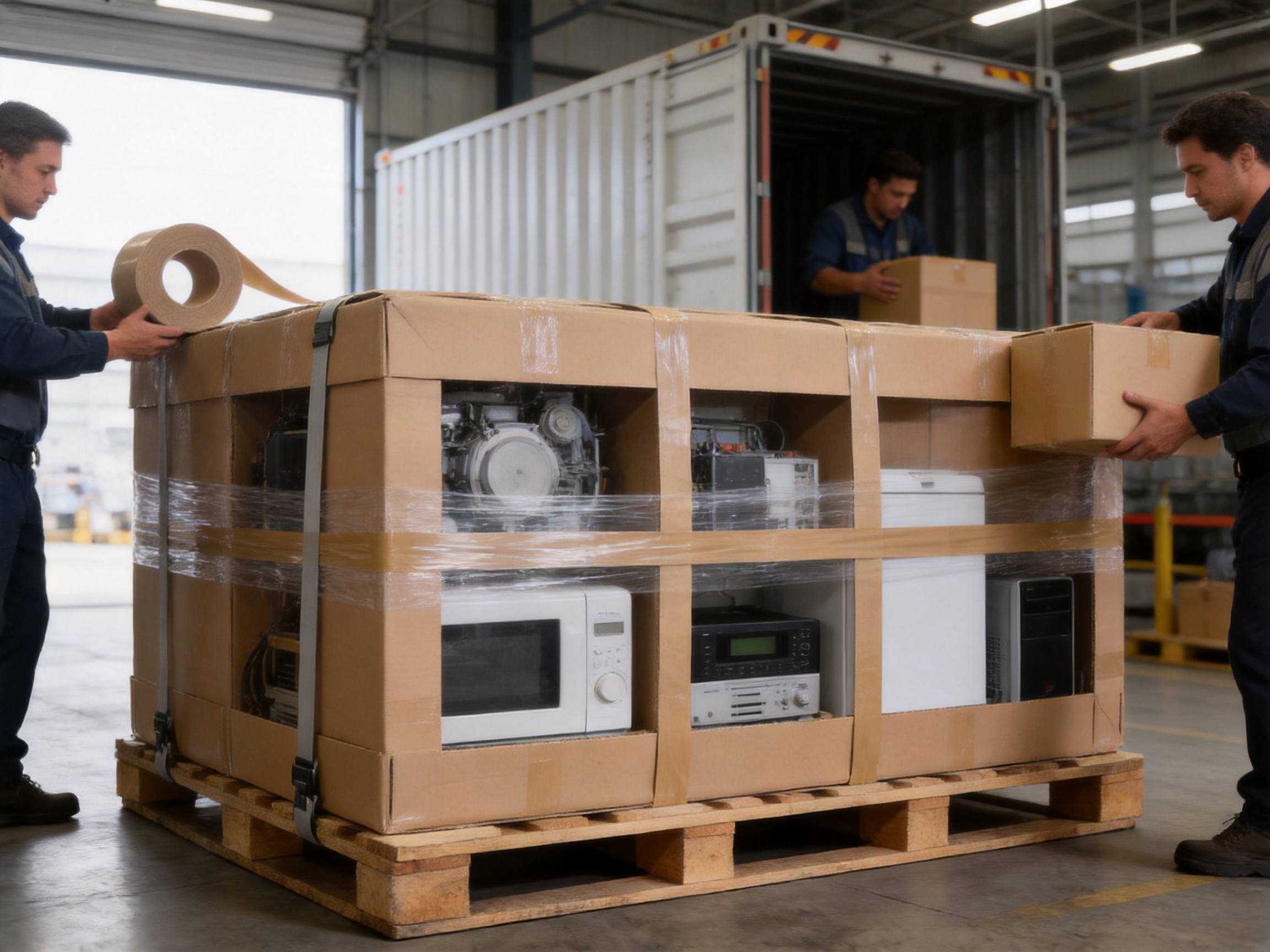
Packaging requirements are changing rapidly across logistics, manufacturing, retail, and international trade. Businesses are expected to protect products through demanding transportation conditions while also reducing plastic consumption, improving recyclability, and meeting increasingly strict environmental expectations. These requirements have created strong demand for packaging materials that combine mechanical strength, dependable adhesion, efficient application, and responsible end-of-life performance.
Water-activated reinforced kraft paper tape is designed to meet these needs. It provides an environmentally preferable alternative to conventional plastic packaging tapes while preserving the secure carton sealing performance required for export shipments, heavy-duty packaging, palletized goods, and industrial distribution. Made from a high-strength kraft paper substrate, plant-based water-activated adhesive, and embedded fiber or grid reinforcement, the tape creates a strong bond with corrugated carton fibers after the adhesive is moistened.
Unlike ordinary paper tape, reinforced water-activated kraft paper tape is engineered for demanding applications where high tensile strength and tear resistance are essential. Unlike many plastic tapes, it can remain attached to a paperboard carton during recycling without introducing a separate plastic film layer that must be removed. This combination of strength, sustainability, and compatibility makes it a practical solution for companies seeking to improve packaging performance while advancing their environmental objectives.
Zhejiang Geruite Packaging Materials Co., Ltd. develops and manufactures a broad portfolio of adhesive tapes, strapping products, films, and related packaging materials. Its product range includes BOPP tape, kraft paper tape, masking tape, high-temperature-resistant tape, metal tape, PE stretch film, PP strapping, and high-strength PET strapping. The company’s experience across multiple packaging categories supports the development of integrated solutions for logistics, manufacturing, cargo stabilization, household products, electronics, construction, and industrial packaging.
This article examines the construction, manufacturing characteristics, performance advantages, application methods, storage requirements, quality considerations, and commercial value of water-activated reinforced kraft paper tape.
1. The Role of Reinforced Kraft Paper Tape in Modern Packaging
Carton sealing is one of the most important stages in a packaging operation. A package may contain a valuable electronic device, a large appliance, construction materials, machine components, or export goods traveling through several distribution centers. If the carton seal opens, lifts, or tears during handling, the result may include product damage, contamination, loss, returns, and increased labor costs.
Traditional plastic pressure-sensitive tape is widely used because it is convenient and can be applied without water. However, plastic film tape may be less compatible with paper-based recycling streams. It may also conflict with corporate plastic-reduction programs, customer sustainability requirements, and packaging regulations in certain markets. Standard paper tape improves recyclability but may not offer enough tensile strength for heavy cartons or high-stress bundling.
Water-activated reinforced kraft paper tape addresses the limitations of both alternatives. Its kraft paper backing integrates naturally with corrugated packaging, while internal reinforcement improves resistance to stretching, tearing, and splitting. The adhesive is activated by moisture, allowing it to penetrate and bond with the fibers of the carton surface. After drying, the bond becomes firm and difficult to remove without damaging the paperboard.
The result is a sealing material that is particularly suitable for packaging operations where the carton itself is paper-based and where secure, tamper-evident closure is important. The tape can be used manually with a sponge or brush, or with a specialized water-activated tape dispenser for higher-volume operations.
2. Product Construction and Functional Design
2.1 Reinforced Kraft Paper Substrate
The primary substrate is kraft paper selected for strength, fiber structure, and compatibility with corrugated cartons. Kraft paper provides a natural appearance and a printable surface that can support brand messages, handling instructions, or security information. Standard color is natural kraft brown, although customized printing can be considered for suitable orders.
The paper base is reinforced with glass fiber, cotton thread, embedded fibers, or a grid structure, depending on the required performance configuration. Reinforcement helps distribute stress across the tape rather than allowing a single tear line to travel through the paper. This is important when a sealed carton is lifted, stacked, compressed, or exposed to vibration during transportation.
The combination of kraft paper and internal reinforcement also improves dimensional stability. A non-reinforced paper tape may stretch or split under heavy load, especially when applied across a carton seam that is under pressure. Reinforced construction offers greater resistance to longitudinal and transverse stress, supporting demanding packaging tasks.
2.2 Water-Activated Adhesive
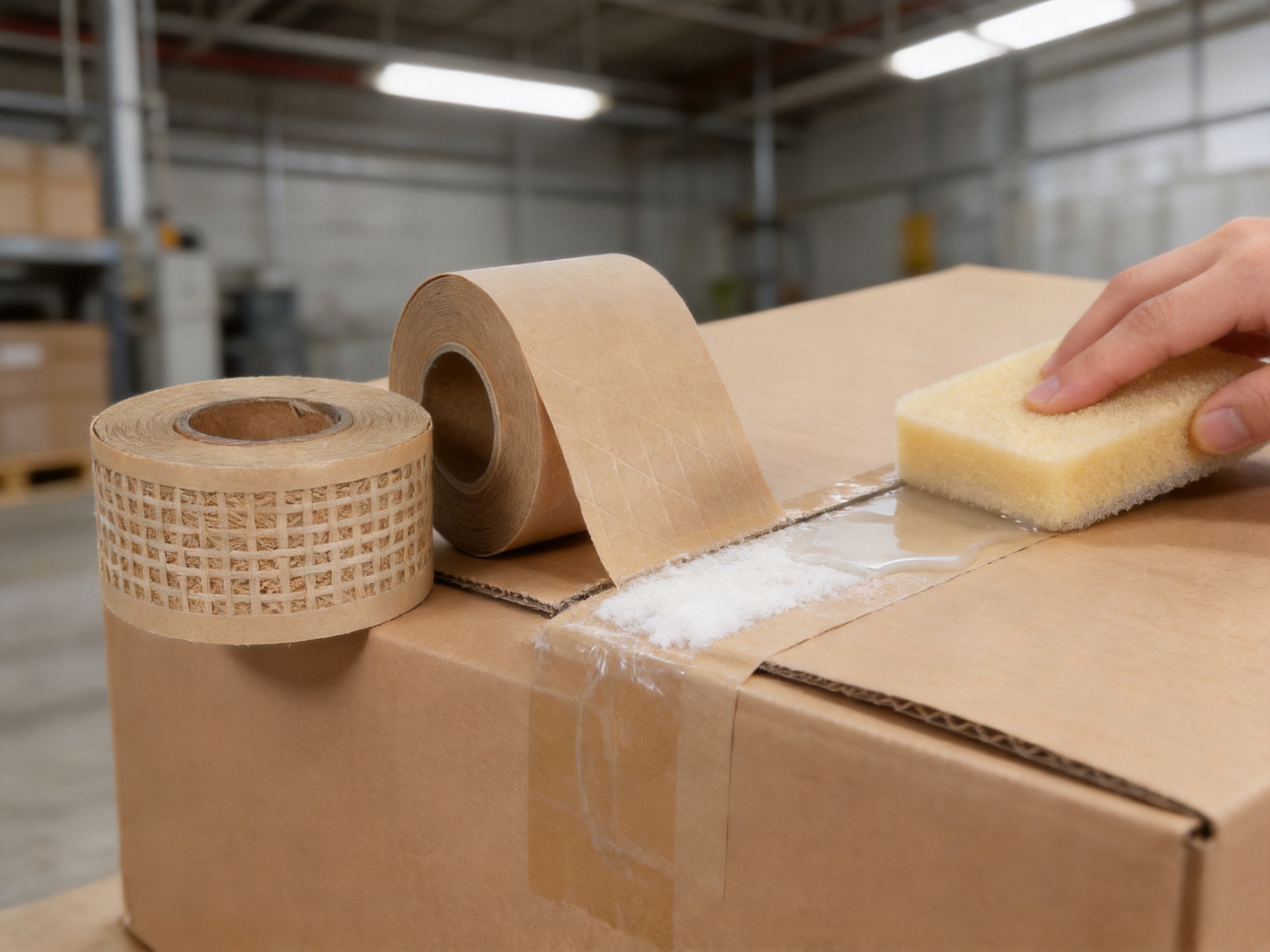
The back coating is a dry plant-starch adhesive designed to be activated with water. Before application, the adhesive side is evenly moistened with a sponge, brush, or water-activated dispensing system. Moisture changes the adhesive from a dry coating into a bonding layer capable of wetting the carton surface.
Once applied, the adhesive interacts with the fibers of the corrugated paperboard. As the moisture dissipates, the bond develops and becomes stronger. This adhesive mechanism is different from pressure-sensitive tape, which depends primarily on immediate surface contact and pressure. Water-activated tape forms a fiber-level bond that can make the tape and carton behave more like a unified paper-based structure.
The adhesive is intended for clean, dry, porous paper surfaces. It is not recommended for long-term bonding on non-porous materials such as plastic or metal because these surfaces do not allow the adhesive to interact with fibers in the same way as corrugated board.
2.3 Reinforcement Structure
Reinforcement may be arranged as longitudinal strands, crosswise fibers, a grid, or another embedded structure. The exact configuration can be matched to the required tensile and tear performance. Longitudinal reinforcement supports resistance to pulling along the length of the tape, while transverse reinforcement helps prevent the tape from splitting across its width.
For heavy cartons, the reinforcement is especially valuable at corners, seams, and closure points. These areas often experience concentrated stress during lifting and stacking. The reinforced structure helps maintain continuity across the carton seam and reduces the likelihood of sudden failure.
2.4 Typical Product Specifications
The product is available in a range of specifications suitable for different packaging tasks. Typical values include a reinforced kraft paper base with grammage options such as 80 to 120 grams per square meter, widths from approximately 12 to 72 millimeters, and roll lengths from approximately 50 to 200 meters. Exact specifications may be adjusted according to application, equipment, order volume, and customer requirements.
| Parameter | Typical Value or Description |
| Product Type | Water-activated reinforced kraft paper tape |
| Substrate | Kraft paper with glass fiber, cotton thread, or other embedded reinforcement |
| Adhesive | Dry plant-starch, water-activated adhesive |
| Typical Grammage | Approximately 80–120 grams per square meter |
| Typical Width Range | Approximately 12–72 millimeters |
| Typical Roll Length | Approximately 50–200 meters |
| Standard Color | Natural kraft |
| Printing | Custom printing may be available |
| Recommended Operating Range | Approximately -5°C to 50°C under suitable application conditions |
| Storage Temperature | Recommended approximately 5°C to 30°C |
| Recommended Storage Humidity | Preferably no higher than 65 percent relative humidity |
The values shown are general product guidance rather than a substitute for a project-specific technical data sheet. Packaging conditions, carton quality, application method, moisture level, load weight, and transportation environment can influence final performance.
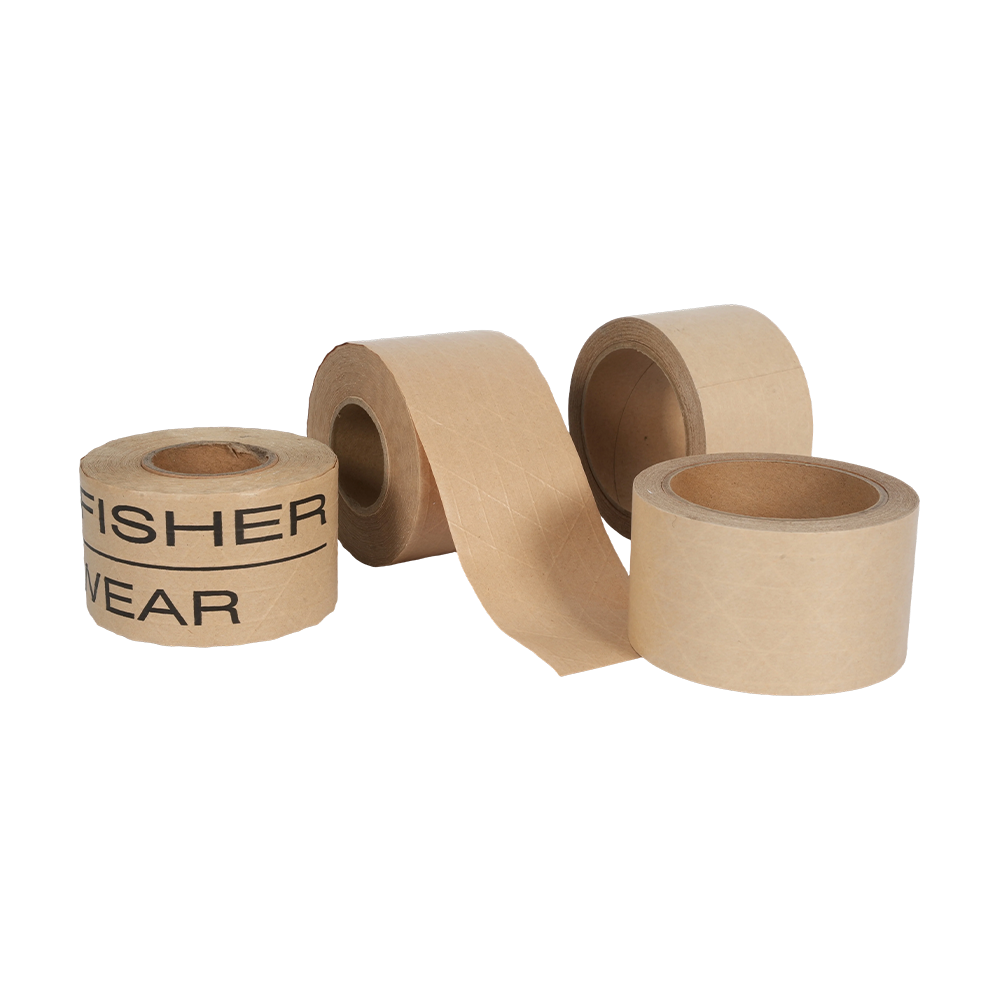
Wet water reinforced kraft paper tape
3. Environmental Advantages Compared with Conventional Plastic Tape
Sustainability is one of the primary reasons companies consider water-activated reinforced kraft paper tape. The tape is based on paper rather than a plastic film, and its adhesive is designed for water activation. This supports packaging systems that aim to reduce plastic content and simplify recycling.
3.1 Paper-Based Construction
Kraft paper is produced from renewable fiber resources and is widely accepted in paper recycling systems. When used to seal corrugated cartons, the tape remains closely associated with the paper packaging rather than creating a separate plastic component. This can reduce the need for manual tape removal before recycling, depending on the local recycling process and contamination requirements.
The paper appearance also communicates a natural and responsible packaging approach. For brands seeking to present a clean, minimalist, or environmentally conscious image, kraft paper tape can be more suitable than glossy plastic film tape.
3.2 Reduced Plastic Waste
Plastic packaging tape can contribute to the volume of mixed packaging waste, especially when used in high quantities across distribution centers. Replacing selected plastic tape applications with paper-based tape can help reduce reliance on plastic film. The greatest benefits are generally achieved when the tape is used with corrugated cartons that are already designed for paper recycling.
It is important to distinguish between environmental preference and absolute environmental performance. Recycling outcomes depend on local facilities, adhesive formulations, printing inks, contamination levels, and waste management practices. Nevertheless, the paper-based structure provides a strong foundation for more recyclable packaging designs.
3.3 Biodegradable and Recyclable Characteristics
The kraft paper substrate and plant-starch adhesive are selected to support recyclable and decomposable packaging solutions. Compared with a plastic film, paper can break down more readily under appropriate natural or industrial conditions. The tape is therefore suitable for companies seeking materials aligned with green packaging programs and responsible procurement policies.
Environmental claims should always be assessed against the applicable market standards and certification requirements. Customers with specific regulatory or retailer requirements should request detailed technical and compliance documentation before making formal product claims.
4. Performance Advantages over Standard Paper Tape
Standard paper tape can be effective for light cartons, document packages, and low-stress applications. However, ordinary paper tape may not be adequate for heavy loads, rough handling, or cartons that experience repeated lifting and stacking. Reinforcement provides a substantial performance advantage in these situations.
4.1 Higher Tensile Strength
Tensile strength is the ability of the tape to resist being pulled apart along its length. When a carton is lifted by hand or moved by a conveyor, forces can be transferred to the center seam and the sealing tape. A reinforced structure helps the tape carry these forces without stretching excessively or breaking.
High tensile strength is valuable for appliances, machinery, building materials, industrial components, and other products with substantial package weight. It is also useful when cartons are stacked in warehouses or loaded into export containers, where compression and movement may place continuous stress on the closure.
4.2 Improved Tear Resistance
Tear resistance is particularly important when the tape encounters a sharp carton edge, a puncture, or uneven tension. Internal fibers or grid reinforcement can interrupt the natural path of a tear and help preserve the integrity of the tape. This reduces the chance that a small cut will rapidly develop into a complete separation.
Improved tear resistance also helps during handling. Cartons may rub against pallets, conveyor guides, shelving, or neighboring packages. A reinforced tape is better suited to these conditions than a light, unreinforced paper tape.
4.3 Strong Bond with Corrugated Fibers
When correctly moistened, the adhesive forms a secure bond with the carton surface. The bond is not limited to the smooth outer surface of the carton. Instead, the water-activated adhesive can interact with the paper fibers, supporting strong attachment after drying.
This feature can make the sealed carton more resistant to edge lifting and peeling. It also offers a degree of tamper evidence because removing the tape may damage the carton surface or leave visible disruption to the paper fibers.
4.4 Better Integration with the Carton
Because both the carton and tape are paper-based, the finished package has a visually integrated appearance. The seal looks neat and consistent, and the tape does not create the same contrast as a glossy plastic strip. This is helpful for premium goods, e-commerce shipments, electronics, and brands that want their packaging to communicate quality and sustainability.
5. Performance Advantages over Conventional BOPP Tape
Biaxially oriented polypropylene tape is widely used because it is economical, convenient, and available in many adhesive grades. However, water-activated reinforced kraft paper tape offers several advantages in applications where paper compatibility, high-strength sealing, and environmental positioning are more important than instant dry application.
5.1 Recycling Compatibility
Paper tape can be processed with corrugated packaging more naturally than a plastic film tape. This may simplify sorting and reduce the need to remove tape from cartons before recycling. For companies shipping large volumes of paperboard packaging, this compatibility can support more consistent recycling practices throughout the supply chain.
5.2 Secure Fiber-Level Bonding
Pressure-sensitive BOPP tape depends on adhesive contact with the carton surface. Water-activated kraft paper tape, when properly applied, can bond with the carton fibers. The resulting closure is particularly suitable for boxes that need a firm, secure seal during export transportation.
5.3 Tamper-Evident Appearance
When a water-activated paper tape seal is forcibly removed, the carton surface may tear or show visible damage. This provides a useful indication that the package has been opened or interfered with. While it should not be considered a complete security system by itself, the characteristic can be valuable for controlled logistics and premium shipments.
5.4 Lower Plastic Content in the Packaging System
Replacing plastic tape with paper tape can contribute to a broader reduction in plastic packaging materials. This is especially relevant for businesses with sustainability targets, retailer requirements, or export customers that evaluate packaging composition.
The main trade-off is application method. BOPP tape can often be applied immediately using a standard hand dispenser, whereas water-activated tape requires controlled wetting. For many high-volume packaging operations, this challenge can be addressed with a water-activated tape dispenser or an automated sealing system.
6. Manufacturing Strengths and Quality Control
Product performance begins with manufacturing discipline. A strong packaging tape is not created only by selecting a paper substrate. The paper, reinforcement, adhesive, coating process, drying conditions, slitting accuracy, roll winding, and final inspection must all work together.
6.1 Material Selection
The selection of kraft paper affects tensile strength, flexibility, surface uniformity, coating acceptance, and print quality. Reinforcement materials must be compatible with the paper structure and positioned consistently throughout the web. Adhesive raw materials must also be selected for stable water activation, bonding performance, and storage behavior.
By working across multiple tape and packaging product categories, Zhejiang Geruite Packaging Materials Co., Ltd. has experience with a variety of substrates, adhesives, films, and reinforcement systems. This broad material knowledge supports the development of packaging products for different load requirements and operating conditions.
6.2 Coating and Adhesive Distribution
Uniform adhesive distribution is essential. If the coating is too light, the tape may not bond reliably. If it is too heavy or uneven, the tape may be difficult to wet, may dry inconsistently, or may experience storage problems. Controlled coating equipment helps maintain a consistent adhesive layer across the width of the product.
Manufacturing parameters such as coating speed, drying temperature, web tension, and moisture balance must be controlled carefully. These factors influence the final activation behavior and the stability of the tape during storage.
6.3 Reinforcement Positioning
Reinforcement must remain properly aligned during production. Uneven spacing or displacement can create inconsistent strength across the roll. A controlled production line helps maintain the desired arrangement of fibers, threads, or grid structures within the paper substrate.
Consistent reinforcement is important for automatic or semi-automatic application because the tape needs to unwind smoothly and maintain predictable performance across each roll. It also helps ensure that different production batches provide similar results in the customer’s packaging line.
6.4 Slitting and Rewinding
After coating and drying, the master roll is slit into customer-specified widths and rewound into finished rolls. Accurate slitting supports clean edges and reduces the risk of uneven application. Proper winding tension prevents telescoping, loose edges, and difficulties during unwinding.
Roll geometry is particularly important for industrial customers. A roll that is wound too tightly may be difficult to activate or unwind, while a roll that is too loose may deform during transportation and storage. Quality control at this stage contributes directly to user productivity.
6.5 Inspection and Final Testing
Quality inspection may include checking roll dimensions, appearance, adhesive coating, unwinding behavior, tensile strength, tear resistance, wetting response, adhesion, and packaging condition. The specific test methods depend on customer requirements and applicable standards.
Zhejiang Geruite Packaging Materials Co., Ltd. emphasizes quality control from raw material procurement through production and final inspection. This process-oriented approach helps provide stable product performance and supports customized packaging requirements for domestic and international customers.
6.6 Manufacturing Capacity and Industry Experience
The company is located in Zhejiang Province, a major manufacturing region with developed industrial infrastructure and extensive supply-chain resources. Its annual output value has exceeded RMB 60 million, reflecting an established production and sales operation rather than a single-product workshop.
Experience in BOPP tape, kraft paper tape, masking tape, specialty tape, stretch film, and strapping allows the company to understand the practical relationship between different packaging materials. Customers can therefore discuss carton sealing, pallet stabilization, bundling, and protective packaging as part of a broader packaging program.
7. Application Scenarios
7.1 Export Carton Sealing
Export cartons may pass through multiple handling points, changes in climate, long-distance transportation, container loading, and warehouse storage. A reliable carton seal is essential to preserve package integrity. Water-activated reinforced kraft paper tape is suitable for export packaging where high strength and environmental compatibility are both required.
The natural kraft appearance can also create a professional presentation for international shipments. Custom printing may be used for company identification, handling instructions, security messages, or sustainability communication, subject to production feasibility and order requirements.
7.2 Heavy Appliances and Machinery
Large appliances and machinery often require cartons with reinforced seams and high resistance to lifting stress. The tape can be used across the main top and bottom seams, around closure flaps, or at selected stress points. It may also support bundling or edge reinforcement when combined with other packaging materials.
Packaging engineers should evaluate the total carton design, including board grade, box dimensions, internal cushioning, load distribution, and stacking height. Tape strength is important, but it works as part of the complete packaging system rather than as an isolated solution.
7.3 Building Materials and Industrial Components
Construction products, tools, hardware, metal components, and industrial supplies may be heavy, angular, or difficult to handle. Reinforced kraft paper tape can help maintain closure integrity when the carton is lifted, moved by pallet truck, or exposed to vibration.
For sharp-edged contents, internal protective packaging should be used to prevent puncture damage. The tape can provide strong closure support, but the carton and internal materials must still be selected to match the product’s geometry and weight.
7.4 Pallet Stabilization and Unitized Loads
Water-activated tape may be used as part of a pallet packaging system for securing cartons, reinforcing seams, or stabilizing grouped packages. It can complement stretch film, strapping, corner boards, and other load-containment materials.
For palletized goods, tape selection should consider the direction of applied forces, the number of cartons, stacking pattern, pallet quality, and transportation route. The tape can improve carton closure, while stretch film or strapping may be required to control movement of the complete load.
7.5 Electronics and Premium Goods
Electronics and premium products often require packaging that looks clean while reflecting environmental responsibility. Natural kraft tape provides a simple and refined appearance, and its paper-based structure supports a coherent recyclable packaging design.
For products that require tamper indication, the fiber-bonding characteristic can offer an additional visual signal if the carton is opened. Brands may also consider printed tape for identification, product handling, or controlled distribution.
7.6 E-Commerce and Direct-to-Consumer Shipping
Direct-to-consumer shipments often face repeated handling and irregular transportation conditions. A reinforced paper seal can help protect cartons through fulfillment centers, courier networks, and final delivery. Its natural appearance may also enhance the unboxing experience by replacing glossy plastic tape with a paper-based closure.
For e-commerce operations, application speed is important. Small and medium-volume pack stations may use hand wetting tools, while larger fulfillment centers can evaluate water-activated dispensers that measure, wet, and cut the tape consistently.
8. Correct Application Procedure
Proper application is necessary to achieve the full performance of the tape. The carton surface should be clean, dry, and free from dust, oil, loose paper fibers, and excessive moisture. Contamination can prevent the adhesive from making adequate contact with the carton.
8.1 Preparing the Carton
Close the carton flaps so that the seam is aligned and the board is not excessively buckled. If the flaps are under strong upward tension, the tape may have difficulty holding them in position. For heavy cartons, use a carton design and board grade appropriate to the product weight.
8.2 Moistening the Adhesive
Evenly moisten the adhesive side with a sponge, brush, or suitable dispenser. The surface should become glossy without being saturated with excess water. Inconsistent wetting may result in areas that bond strongly and areas that remain weak.
For commercial operations, a water-activated dispenser can improve consistency by controlling water quantity, tape length, and cutting. Operators should be trained to recognize the correct wetting level and avoid touching the adhesive unnecessarily.
8.3 Applying and Pressing the Tape
Place the moistened tape centrally over the carton seam. Press firmly along the entire length, paying particular attention to the ends and corners. A roller, hand applicator, or firm manual pressure can help remove air gaps and improve contact with the corrugated surface.
The tape should extend sufficiently beyond the seam to provide reliable attachment to both flaps. For large or heavy cartons, additional strips may be applied perpendicular to the main seam or along vulnerable edges, depending on the packaging design.
8.4 Allowing the Bond to Cure
Allow approximately one to two minutes for initial curing and bonding after application. Exact curing time depends on temperature, humidity, carton absorption, adhesive quantity, and package weight. Heavy cartons should not be subjected to severe lifting or stacking loads before the bond has developed adequately.
Operators should avoid applying the tape to wet cartons. Excess moisture can dilute the adhesive, weaken the paperboard, and interfere with consistent bonding.
9. Storage and Handling Guidelines
Water-activated paper tape is sensitive to moisture before use. Rolls should be stored in a cool, dry, and clean location away from direct sunlight, heat sources, condensation, and water exposure. Recommended storage conditions are approximately 5°C to 30°C with relative humidity preferably no higher than 65 percent.
Keep rolls in their original packaging until use. Store them on a stable surface and avoid placing heavy objects on top of the rolls. Excessive compression can deform the roll edges and affect unwinding.
Sudden changes in temperature may create condensation. If the tape is moved from a cold environment into a warm and humid area, allow it to acclimatize while remaining packaged. This reduces the risk of moisture entering the roll before application.
Rotate inventory according to a first-in, first-out system. Although product shelf life depends on packaging and storage conditions, good inventory management helps ensure that older rolls are used before newer stock. Customers with long-term storage requirements should request product-specific shelf-life guidance.
10. Selection Guidance for Different Packaging Requirements
Choosing the correct tape involves more than selecting a width. Packaging managers should evaluate carton weight, seam design, transportation duration, temperature, humidity, application speed, recycling goals, and whether custom printing is required.
10.1 Light and Medium Cartons
For light and medium cartons, a lower grammage or narrower tape may be sufficient if the carton is properly designed and the contents are stable. The tape should still cover the seam adequately and be applied with enough moisture and pressure.
10.2 Heavy Cartons
Heavy cartons generally benefit from higher-strength paper, stronger reinforcement, wider tape, or multiple sealing strips. The carton board itself must be capable of carrying the load. Tape should not be used to compensate for undersized cartons, weak flaps, or inadequate internal support.
10.3 Cold or Warm Environments
The stated operating range is approximately -5°C to 50°C, but actual performance depends on application conditions. At low temperatures, adhesive activation and drying may take longer. At high temperatures, moisture may evaporate quickly and storage conditions become more important. Testing under actual warehouse and transportation conditions is recommended.
10.4 Manual versus Machine Application
Manual application may be suitable for small production runs, special packaging, and variable carton sizes. Machine application is more appropriate for consistent, high-volume operations. A dispenser can improve speed and reduce variation in tape length and wetting.
10.5 Printed Tape
Custom printing can help identify shipments, communicate handling instructions, strengthen brand presentation, or provide tamper-evident messaging. Customers should confirm print colors, repeat length, minimum order quantity, artwork requirements, and compatibility with the selected tape specification.
11. Advantages for International Customers
International buyers often need packaging products that can support both operational requirements and local environmental policies. Water-activated reinforced kraft paper tape provides a practical combination of paper-based construction, high mechanical strength, and compatibility with corrugated cartons.
Its natural kraft appearance is widely accepted across different markets. The product can be used for export cartons, industrial shipments, warehouse packaging, and logistics operations where plastic reduction is a purchasing priority.
Zhejiang Geruite Packaging Materials Co., Ltd. is based in Hangzhou, Zhejiang Province, China, and serves customers requiring packaging tapes, stretch films, strapping, and related materials. Its production experience, quality management approach, and broad product portfolio support cooperation with distributors, packaging wholesalers, manufacturers, and logistics companies.
The company’s technical and commercial strengths include product development, multi-category manufacturing, production quality control, specification customization, and experience serving diverse industries. Its packaging materials are used in logistics and express delivery, household goods, electronics, construction and decoration, industrial manufacturing, cargo stabilization, and packaging protection.
12. Cost and Operational Considerations
Material price is only one part of the total cost of carton sealing. A packaging manager should also consider application speed, equipment investment, carton damage, product loss, recycling handling, labor, storage, and customer expectations.
Water-activated tape may require a dispenser or a small manual wetting process. However, the secure fiber-level bond can reduce the risk of opened cartons, failed seals, and repeated taping. When the tape is integrated into a recycling-oriented packaging system, it may also reduce the effort associated with separating plastic tape from paperboard.
Industrial buyers should compare products based on cost per sealed carton rather than cost per roll alone. A stronger tape may require fewer strips or provide better security for a heavy package. A properly selected width and reinforcement structure can improve material efficiency while maintaining performance.
Trial orders are recommended when changing from plastic tape or standard paper tape. A controlled packaging trial can measure application time, seal quality, carton failure rate, storage behavior, and performance after simulated transportation.
13. Why Manufacturing Partnership Matters
Packaging tape performance is affected by many variables, including substrate quality, adhesive formulation, reinforcement placement, coating consistency, roll winding, and storage packaging. A manufacturer with control over these stages can respond more effectively to customer requirements than a supplier focused only on trading finished goods.
Zhejiang Geruite Packaging Materials Co., Ltd. combines product research, production, sales, and quality control within its packaging materials business. Its range of products enables customers to source several related materials from one experienced supplier. This can simplify product evaluation, procurement communication, packaging standardization, and supply planning.
The company’s stated focus on research and innovation supports continued improvement in high-performance tapes and packaging materials. Its investment in equipment and quality systems is intended to maintain stable product performance from raw material procurement through final inspection.
For customers with specialized requirements, cooperation may include selecting grammage, reinforcement type, width, roll length, printing, packaging format, and application method. Technical communication before production is important because the best specification depends on the carton, product weight, shipping route, and operating environment.
14. Sustainability in a Complete Packaging System
A sustainable tape should be considered as part of the full packaging system. The carton, cushioning materials, labels, inks, pallet materials, stretch film, strapping, and end-of-life process all influence the environmental outcome.
Water-activated reinforced kraft paper tape can support a paper-dominant packaging design. When used with recyclable corrugated board, paper labels, and appropriately selected printing materials, it can help reduce the number of mixed-material components in the package.
Businesses should also consider material efficiency. Using a stronger tape does not automatically create a better package if excessive amounts are applied. Correct carton design, optimized strip length, efficient application, and suitable reinforcement can reduce waste while preserving protection.
Environmental communication should be accurate and supported by applicable documentation. Claims such as recyclable, biodegradable, or environmentally friendly may have different meanings in different countries and recycling systems. Buyers should verify local requirements before using environmental claims in marketing or regulatory submissions.
15. Recommended Quality Evaluation Program
Before adopting a new tape across a large packaging operation, customers can conduct a structured evaluation. The first stage is a visual inspection of the roll, including edge quality, winding, surface appearance, and packaging condition.
The second stage is an application test on the actual carton. Operators should record the amount of water used, wetting uniformity, application time, pressure, initial bond, and ease of handling. The tape should be checked for edge lifting, bubbling, incomplete bonding, and uneven drying.
The third stage is a performance test. Sealed cartons can be lifted, stacked, vibrated, moved across conveyors, and exposed to expected temperature and humidity conditions. Heavy packages should be tested with the actual product weight and carton configuration.
The fourth stage is a recycling and operational review. The company should confirm that the tape fits its waste handling process, that operators can apply it efficiently, and that packaging staff understand storage requirements. These steps help ensure that product performance and sustainability goals are achieved in daily practice.
16. Frequently Asked Questions
16.1 What is water-activated reinforced kraft paper tape?
It is a paper-based packaging tape made from reinforced kraft paper and a dry, water-activated adhesive. The adhesive is moistened before application and forms a strong bond with corrugated carton fibers as it dries.
16.2 How is it different from ordinary kraft paper tape?
Reinforced kraft paper tape contains embedded fibers, threads, or a grid structure that improves tensile strength and tear resistance. It is therefore more suitable for heavy cartons, export packaging, palletized loads, and industrial applications than many standard unreinforced paper tapes.
16.3 Can it replace BOPP plastic tape?
It can replace BOPP tape in many carton-sealing applications, particularly where the carton is paper-based and recycling compatibility is important. However, the application method is different because the adhesive must be moistened. Testing is recommended before changing an entire packaging line.
16.4 Is the tape recyclable?
The paper-based tape and plant-starch adhesive are designed to support recyclable packaging systems. Actual recycling results depend on local recycling facilities, packaging composition, contamination, and applicable regulations. Customers should verify requirements in their target markets.
16.5 Is it biodegradable?
The kraft paper substrate and starch-based adhesive are designed to decompose more readily than plastic film materials under suitable conditions. Decomposition speed depends on moisture, temperature, microorganisms, and the disposal environment.
16.6 Can it be used on plastic or metal?
It is not recommended for long-term bonding on non-porous surfaces such as plastic or metal. The adhesive is designed to bond most effectively with porous paper and corrugated carton surfaces.
16.7 How should the adhesive side be moistened?
Use a sponge, brush, or water-activated tape dispenser to wet the adhesive side evenly until it becomes glossy. Avoid excessive water, because oversaturation can weaken the adhesive layer and the carton surface.
16.8 How long does the bond take to develop?
Approximately one to two minutes is recommended for initial curing after application. Actual curing time depends on temperature, humidity, carton absorption, adhesive wetting, and package weight.
16.9 What widths and lengths are available?
Typical widths range from approximately 12 to 72 millimeters, while typical roll lengths range from approximately 50 to 200 meters. Exact specifications can be discussed according to packaging equipment and order requirements.
16.10 Can the tape be printed?
Custom printing may be available. Printing can be used for brand identification, handling information, security messages, or other packaging communication. Artwork and production details should be confirmed before ordering.
16.11 What storage conditions are recommended?
Store the rolls in a cool, dry place away from heat, moisture, and direct sunlight. Recommended conditions are approximately 5°C to 30°C and relative humidity of no more than 65 percent whenever possible.
16.12 Is it suitable for export shipments?
Yes. The tape is designed for export carton sealing and other applications where strength, secure bonding, and paper-based packaging compatibility are important. The complete carton design should still be evaluated for the expected shipping conditions.
16.13 Can it be applied by machine?
It can be used with suitable water-activated tape dispensers or application equipment. Machine selection should match tape width, roll dimensions, required speed, and carton size.
16.14 What should customers provide when requesting a quotation?
Useful information includes carton material, carton dimensions, package weight, application method, required width and length, estimated monthly volume, printing requirements, shipping environment, and target market. These details help the manufacturer recommend a suitable specification.
17. Conclusion
Water-activated reinforced kraft paper tape is a practical solution for companies seeking to balance packaging strength with environmental responsibility. Its reinforced kraft paper substrate provides high tensile and tear resistance, while the plant-starch adhesive forms a strong bond with corrugated carton fibers after wetting. The result is a secure, paper-based seal suitable for export cartons, heavy-duty packaging, palletized goods, appliances, machinery, electronics, premium products, and e-commerce shipments.
Compared with ordinary paper tape, the reinforced structure offers greater durability and load resistance. Compared with conventional BOPP tape, the product provides a paper-based alternative that can integrate more naturally with corrugated packaging and support plastic-reduction objectives. Its natural appearance, potential for custom printing, and compatibility with recycling-oriented packaging systems further increase its commercial value.
Product performance depends on correct application, appropriate carton design, controlled storage, and suitable specification selection. Companies should evaluate the tape under actual packaging and transportation conditions, especially when sealing heavy cartons or changing from plastic tape.
Zhejiang Geruite Packaging Materials Co., Ltd. supports this product with experience in packaging tape, stretch film, strapping, and related materials. Its focus on research, equipment, quality control, and multi-category production provides a strong foundation for customers seeking reliable packaging supply and customized material solutions. As businesses continue to reduce plastic use and improve logistics efficiency, reinforced water-activated kraft paper tape is positioned to become an increasingly important component of modern sustainable packaging.
References
1. Product specification and application information supplied for water-activated reinforced kraft paper tape.
2. Technical information concerning kraft paper substrates, embedded reinforcement, plant-starch adhesive, and carton sealing performance.
3. General packaging engineering principles for corrugated carton design, sealing, stacking, and transportation protection.
4. General guidance on paper packaging recycling, material compatibility, and mixed-material reduction.
5. Company information concerning Zhejiang Geruite Packaging Materials Co., Ltd., its product portfolio, manufacturing capabilities, and quality management approach.
6. General industrial practices for adhesive tape coating, reinforcement placement, slitting, rewinding, roll storage, and application control.
Product: Wet water reinforced kraft paper tape

LATEST POST
Let’s create something amazing together
contact us

CONTACT DETAILS
- Address:No. 241, Yaojiafan, Zhangpanqiao, Shushan Street, Xiaoshan District, Hangzhou City, Zhejiang Province, China
- TEL:+86-0571-83175630
- Phone:+86-13336160217
- Email:anqiaocun@163.com
PRODUCTS
NEWS CENTER
MOBILE TERMINAL
Copyright© Zhejiang Geruite Packaging Materials Co., Ltd. All Rights Reserved.
Privacy Wholesale industrial packaging tape Manufacturers