


 English
 Español
 عربى

Short-Handle Hand Stretch Film for Precision Packaging in Confined Spaces
Content
- 1 Understanding the Short-Handle Stretch Film Concept
- 2 Why Precise Film Control Matters
- 3 Key Advantages Over Conventional Long-Handle Dispensers
- 4 Product Construction and Material Configuration
- 5 Application Areas
- 6 Short Handle Versus Long Handle: Selecting the Right Tool
- 7 Operating Principles for Better Results
- 8 Manufacturing Strengths and Quality Focus
- 9 Customisation and Purchasing Considerations
- 10 Environmental and Operational Efficiency
- 11 Workplace Safety and Good Practice
- 12 How the Product Supports Different Business Models
- 13 Frequently Asked Questions
- 13.1 What is the main purpose of the Hand Stretch Film Short Handle?
- 13.2 Does the short-handle model replace a conventional stretch film applicator?
- 13.3 What film cores are compatible with the product?
- 13.4 What film sizes are listed for this product?
- 13.5 Can the handle colour be customised?
- 13.6 Is this tool suitable for pallet wrapping?
- 13.7 Which products are suitable for this dispenser?
- 13.8 Does the short handle reduce wrist fatigue?
- 13.9 What should be checked before using the product?
- 13.10 How can a buyer evaluate the product before purchasing in volume?
- 13.11 What manufacturing capabilities support this product?
- 14 Conclusion
- 15 References
- 16 Product: Hand Stretch Film Short Handle
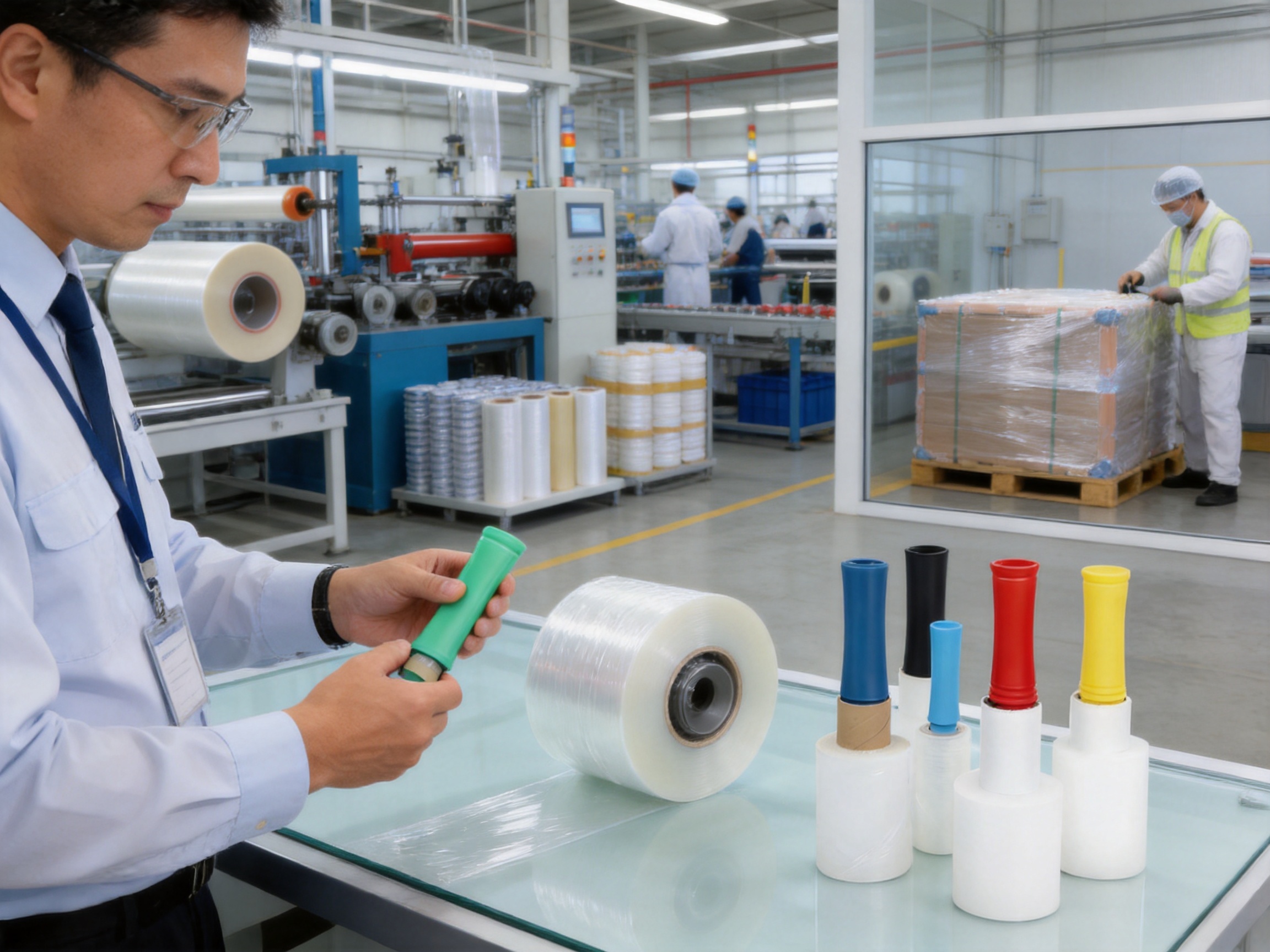
Modern packaging operations are becoming more diverse. Warehouses no longer handle only uniform pallets and large cartons. Factories, retailers, e-commerce fulfilment centres, maintenance departments, and distribution facilities increasingly package precision instruments, irregular products, machinery components, furniture, cables, fittings, and small mixed consignments. These products often contain corners, recesses, fragile surfaces, and uneven profiles that are difficult to secure with a conventional long-handled stretch film dispenser.
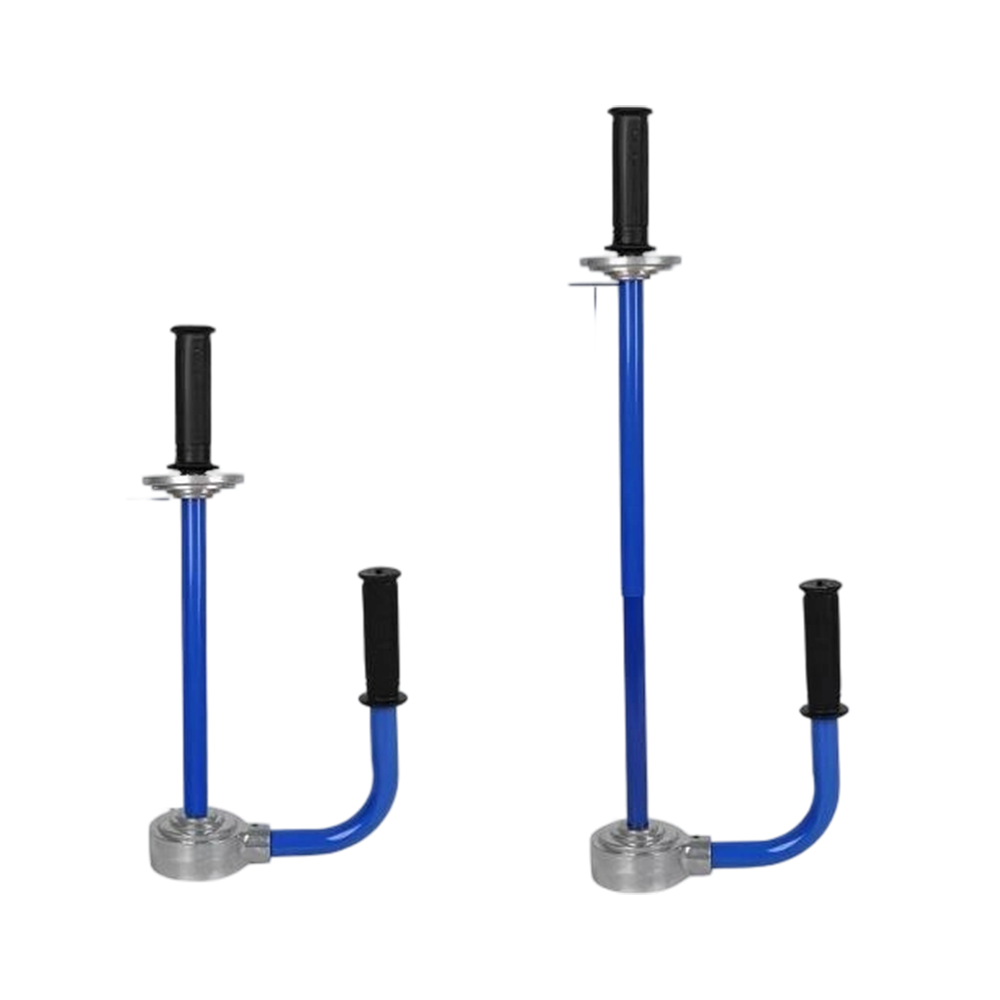
The Hand Stretch Film Short Handle is designed for this exact challenge. It is a compact manual wrapping solution that places the operator’s point of control close to the film surface. This construction enables accurate tension management, improved manoeuvrability, and more comfortable operation in locations where a standard long-handled applicator is inconvenient or impossible to use.
Rather than replacing conventional stretch film dispensers, the short-handle model provides a specialised complement. Long-handled tools are generally selected for speed and productivity when wrapping standard pallets or large, open loads. The short-handle design is selected when precision, access, and control are more important than maximum wrapping speed. This distinction makes it a valuable part of a complete packaging-tool portfolio.
Understanding the Short-Handle Stretch Film Concept
A stretch film handle is a manual tool that helps an operator hold, guide, and tension hand-wrapping film around a product. The handle supports the film roll and allows the user to apply wrapping force more consistently than wrapping directly by hand. The length and geometry of the handle have a direct effect on how the operator controls the film.
Traditional long-handled dispensers create a larger distance between the operator’s hand and the film contact point. This can be beneficial when the operator needs to reach across a pallet or maintain a wider wrapping radius. However, the same length can become a disadvantage when working between shelves, inside vehicle compartments, around machinery, or near densely positioned products.
The short-handle format reduces this distance. The operator can guide the film closer to the product and make smaller adjustments while moving around corners and irregular surfaces. The result is a tool intended for close-control packaging, especially where the wrapping path changes frequently or where the available working space is restricted.
The product is compatible with 3-inch or small-core paper cores and with 450–500 mm hand-wrapping film. The listed material configurations include PE and LDPE film in sizes of 0.015 mm × 10 cm × 150 m and 0.02 mm × 10 cm × 150 m. These compact film dimensions are suitable for controlled wrapping tasks involving small products, bundles, components, and items that require a narrower wrapping path.
Why Precise Film Control Matters
Stretch film performs best when it is applied with an appropriate balance of tension, overlap, and coverage. Excessive tension can deform, mark, or damage a product, while insufficient tension may allow the film to loosen during movement. Uneven tension can also cause curling, wrinkling, or openings around corners and recessed sections.
When the operator works with a long lever arm in a small area, minor hand movements can produce larger changes in film position or tension. This may make it difficult to follow the shape of a product accurately. The short handle brings the control point closer to the wrapping surface, helping the operator make finer adjustments as the film moves around edges and contours.
For precision instruments, finished components, and products with sensitive surfaces, the ability to regulate film tension is particularly important. A controlled application can help hold the product securely without applying unnecessary pressure. It can also reduce the risk of gaps that allow dust, loose debris, or moisture exposure during short-term handling and transport.
The short handle is not a replacement for good packaging technique. Operators still need to select suitable film thickness, maintain consistent overlap, avoid excessive stretching, and inspect the completed wrap. However, the tool gives the operator a more practical way to apply these techniques in confined or irregular working conditions.
Key Advantages Over Conventional Long-Handle Dispensers
Enhanced Control Precision
The main advantage of the short-handle design is improved control over the film at the point of application. The short lever arm allows the operator to react quickly when the film reaches an edge, corner, recess, or change in product height. Instead of making broad movements, the user can guide the roll through smaller and more deliberate motions.
This is especially useful for irregularly shaped e-commerce items. Many online orders contain products with projecting corners, different package heights, soft sections, or mixed components. A tool designed only for large rectangular loads may not follow these shapes efficiently. The short-handled model allows the operator to redirect the film around the individual profile of the item.
Close control can also help reduce loose film tails. When film is applied inconsistently, the end of the roll may curl away from the load or create a loose section that must be corrected. By positioning the film more accurately, the operator can achieve a cleaner, more uniform wrap and reduce the need for repeated passes.
Superior Access in Restricted Areas
Many packaging tasks take place after products have already been placed in storage racks, service areas, delivery vehicles, or production zones. In these circumstances, the operator may not be able to stand at a comfortable distance from the item. A long handle can collide with shelves, adjacent products, equipment frames, or vehicle walls.
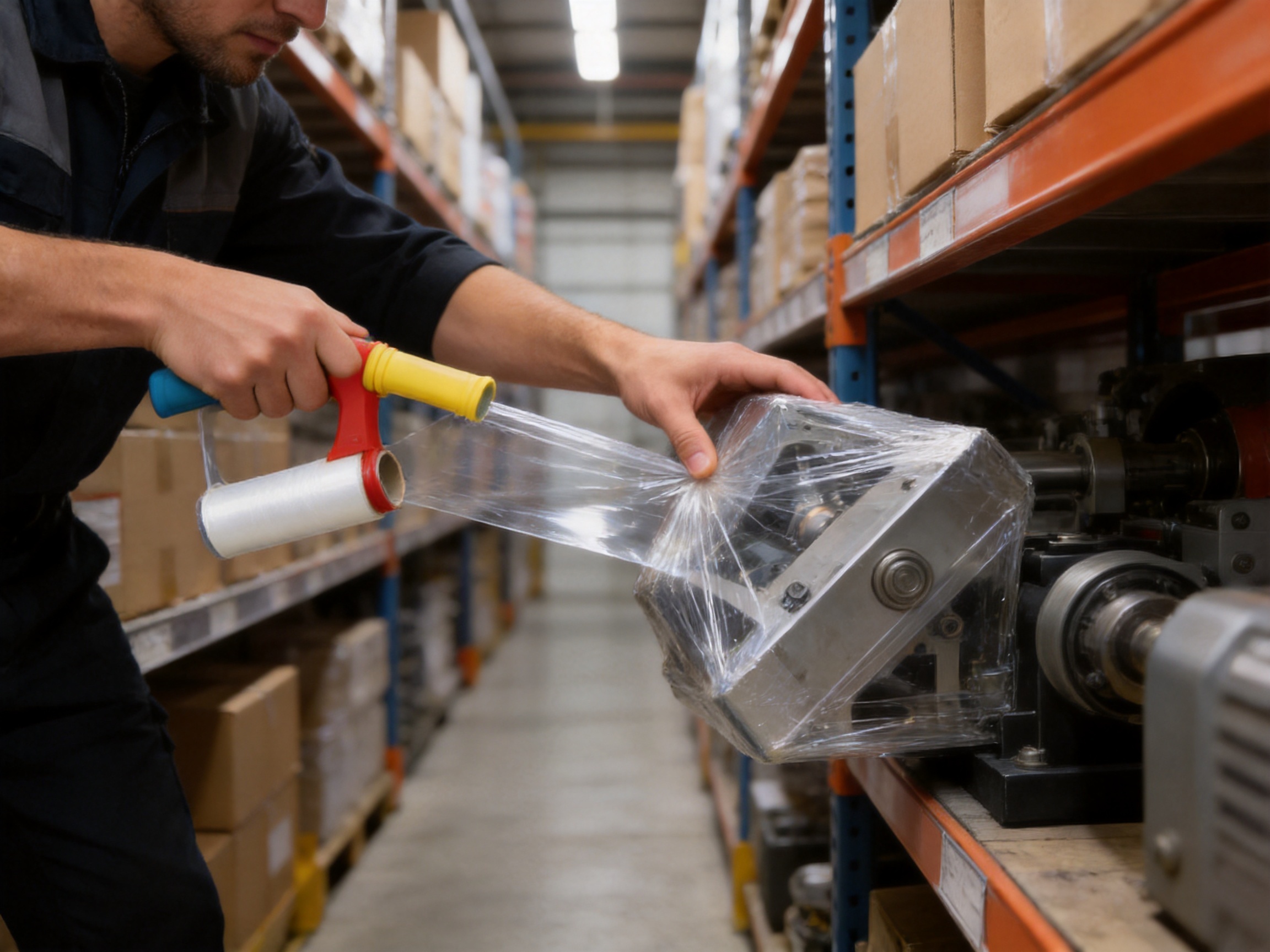
The compact short handle is better suited to narrow working spaces. It can be turned in gaps between shelves, moved around the corners of vehicle compartments, and used near densely packed equipment. The operator does not need to create as large a swing radius to guide the film around the product.
This spatial adaptability is valuable in warehouses where re-wrapping is required. Products may need additional protection after inspection, partial picking, or order consolidation. Moving the entire load to an open wrapping station may consume time and labour. A short-handled dispenser can enable the operator to complete targeted re-wrapping at the storage location, provided that the surrounding area is safe and accessible.
Reduced Wrist Strain
Manual wrapping can involve repeated rotation of the wrist and forearm. When a long tool is used in a confined space, the operator may need to apply additional torsional movement to prevent the handle from contacting nearby objects. Over a long shift, these repeated movements can contribute to discomfort and fatigue.
The short handle reduces the distance through which force is transmitted from the operator’s hand to the film roll. This can minimise the torsional effect associated with the lever mechanism. The benefit may be particularly noticeable for operators who perform small-batch wrapping throughout the day, including female operators and personnel working extended shifts.
Ergonomic benefits depend on correct use, suitable film tension, workstation height, and working posture. The handle cannot eliminate all physical effort, but its compact form can help the operator maintain a more natural position in tasks requiring frequent close-range control.
Better Suitability for Irregular Loads
Large pallets with straight sides are generally easy to wrap using a conventional applicator. Irregular items require a different approach. Machinery parts, furniture elements, hardware fittings, ceramic products, cables, hoses, and bundled materials may include multiple changes in width and height.
A short-handled dispenser can follow these changes without forcing the operator to make wide, awkward movements. The film can be directed into recessed sections, around protruding parts, and across areas where a broad dispenser would be difficult to position. This makes the tool well suited to products that cannot be treated as simple rectangular loads.
Useful for Small-Batch Operations
Not every packaging department needs an automated wrapping system or a large pallet dispenser. Retail back-of-house areas, workshops, service departments, and small fulfilment operations may process only a limited number of items at a time. In such environments, a compact manual tool can offer a practical balance between cost, flexibility, and packaging quality.
The short-handle design can be stored easily near a packing bench or workstation. It does not require a dedicated machine footprint and can be used when required for individual items or small groups of products. This makes it suitable for businesses that need professional packaging results but do not have a constant volume of standard palletised goods.
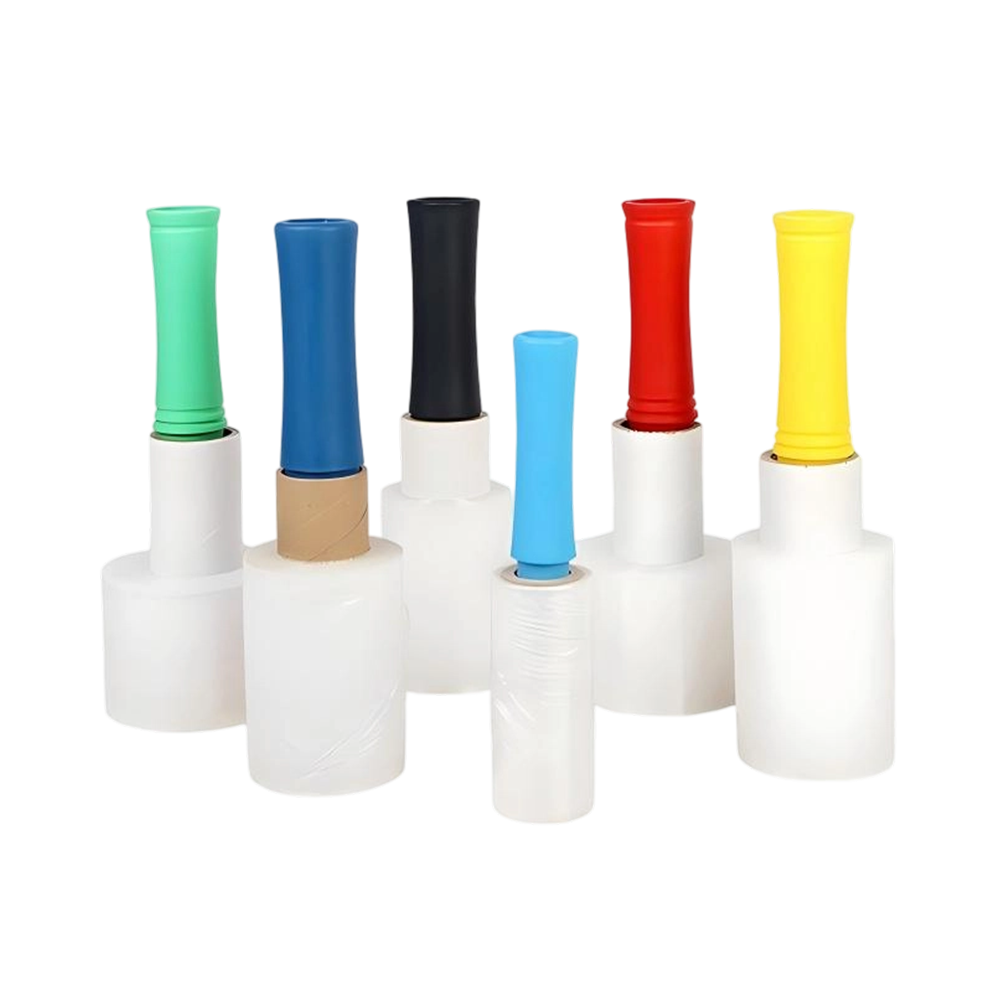
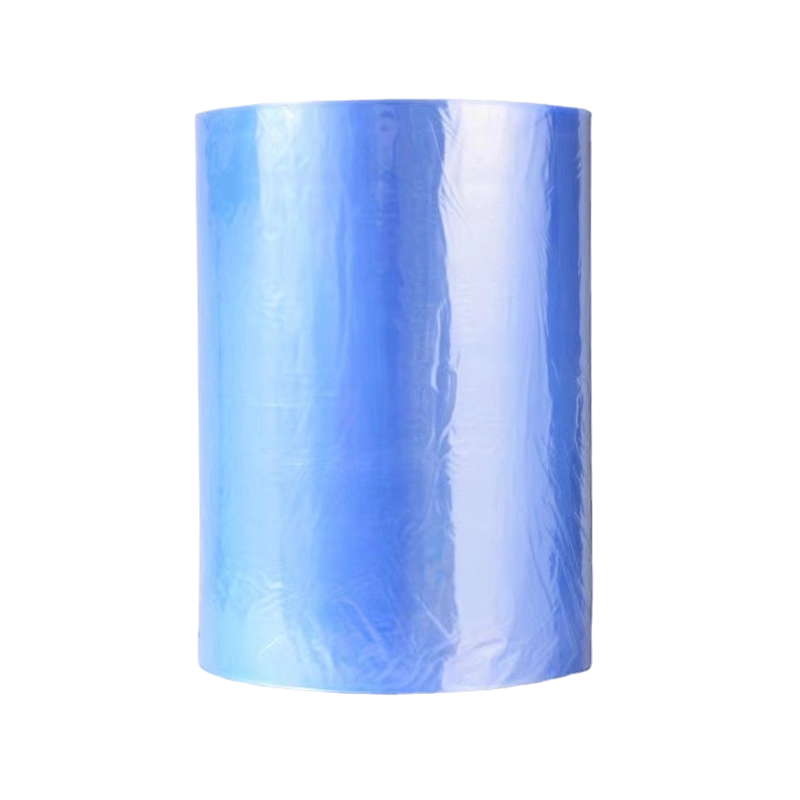
Hand Stretch Film Short Handle
Product Construction and Material Configuration
The product is specified with PE and LDPE stretch film material options. Polyethylene-based films are widely used in packaging because they combine flexibility, light weight, and resistance to ordinary handling stresses. LDPE, or low-density polyethylene, is known for its pliability and ability to conform to different shapes, making it appropriate for hand-wrapping applications.
The listed film dimensions are 0.015 mm × 10 cm × 150 m and 0.02 mm × 10 cm × 150 m. The two thickness options allow users to select a configuration according to the nature of the product, the required holding force, and the handling environment. Thinner film may be appropriate for lighter or less demanding wrapping tasks, while thicker film can provide additional material strength where the load requires it.
The 10 cm width is narrower than the film commonly used for full pallet wrapping. This narrower format supports close-range work and helps the operator follow smaller surfaces. It can be easier to position around individual products, components, bundles, and irregular shapes without covering unnecessary areas or creating excessive overlap.
The 150 m length provides a practical supply for repeated hand-wrapping tasks. Actual consumption will depend on the size and shape of the products, the number of layers applied, the overlap selected, and the operator’s technique. Businesses can monitor usage by application type and select the most appropriate film thickness for their routine packaging requirements.
The plastic handle is supplied in a random colour and can be customised. Random colour availability helps simplify general production and inventory management, while customisation may support customer-specific requirements such as colour identification, private-label programmes, or internal tool differentiation. Customisation details should be confirmed with the supplier before production.
Application Areas
Precision Instruments and Sensitive Equipment
Precision instruments often require secure external protection without excessive compression. Their surfaces may include displays, adjustment mechanisms, projecting controls, or delicate housings. The short-handled tool allows operators to apply film carefully around these features and to regulate tension as the wrapping path changes.
When packaging such equipment, the film should not be used as the only protective layer where impact protection is required. Foam, corrugated inserts, edge protection, or other cushioning materials may be necessary depending on the product. The stretch film can then help hold those protective materials in position and stabilise the packaged unit during handling.
High-Density Storage Areas
Storage areas often become more crowded as inventory changes. Products may be placed close together, leaving insufficient space for a large dispenser. The short handle can support re-wrapping, bundling, and temporary stabilisation without requiring a wide movement path.
This application is useful when a product has been opened for inspection or partial picking. The operator can restore the protective film around the remaining contents and reduce exposure to dust or accidental contact. The tool can also help secure groups of small packages before they are moved to a dispatch area.
Vehicle Compartments and Delivery Preparation
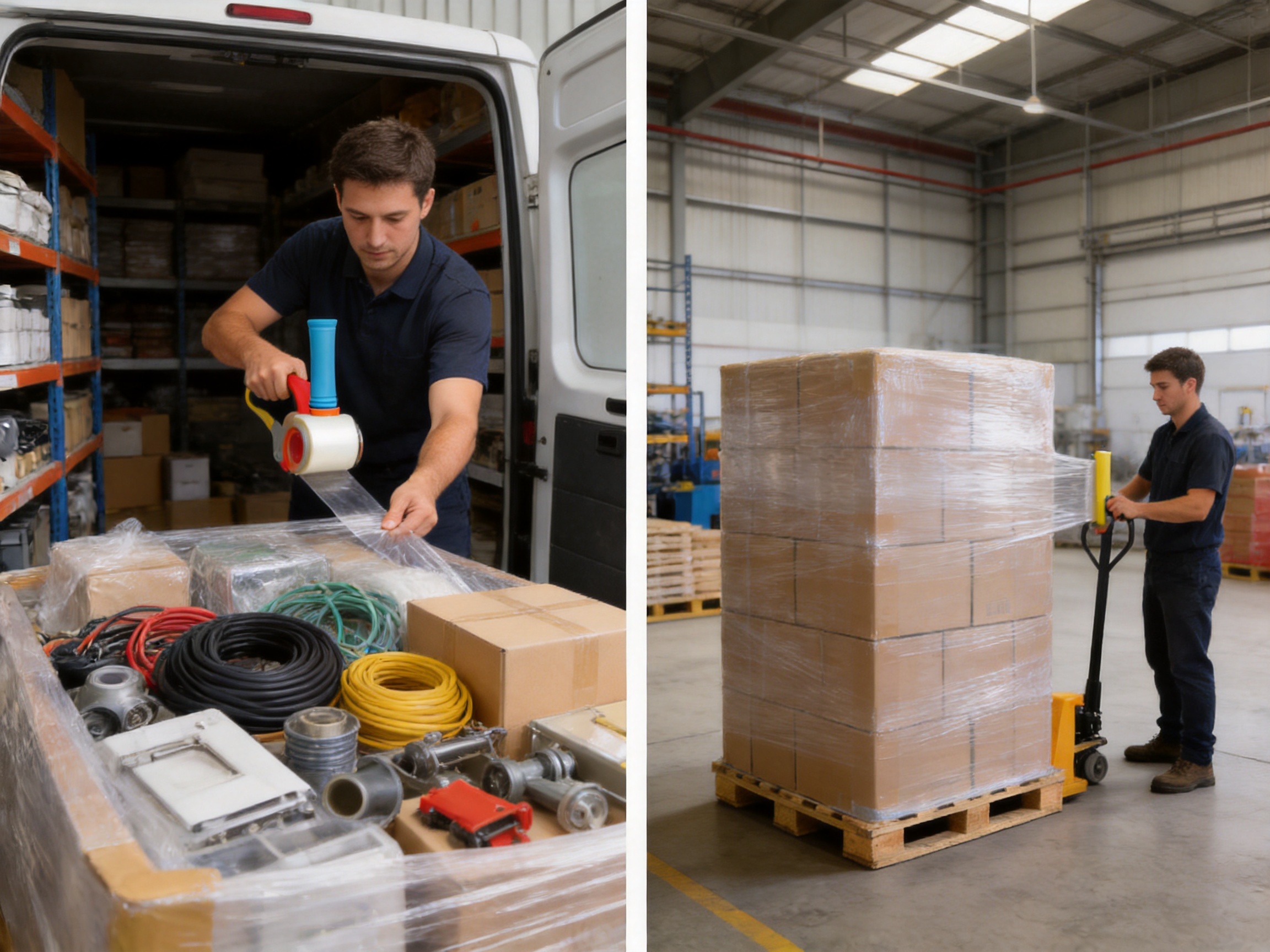
Vehicle compartments can contain narrow aisles, side walls, wheel arches, tie-down equipment, and other obstructions. A long-handled dispenser may be difficult to rotate inside the available space. The short handle enables the operator to work closer to the load and make compact turns.
It can be used for securing irregular parcels, protecting grouped items, or applying additional film after a load has been repositioned. Operators should always ensure that the vehicle is stationary, the working area is adequately lit, and no part of the tool or film interferes with vehicle doors, safety equipment, or load-restraint systems.
Wires, Cables, and Rubber Hoses
Wires, cables, and rubber hoses are often flexible, coiled, or bundled. Without suitable containment, they can unwind, separate, or become difficult to handle. Stretch film can provide temporary bundling and surface protection, particularly when the film is applied evenly around the group.
The short handle is useful when wrapping a bundle that has a small diameter or an uneven contour. The operator can control the film around the ends and along the curved body without needing the large sweeping motion associated with a pallet applicator.
Steel Pipes, Wire Rods, and Hardware Fittings
Metal products may have smooth surfaces, sharp edges, or irregular bundles. Stretch film can help hold grouping materials in position and provide a layer of protection against dirt and light surface contact. Edge protection should be considered where sharp corners could puncture the film.
For hardware fittings and small metal components, the short handle is suitable for wrapping cartons, trays, or consolidated groups. Its compact format can help operators work efficiently at a packing bench where products are handled individually rather than on pallets.
Machinery, Furniture, and Building Materials
Machinery and furniture often combine large surfaces with protrusions, legs, handles, brackets, and recesses. The short handle can be used for targeted wrapping around these complex profiles, especially after foam or other protective materials have been positioned.
Building and decorative materials may include trim, panels, mouldings, fittings, or mixed bundles. The tool can help secure these items for internal movement or short-distance transport. The selected film thickness should reflect the weight, surface texture, and risk of abrasion associated with the packaged material.
Ceramics and Daily Consumer Goods
Ceramic products require careful handling because their surfaces can be hard but brittle. Stretch film can help retain protective paper, foam, or carton components, but it should not be tightened to the point that it creates damaging pressure. The short handle gives the operator better control during this process.
For daily consumer goods, the tool may be used in retail back-of-house operations, store replenishment, returns processing, and small-order dispatch. It can help consolidate products quickly without requiring a full wrapping machine or a large packaging station.
Short Handle Versus Long Handle: Selecting the Right Tool
| Evaluation factor | Short-handle model | Conventional long-handle dispenser |
| Primary strength | Precision and close-range control | Reach and efficient pallet wrapping |
| Best working environment | Confined spaces, shelves, vehicle compartments, and benches | Open floors and accessible pallet sides |
| Suitable load profile | Small, irregular, mixed, or detailed items | Large, regular, and palletised loads |
| Movement style | Compact turns and fine adjustments | Broad movements around large loads |
| Operator priority | Tension control and positioning accuracy | Speed and wider coverage |
| Film compatibility | 3-inch or small-core film, 450–500 mm hand film options | Typically selected according to the dispenser’s own core and film specifications |
The table illustrates why the two designs should not be treated as direct substitutes. A long handle remains advantageous for wrapping a standard pallet rapidly from a comfortable distance. The short handle is more suitable when the operator must stay close to the product and negotiate a complex wrapping path.
Many packaging departments can benefit from maintaining both formats. A long-handled dispenser can be assigned to standard pallet operations, while the short-handled model can be kept at packing benches, storage aisles, vehicle-loading areas, or quality-control stations. This division allows operators to use the most appropriate tool for each task rather than forcing one design to cover every application.
Operating Principles for Better Results
Prepare the Product Before Wrapping
Before applying film, remove loose debris and check for sharp projections that could puncture the material. Where necessary, cover corners and edges with protective board, foam, paper, or other suitable materials. Confirm that detachable parts, cables, covers, and accessories are positioned correctly.
The short handle is designed to improve control, but it cannot compensate for an unstable or poorly prepared load. Product components should be arranged so that the film can support the group rather than attempting to hold loose pieces in place by tension alone.
Install the Correct Film Core
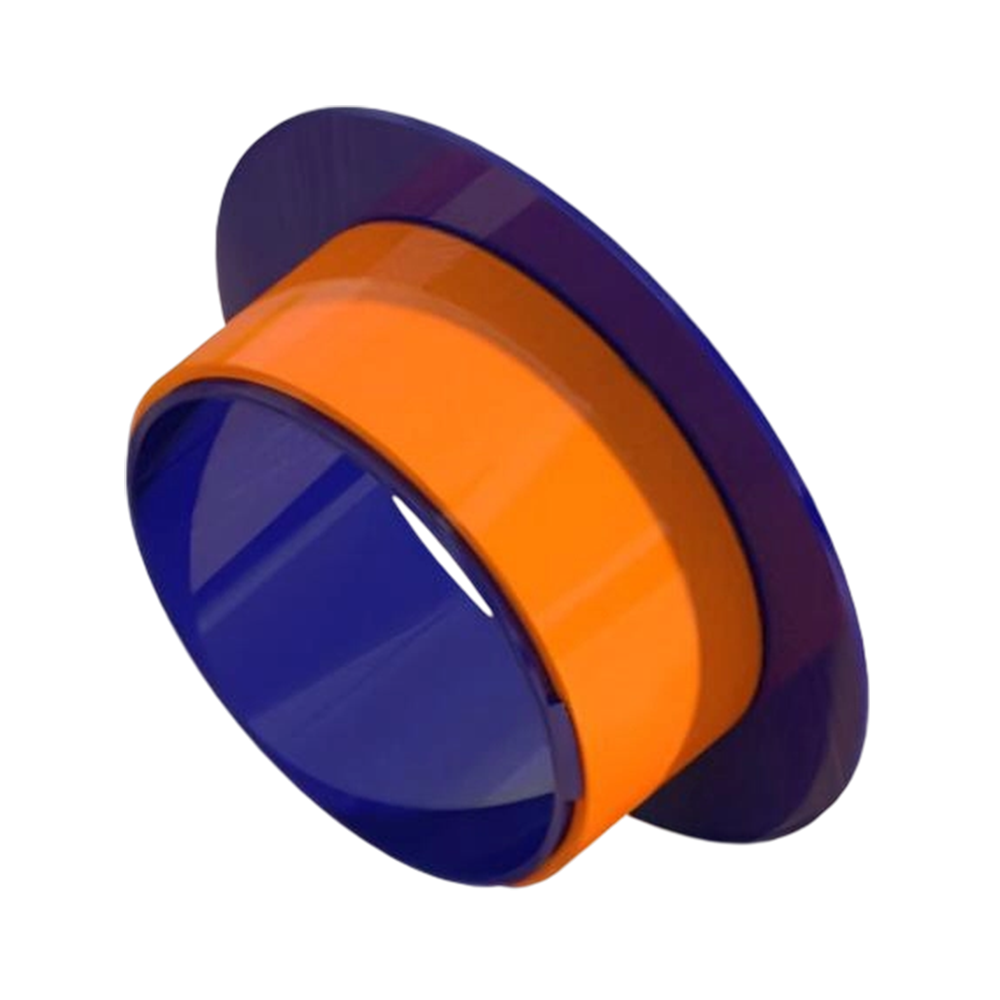
Check that the film roll has a compatible 3-inch or small-core paper core. The roll should sit securely on the handle and rotate smoothly. A core that is too large, too small, damaged, or poorly seated can affect film release and make tension control more difficult.
Before beginning a production run, operators should verify the film thickness and width. The listed product configurations include 10 cm-wide film in 0.015 mm and 0.02 mm thicknesses. Using a configuration that matches the load and application helps maintain consistent performance.
Maintain Controlled Tension
Start with moderate tension and observe how the film responds to the product surface. The objective is to create stable contact and suitable overlap without stretching the film excessively. Around delicate products, use a lower tension and rely on additional layers or protective materials when greater stability is needed.
On irregular products, adjust the angle of the handle gradually. Avoid abrupt pulling motions that may narrow the film, create edge stress, or cause the film to curl. The short handle makes these fine adjustments easier, but a steady pace remains important.
Use Consistent Overlap
Overlap is an important part of film coverage. Inconsistent overlap can leave weak sections, while excessive overlap may consume more film than necessary. Operators should establish a repeatable wrapping pattern appropriate to the product size and shape.
For items with corners and recesses, the overlap may need to be adjusted locally. The goal is not necessarily to apply the same movement everywhere, but to ensure that all important surfaces remain covered and that the film does not bridge open gaps in a way that leaves the load unsupported.
Finish and Inspect the Wrap
At the end of wrapping, secure the film according to the worksite’s standard procedure. Inspect the load for loose tails, exposed edges, open gaps, excessive pressure marks, or film damage. If a section is unsatisfactory, correct it before the product enters storage or transport.
A short-handled dispenser supports quality control because the operator can see the application area closely. This is particularly useful for products where presentation, surface protection, or precise containment is important.
Manufacturing Strengths and Quality Focus
The product is manufactured by Zhejiang Geruite Packaging Materials Co., Ltd., a packaging-materials company based in Zhejiang Province, China. The company operates in a region recognised for its developed manufacturing sector and established industrial supply chains. Its business covers the research, development, production, and sales of packaging materials and related products.
The company’s product range includes BOPP tapes, kraft paper tapes, masking tapes, high-temperature-resistant tapes, metal tapes, PE stretch film, PP strapping, and high-strength PET strapping. This wider product portfolio is relevant to the short-handle dispenser because it demonstrates experience across several packaging-material categories rather than reliance on a single product line.
Packaging tools perform best when they are considered together with the materials they dispense. Understanding film thickness, core dimensions, flexibility, and handling characteristics helps a manufacturer develop more practical combinations of film and applicator. A company involved in both film and packaging materials can use this broader product knowledge when planning compatible specifications.
Research and Product Development
The company states that it focuses on research and innovation in packaging materials. For a specialised product such as a short-handled film tool, development should consider more than basic handle shape. Important factors include the relationship between the handle and film core, the stability of the roll during rotation, operator grip, access in narrow areas, and compatibility with the intended film width.
Product development also involves identifying gaps in conventional packaging methods. The short handle responds to a specific market need: operators require a tool that provides closer control for small and irregular products while remaining simpler and more flexible than an automated system. This application-led approach helps distinguish the product from general-purpose dispensers.
Advanced Production Equipment
The company reports that it is equipped with advanced production equipment. Modern packaging manufacturing depends on equipment capable of maintaining repeatable dimensions, stable material processing, and consistent output. For film and packaging components, production accuracy can influence ease of use, roll performance, and final wrapping quality.
In the case of the short-handle product, manufacturing consistency is important for the handle body, core-supporting areas, and overall fit. A handle that is formed or assembled inconsistently may create unnecessary movement during application. Reliable production processes help ensure that the tool can be used in a repeatable manner across different batches.
Advanced equipment also supports production efficiency. Efficient processing can help the manufacturer serve different order quantities, manage multiple product specifications, and coordinate standard and customised requirements. This is valuable for distributors, importers, packaging wholesalers, and industrial customers seeking a stable supply of packaging products.
Multi-Stage Quality Control
The company describes a rigorous quality-control system covering raw-material procurement, production, and final inspection. This multi-stage approach is important because product quality is not determined at the final packing stage alone. The characteristics of incoming materials, the stability of production conditions, and the final assembly or inspection process all influence the finished product.
Raw-material control helps establish a consistent foundation for plastic components and film materials. During production, process monitoring can help identify dimensional variation, surface defects, or other issues before they become widespread. Final inspection provides an additional opportunity to verify the finished goods before shipment.
For customers, a structured quality system can reduce uncertainty when purchasing packaging products in volume. Consistent products are easier to introduce into standard operating procedures, easier to train operators on, and easier to reorder. Businesses can also discuss specific inspection requirements, sample approval, packaging standards, and customisation details with the supplier.
Integrated Packaging Product Capability
The company’s portfolio covers adhesive tapes, stretch film, strapping products, and related packaging materials. This breadth can be advantageous for customers that want to consolidate sourcing. A business may require stretch film tools for irregular products, BOPP tape for carton sealing, PP or PET strapping for heavier bundles, and protective film or bags for surface and dust protection.
Working with a supplier that understands several packaging categories can simplify product selection. It may also make it easier to develop a coordinated packaging programme in which different materials address different stages of storage, handling, and transport.
Production Scale and Supply Reliability
The company reports an annual output value of more than RMB 60 million. This figure indicates an established operating scale and provides context for its ability to serve a range of packaging-material customers. Output value alone does not determine product suitability, so buyers should still evaluate samples, specifications, quality requirements, lead times, and service arrangements.
For distributors and industrial purchasers, supply reliability is an important part of total product value. A short-handle dispenser may be a small item in relation to a complete packaging programme, but shortages can interrupt workstations and force operators to use less suitable tools. A manufacturer with multiple product categories and established production resources may be better positioned to support repeat orders and broader packaging needs.
Customisation and Purchasing Considerations
The plastic handle is available in a random colour and can be customised. Buyers considering customised handles should clarify minimum order quantities, colour specifications, logo or marking requirements, packaging formats, sampling procedures, and production lead times. Customisation may be useful for identifying tools assigned to different departments or for creating a consistent appearance across a distributor’s product range.
Film specifications should also be confirmed before purchase. The stated configurations include PE and LDPE film, two thickness options, a 10 cm width, and a 150 m length. Customers should confirm whether the order includes the film, the handle, or a combined set, because packaging programmes may require separate procurement of reusable handles and replacement film rolls.
Core compatibility is another essential consideration. The product is intended for 3-inch or small-core paper cores, while the compatible hand-wrapping film range is identified as 450–500 mm. Buyers should compare the actual film roll dimensions and core design with their existing inventory before placing a large order.
Sample testing is recommended for applications involving valuable, fragile, unusually shaped, or high-volume products. A trial can assess the operator’s comfort, film release, wrapping speed, tension control, overlap, and final package stability. It can also help determine which of the available film thicknesses is most appropriate.
Environmental and Operational Efficiency
Efficient packaging is not only about using less material. It is also about applying the right amount of material in a consistent way. A tool that improves tension control may help reduce unnecessary loose film, repeated passes, and rework. The actual result depends on operator training and process management, but close control is an important starting point.
The short-handle model can also support decentralised packaging. Instead of moving every irregular product to a central machine, workers may be able to complete suitable wrapping tasks at the point of storage, inspection, or dispatch. Fewer internal movements can save time and reduce handling steps, particularly in busy warehouses.
Users should establish procedures for film waste collection and recycling in accordance with local requirements. Clean polyethylene film may be accepted by some recycling systems, while contaminated or mixed-material packaging may require different treatment. The short handle itself can be reused with compatible replacement rolls, helping avoid the need to discard the tool after one film roll.
Workplace Safety and Good Practice
Operators should receive basic instruction before using the dispenser. Training should cover film loading, safe handling of the roll, correct wrapping tension, product-specific restrictions, and the method for cutting or securing the film. Workers should avoid wrapping around their hands, limbs, or any part of the body.
Sharp product edges should be protected before wrapping. The film can tear if it is pulled across an exposed point, and a torn film tail may create a trip or entanglement hazard. Work areas should be kept clear, particularly when wrapping products in narrow aisles or near vehicle-loading zones.
Operators should use suitable posture and avoid excessive twisting. The short handle is intended to reduce awkward torsional movement, but the user should still move around the product when possible rather than reaching beyond a comfortable range. If wrapping is performed for long periods, task rotation and regular breaks may help reduce repetitive strain.
The tool should be inspected periodically. Check the handle for cracks, deformation, loose components, or rough edges. Inspect the film roll for damage and ensure that it rotates correctly. Any tool that no longer provides stable control should be removed from service until it has been assessed or replaced.
How the Product Supports Different Business Models
Factories and Industrial Plants
Factories often package a mixture of finished goods, spare parts, components, and work-in-progress materials. Some products move on pallets, while others are transferred individually between production lines or storage locations. The short-handle dispenser is suited to the second category, where close-range wrapping can be performed quickly without setting up a large machine.
It may be used alongside strapping, cartons, edge protectors, bags, and adhesive tapes. Stretch film can hold protective layers in place, consolidate parts, or prepare goods for internal transfer. The tool’s compact size is also useful in production areas where floor space is allocated primarily to machinery.
Logistics and Warehousing Companies
Third-party logistics providers manage products with varying dimensions and packaging requirements. A standard pallet tool may be sufficient for some shipments but inconvenient for others. Keeping short-handled dispensers available allows operators to respond to exceptions such as damaged outer packaging, split cartons, mixed orders, and non-standard loads.
Because the product is designed for precision rather than maximum pallet speed, it can be assigned to rework stations and inspection areas. This creates a practical division of labour: automated or long-handle systems process standard loads, while short-handled tools resolve individual packaging issues.
E-Commerce Fulfilment Operations
E-commerce orders are often characterised by variety. A single shift may involve small cartons, soft goods, household products, accessories, tools, and irregular items. The short handle can be useful when several items need to be consolidated or when a product cannot be wrapped effectively with a broad, long-handled movement.
Retailers can also use the tool for returns processing. Returned goods may have damaged or missing outer packaging and may require temporary stabilisation before inspection, storage, or resale preparation. The short handle supports controlled wrapping without requiring each item to be moved to a pallet station.
Retail Back-of-House Departments
Retail stockrooms often have restricted space and changing inventory. Employees may need to secure seasonal displays, bundle products for transfer, or protect open cartons. The compact format makes the dispenser easy to keep near a receiving or dispatch area.
For small-batch use, a manual tool can be more practical than installing dedicated equipment. It can be used when needed and returned to storage after the task is complete. This flexibility is especially valuable for shops and smaller distribution centres with moderate packaging volumes.
Frequently Asked Questions
What is the main purpose of the Hand Stretch Film Short Handle?
Its main purpose is to provide close-range control when applying hand stretch film around small, irregular, or difficult-to-access products. It is designed for precision wrapping in spaces where a long-handled dispenser is difficult to manoeuvre.
Does the short-handle model replace a conventional stretch film applicator?
No. It is intended as a complementary tool. Long-handled dispensers generally prioritise reach and efficiency for standard pallets, while the short-handle model prioritises precision, access, and control for irregular or confined applications.
What film cores are compatible with the product?
The product is compatible with 3-inch or small-core paper cores. Buyers should confirm the exact core dimensions of their selected film roll before ordering.
What film sizes are listed for this product?
The listed configurations include PE and LDPE film measuring 0.015 mm × 10 cm × 150 m and 0.02 mm × 10 cm × 150 m. The compatible hand-wrapping film range is identified as 450–500 mm. Final specifications should be confirmed for each order.
Can the handle colour be customised?
Yes. The standard plastic handle colour is random, and customisation is available. Customers should discuss colour, marking, packaging, minimum order quantities, and other customisation conditions with the supplier.
Is this tool suitable for pallet wrapping?
It can be used for selected pallet-related tasks, especially targeted repairs, corner work, or re-wrapping in restricted areas. However, a long-handled applicator or machine is generally more efficient for wrapping large, regular pallets in an open workspace.
Which products are suitable for this dispenser?
Suitable applications include precision instruments, wires and cables, rubber hoses, steel pipes, wire rods, machinery, hardware fittings, furniture, building and decorative materials, non-woven fabrics, ceramics, daily consumer goods, and irregular e-commerce products.
Does the short handle reduce wrist fatigue?
Its compact design can reduce the torsional force associated with a longer lever arm and may make repetitive close-range wrapping more comfortable. Ergonomic results also depend on posture, film tension, workstation layout, and operator technique.
What should be checked before using the product?
Check the film core, roll condition, handle stability, film thickness, and product suitability. Protect sharp edges, organise loose components, and ensure that the wrapping area is clear and safe before beginning.
How can a buyer evaluate the product before purchasing in volume?
A buyer can request samples and test them on representative products. The evaluation should consider film release, tension control, operator comfort, wrap consistency, product protection, film consumption, and the final stability of the packaged item.
What manufacturing capabilities support this product?
The manufacturer reports advanced production equipment, a quality-control system covering raw materials, production, and final inspection, and experience in the development and manufacture of tapes, stretch film, strapping, and other packaging materials. These capabilities support consistent supply and coordinated packaging-material sourcing.
Conclusion
The Hand Stretch Film Short Handle addresses a practical limitation in conventional packaging equipment. A long handle is efficient when the operator has room to move around a large, regular load. It becomes less convenient when the packaging task involves narrow gaps, crowded shelves, vehicle compartments, delicate surfaces, or irregular shapes.
By bringing the control point closer to the film surface, the short-handle design supports more precise tension management and smaller movements. It can help operators wrap around edges, recesses, corners, and uneven profiles while reducing the need for broad manoeuvres. Its compact format may also reduce wrist torsion during repeated close-range tasks.
The product is compatible with 3-inch or small-core paper cores and listed 450–500 mm hand-wrapping film options, including PE and LDPE configurations measuring 0.015 mm × 10 cm × 150 m and 0.02 mm × 10 cm × 150 m. The random-colour plastic handle can also be customised for selected customer requirements.
Its applications extend across industrial manufacturing, logistics, warehousing, e-commerce, retail, furniture, machinery, cables, hoses, hardware, ceramics, building materials, and consumer goods. The strongest value appears when the load is irregular or the working area is restricted and when controlled wrapping is more important than maximum pallet throughput.
Supported by a manufacturer with broad packaging-material expertise, advanced production equipment, multi-stage quality control, and an established product portfolio, the short-handle tool is a practical addition to professional packaging operations. Used alongside long-handled dispensers, stretch film, adhesive tapes, strapping, and protective materials, it helps create a more flexible and application-specific packaging system.
References
1. Product specification sheet for Hand Stretch Film Short Handle, including material, dimensions, compatibility, and application information.
2. Internal product description concerning short-handle control, confined-space operation, wrist comfort, and precision wrapping.
3. General packaging engineering principles for stretch film tension, overlap, load stabilisation, and edge protection.
4. Manufacturer company information concerning packaging-material research, production capabilities, quality control, and product categories.
5. General occupational guidance on repetitive manual handling, ergonomic workstation design, and safe use of packaging tools.
Product: Hand Stretch Film Short Handle

LATEST POST
Let’s create something amazing together
contact us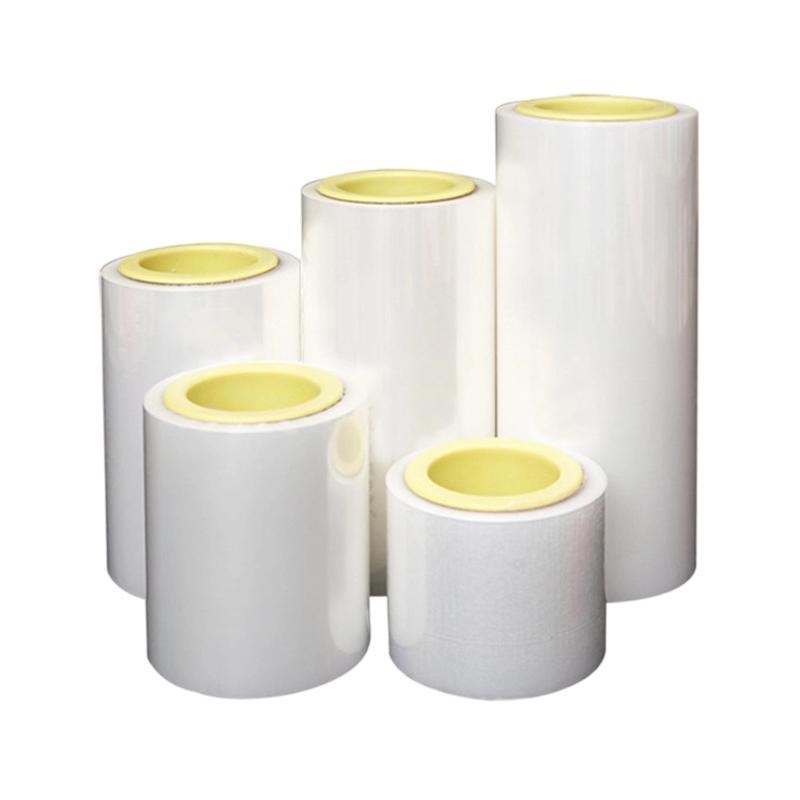
CONTACT DETAILS
- Address:No. 241, Yaojiafan, Zhangpanqiao, Shushan Street, Xiaoshan District, Hangzhou City, Zhejiang Province, China
- TEL:+86-0571-83175630
- Phone:+86-13336160217
- Email:jeffrey@grtpk.com
- WeChat/WhatsApp:+86-18058115265
PRODUCTS
NEWS CENTER
MOBILE TERMINAL
Copyright© Zhejiang Geruite Packaging Materials Co., Ltd. All Rights Reserved.
Privacy Wholesale industrial packaging tape Manufacturers