


 English
 Español
 عربى

PET High-Temperature Tape for Reliable Industrial Masking, Protection, and Packaging
Content
- 1 What Is PET High-Temperature Tape?
- 2 Key Product Specifications
- 3 Advantages of the PET Film Backing
- 4 Temperature Resistance for Industrial Processes
- 5 Applications Across Manufacturing and Packaging
- 6 How It Compares with General-Purpose Packaging Tape
- 7 Advantages over Competing Polyester Tape Options
- 8 Manufacturing Strengths and Quality Control
- 9 Production Process from Film to Finished Roll
- 10 Customization for Different Buyers
- 11 Correct Application Practices
- 12 Storage and Handling Recommendations
- 13 Why Supplier Capability Matters
- 14 Environmental and Efficiency Considerations
- 15 Quality, Reliability, and Total Cost
- 16 Selection Guide for Buyers
- 17 Recommended Uses by Tape Width
- 18 Frequently Asked Questions
- 18.1 What is the main material used in this tape?
- 18.2 What temperature can the tape withstand?
- 18.3 What colors are available?
- 18.4 What widths can be supplied?
- 18.5 What lengths are available?
- 18.6 Can the tape be used for carton sealing?
- 18.7 Is it suitable for electronic applications?
- 18.8 Can it be used on painted or coated surfaces?
- 18.9 Can the supplier provide customized products?
- 18.10 What makes PET tape different from ordinary plastic tape?
- 18.11 How should the tape be stored?
- 18.12 Who can provide additional product information?
- 19 Conclusion
- 20 References
- 21 Product: PET High-Temperature Tape
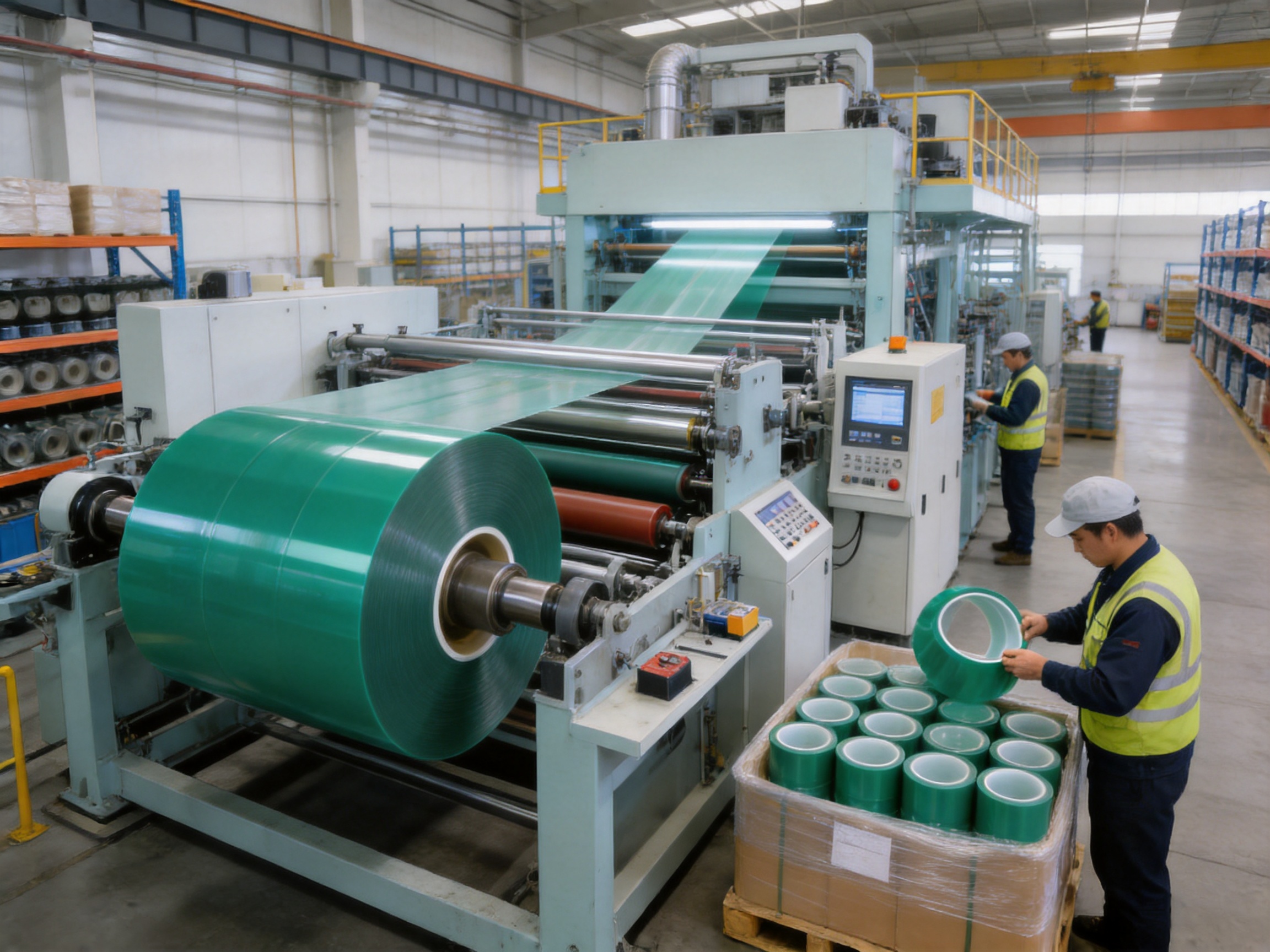
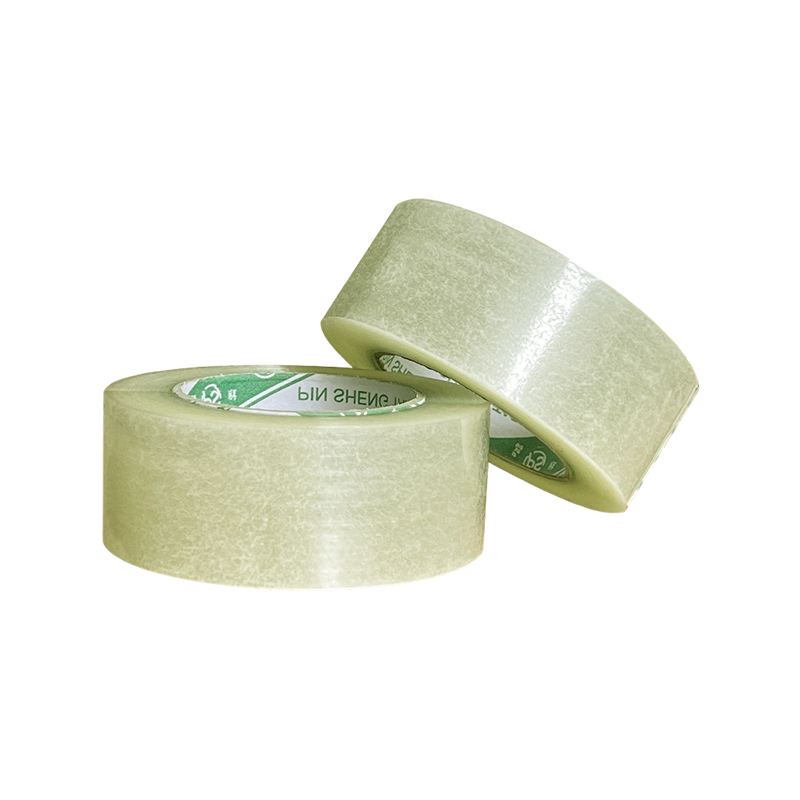
PET high-temperature tape is a specialized adhesive tape designed for applications that require dimensional stability, clean handling, dependable adhesion, and resistance to elevated temperatures. Made with a thermoplastic polyester, commonly known as PET or Mylar, this tape combines a strong and flexible film backing with a practical temperature resistance of up to 120°C. Its performance makes it suitable for industrial masking, component protection, bundling, labeling, insulation support, surface protection, and a variety of packaging-related operations.
In modern manufacturing, ordinary packaging tape is often unable to meet the requirements of heat-sensitive production environments. Standard films may soften, shrink, curl, leave residue, or lose their holding strength when exposed to heat. PET high-temperature tape is developed for situations in which a tape must remain stable and functional while exposed to moderate elevated temperatures. It provides a more controlled and dependable solution for manufacturers that need consistent results across repeated production cycles.
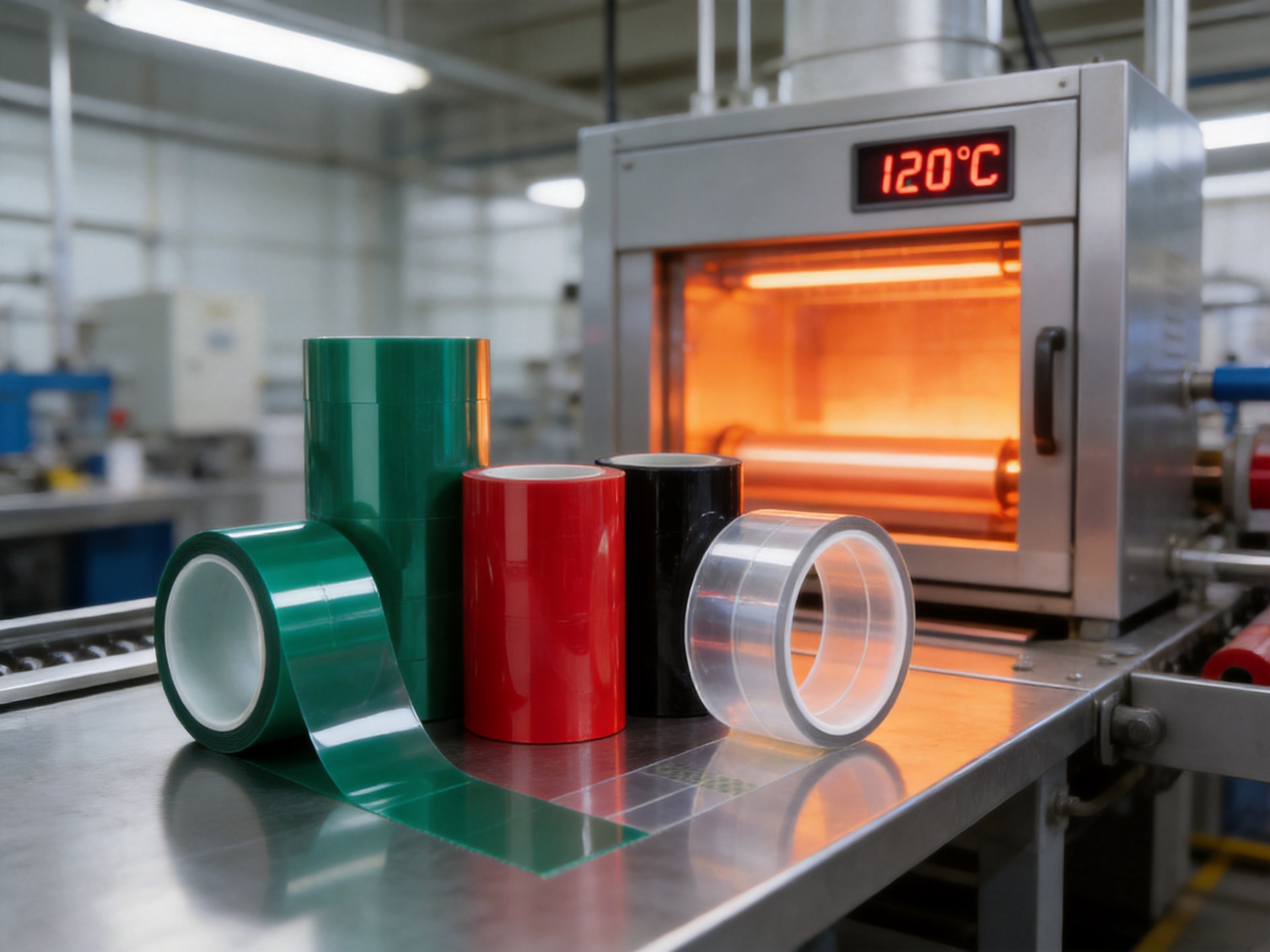
The product is available in green, red, black, and clear. Widths can range from 5 mm to 500 mm, with custom widths available for specific production needs. Standard length options range from 33 m to 66 m. This combination of material stability, color choice, dimensional flexibility, and industrial usability allows buyers to select a format that matches their equipment, process, and application requirements.
Manufactured by Zhejiang Geruite Packaging Materials Co., Ltd., the tape is part of a wider portfolio of packaging and adhesive materials. The company’s experience includes BOPP tape, kraft paper tape, masking tape, high-temperature-resistant tape, metal tape, PE stretch film, PP strapping, and high-strength PET strapping. This broad product background supports a practical understanding of packaging operations and helps the company serve customers looking for coordinated material solutions.
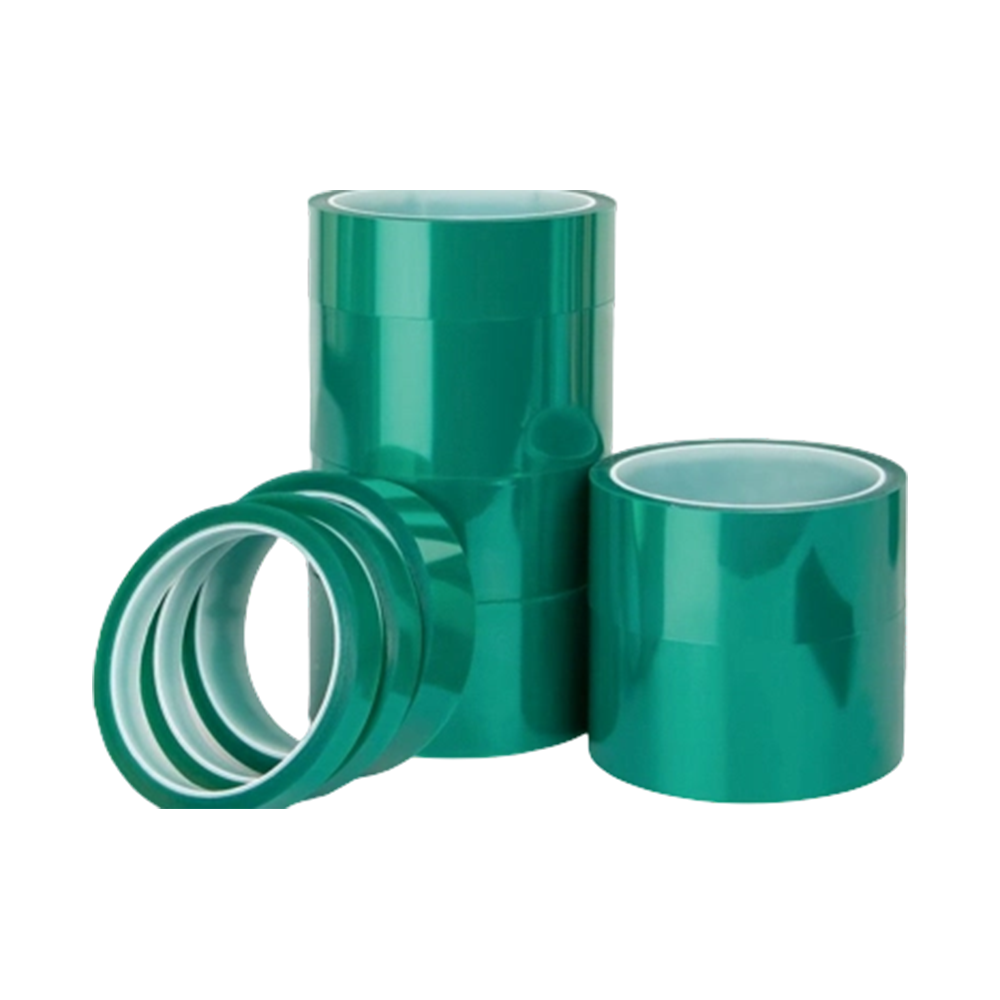
PET High-Temperature Tape
What Is PET High-Temperature Tape?
PET high-temperature tape uses thermoplastic polyester as its base material. PET is a strong polymer film valued for its tensile strength, dimensional stability, resistance to deformation, and smooth surface. When converted into adhesive tape, it creates a thin yet durable product that can be applied to surfaces, components, packages, and production fixtures where ordinary film tape may not perform adequately.
The term “high-temperature” refers to the tape’s ability to withstand temperatures of up to 120°C under suitable application conditions. Actual performance can depend on exposure time, surface type, pressure, load, humidity, chemical contact, and the adhesive system used. Therefore, buyers should evaluate the tape under their own process conditions before adopting it for critical applications. Nevertheless, the stated temperature resistance provides a useful performance range for many industrial, electronic, manufacturing, and packaging processes.
PET tape is often selected because the polyester backing offers a balance between strength and flexibility. It can conform to many surfaces without behaving like a soft, easily stretched plastic film. Its relatively stable structure helps reduce unwanted elongation and makes it suitable for applications where neat edges, stable dimensions, and clean removal or handling are important.
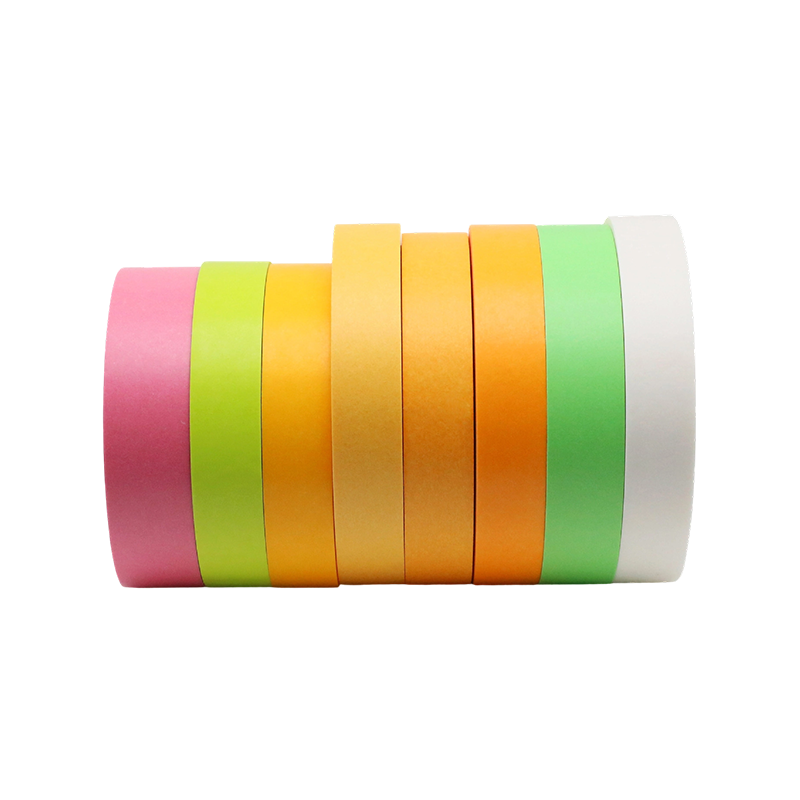
The tape’s color range also provides functional value. Green, red, black, and clear versions can be used for process identification, visual organization, product differentiation, masking recognition, or aesthetic requirements. Clear tape is useful when visibility of the underlying surface is desired. Colored tape can support production control by distinguishing process stages, material categories, or application areas.
Key Product Specifications
| Item | Details | Practical Significance |
|---|---|---|
| Base material | Thermoplastic Polyester (PET) | Provides a strong, stable, and durable film backing |
| Available colors | Green, red, black, and clear | Supports identification, masking, organization, and visual control |
| Temperature resistance | Up to 120°C | Suitable for many moderate-temperature industrial processes |
| Width range | 5 mm to 500 mm | Accommodates narrow strip applications and broad surface coverage |
| Custom widths | Available according to requirements | Allows compatibility with specialized tools, fixtures, and production lines |
| Length range | 33 m to 66 m | Provides options for different usage frequencies and dispensing systems |
| Product category | Mylar tape | Positions the product within the industrial polyester film tape segment |
The specifications show that the tape is designed for more than one narrow application. A 5 mm width may be appropriate for fine-line separation, small component support, edge masking, or narrow bundling. Wider formats up to 500 mm can be used for larger coverage requirements, surface protection, or customized industrial processes. Custom widths help reduce waste when a standard roll does not match the actual working width of the customer’s equipment.
The 33 m to 66 m length range provides flexibility for both regular and higher-volume operations. Shorter rolls may be suitable for workstations, maintenance tasks, sampling, or applications with frequent product changes. Longer rolls can reduce interruptions and support continuous production. The correct roll length depends on the application, dispensing equipment, operator workflow, and expected consumption rate.
Advantages of the PET Film Backing
Dimensional Stability
One of the primary advantages of PET backing is its dimensional stability. During use, a tape may be pulled, pressed, wrapped, cut, or exposed to heat. A backing that stretches excessively can create uneven application, inaccurate coverage, or inconsistent tension. PET film generally maintains its shape more effectively than many softer and less stable plastic films, helping users achieve cleaner and more repeatable results.
Dimensional stability is especially important for masking and process protection. If a tape edge moves or contracts during heating, the protected area may no longer remain fully covered. This can lead to unwanted exposure, overspray, contamination, or irregular finishing. A stable polyester backing helps preserve the intended tape position during the working process.
Strength and Handling Performance
PET tape is also valued for its balance of thinness and strength. A strong backing can make a roll easier to unwind, cut, apply, and remove without excessive tearing. It can support temporary holding and light bundling while reducing the risk of accidental breakage during manual handling.
For industrial users, reliable handling can improve productivity. Operators spend less time correcting torn sections, replacing damaged tape, or cleaning fragments from production areas. A tape that handles consistently also contributes to more predictable consumption, which can simplify purchasing and inventory control.
Clean and Controlled Application
The smooth polyester surface supports neat application on many suitable surfaces. When applied with appropriate pressure, the tape can create a defined barrier or holding line. This is useful when the visual appearance of the finished product matters or when a process requires a clear boundary between protected and exposed areas.
In addition, the relatively stable film can be easier to position than a highly elastic tape. Operators can place it along a straight edge, around a component, or across a surface without the material changing shape excessively during application.
Temperature Resistance for Industrial Processes
Many production environments involve heat, whether from ovens, heated fixtures, drying systems, thermal processing, electrical work, or nearby equipment. Tape used in these areas must retain its basic function long enough to complete the process. PET high-temperature tape is designed to provide performance up to 120°C, making it suitable for a range of moderate-temperature applications.
Temperature resistance can offer several practical benefits. First, it may reduce the risk of film shrinkage or distortion during heating. Second, it can help maintain the position of a masked or protected area. Third, it can reduce the likelihood that the tape will soften prematurely and interfere with production. Finally, it can help manufacturers standardize material selection for processes that exceed the limits of ordinary packaging tape.
Temperature ratings should always be interpreted in relation to actual conditions. A short exposure at 120°C may produce a different result from continuous exposure at the same temperature. Contact with oils, solvents, plasticizers, rough surfaces, or sharp edges may also affect performance. For this reason, users should test the product with the exact substrate, dwell time, pressure, and environmental conditions required in their process.
Even with this qualification, a stated resistance of up to 120°C places the product above many general-purpose tapes intended only for room-temperature packaging. It is a practical choice when a standard BOPP or ordinary plastic tape cannot provide sufficient thermal stability.
Applications Across Manufacturing and Packaging
Industrial Masking
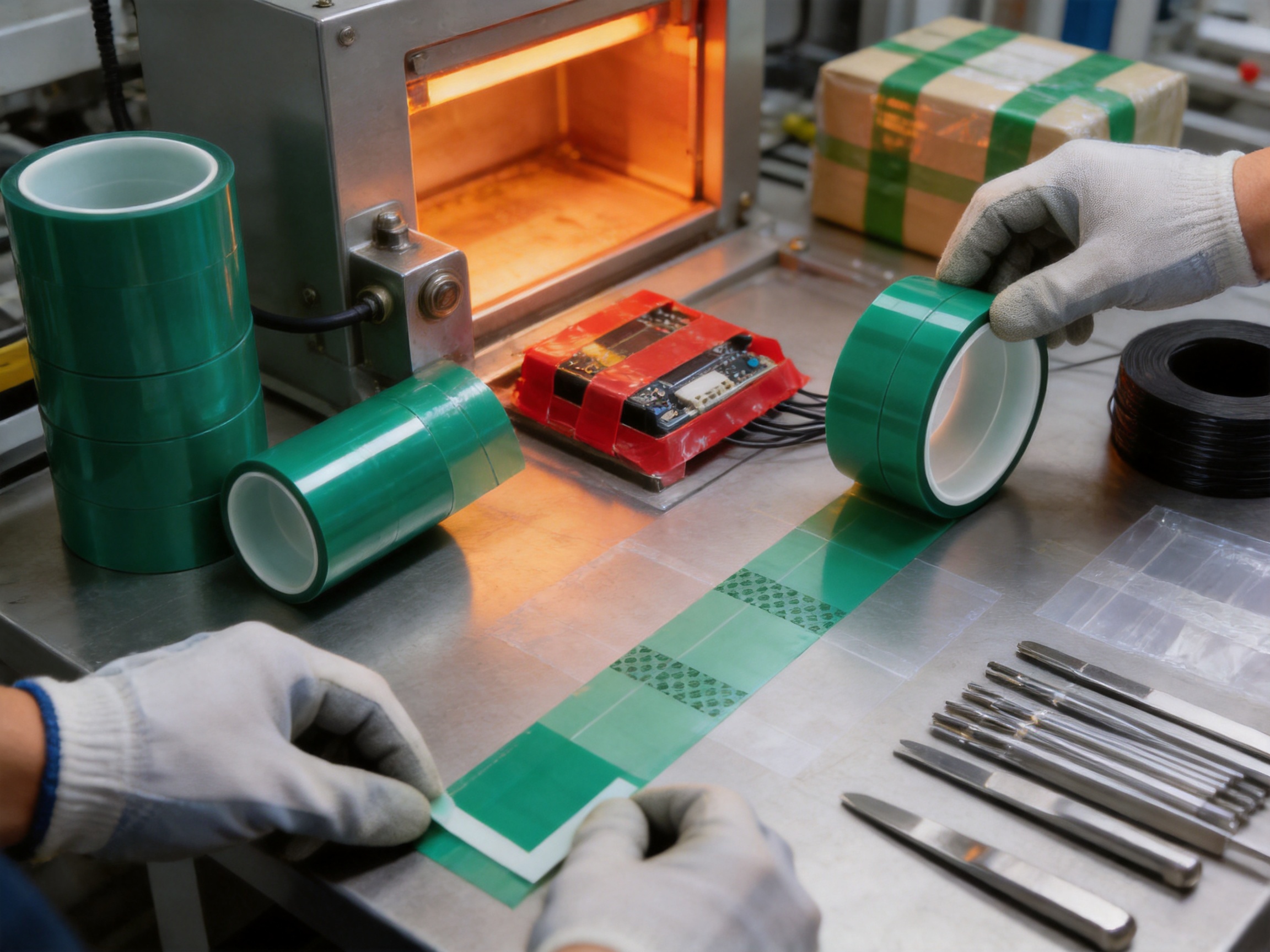
PET high-temperature tape can be used to mask selected areas during painting, coating, finishing, heating, or surface treatment. The tape creates a temporary barrier that helps define where a material should or should not be applied. Its stable polyester backing can support clean lines and controlled coverage when the tape is applied to a properly prepared surface.
Colored versions can be useful in masking operations that use multiple process stages. For example, one color may identify a first masking step while another color identifies a later inspection or rework stage. Clear tape can be selected when the operator needs to see the underlying surface or reference mark.
Electronics and Component Protection
Electronic manufacturing often requires temporary holding, separation, insulation support, surface protection, and controlled handling. PET film tape can be useful in these areas because it is thin, stable, and available in narrow widths. It may be used to hold wires or small components in place, protect surfaces during processing, or create a temporary barrier around selected areas.
Application suitability depends on the electrical, thermal, and chemical requirements of the specific assembly. The tape should not be treated as a universal electrical insulation product unless the required electrical properties have been independently confirmed. However, as a general industrial polyester film tape, it can offer useful support for many non-critical electronic assembly and protection tasks.
Coil, Cable, and Wire Management
Narrow PET tape can support temporary organization of wires, cable groups, coils, and small parts. The tape can help keep items together during transportation, assembly, or intermediate storage. Its color options make it possible to distinguish cable groups or identify work stages without relying only on printed labels.
When used for bundling, the tape should be selected according to the weight, surface texture, tension, and duration of the application. For heavy-duty permanent strapping, dedicated PP or PET strapping is generally more appropriate. PET tape is most useful when the requirement involves light holding, organization, protection, or process support rather than primary load restraint.
Surface Protection
During manufacturing and transport, finished surfaces can be exposed to dust, scratches, abrasion, or contact with adjacent materials. PET tape may be used to protect small sections, edges, seams, or vulnerable areas. Clear tape can preserve visibility, while colored tape can make the protected section easy to identify during inspection.
Before applying tape to a finished surface, users should confirm compatibility. Some coatings, plastics, painted surfaces, and sensitive finishes can react differently to adhesive products. A small-area test can help verify that the tape does not cause staining, lifting, transfer, or surface damage after removal.
Packaging and Shipping Preparation
Although PET high-temperature tape is more specialized than ordinary carton-sealing tape, it can support packaging preparation in areas where temperature stability or stronger film performance is needed. It may be used to secure protective materials, hold internal components, mark packages, or protect selected sections during storage and handling.
In a complete packaging system, PET tape can work alongside stretch film, strapping, kraft paper tape, BOPP tape, edge protection, and protective bags. Each material performs a different function. Stretch film stabilizes palletized goods, strapping provides load restraint, and tape can assist with sealing, marking, temporary holding, or localized protection.
Construction and Decoration
Construction, renovation, and decoration work frequently require temporary masking and surface protection. PET tape can be considered for applications where a stable, clean, and heat-resistant film is preferred. It may help protect edges, organize materials, or define working zones during selected processes.
The correct product choice depends on the substrate and the expected removal period. For delicate painted walls or specialty finishes, a tape specifically developed for low-tack masking may be more suitable. PET high-temperature tape is best evaluated where its strength, film stability, and temperature resistance provide a clear advantage.
How It Compares with General-Purpose Packaging Tape
General-purpose packaging tape is typically optimized for carton sealing at normal temperatures. It is economical and effective for many shipping applications, but it may not be designed for controlled masking, heat exposure, or dimensionally demanding production work. When exposed to elevated temperatures, some general packaging tapes can soften, lose adhesion, shrink, or leave adhesive residue.
PET high-temperature tape offers a more specialized construction. Its polyester backing provides greater stability than a basic film used for routine box sealing. This can improve performance when a tape must stay in place during a heated process or maintain a defined edge during application.
The products also differ in intended use. General packaging tape is commonly selected for closing cartons and securing parcels. PET high-temperature tape is more appropriate for production support, masking, component protection, process identification, and applications requiring a stronger and more stable film backing.
| Comparison factor | General-purpose packaging tape | PET high-temperature tape |
|---|---|---|
| Primary purpose | Carton sealing and routine packaging | Industrial masking, protection, holding, and process support |
| Backing stability | Suitable for ordinary handling conditions | Designed around stable polyester film performance |
| Heat exposure | May be limited depending on construction | Rated up to 120°C under suitable conditions |
| Width flexibility | Often supplied in common standard sizes | Available from 5 mm to 500 mm, with custom widths |
| Color selection | Often limited to clear or standard colors | Green, red, black, and clear options |
| Industrial customization | Usually focused on standard packaging formats | Can be adapted through width and roll-length selection |
This comparison does not mean that PET tape should replace every other tape. Instead, it demonstrates the importance of matching the product to the process. Choosing a specialized material for a specialized task can reduce failures, rework, and unnecessary material consumption.
Advantages over Competing Polyester Tape Options
In the industrial tape market, buyers may compare several polyester-based products with similar appearances. The key differences may involve temperature resistance, width availability, color selection, roll length, quality consistency, supply capability, and service responsiveness.
A notable advantage of this PET high-temperature tape is its broad width range. Many suppliers focus on a limited group of standard narrow widths. The availability of sizes from 5 mm to 500 mm gives buyers more freedom to specify the actual coverage required. Custom widths can also help manufacturers reduce overlapping, trimming, and waste.
The four-color selection is another practical advantage. Green, red, black, and clear versions allow the tape to serve both technical and organizational purposes. In a factory environment, visual differentiation can help operators identify materials quickly and reduce confusion between similar work orders.
The product’s temperature resistance of up to 120°C also provides a clear benefit in moderate-temperature applications. Buyers do not need to rely solely on general-purpose tape when a process includes heating. At the same time, the product remains more accessible for ordinary industrial use than specialized tapes designed for much higher temperatures.
Supply flexibility is also important. A supplier that produces several kinds of packaging tape, film, and strapping can help customers coordinate different materials. This may simplify procurement and support more consistent packaging standards across departments or facilities.
Manufacturing Strengths and Quality Control
Zhejiang Geruite Packaging Materials Co., Ltd. is based in Hangzhou, Zhejiang Province, China, an area with a strong manufacturing base and an established packaging industry. The company focuses on the research, development, production, and sales of packaging materials and adhesive products.
The company’s stated manufacturing approach emphasizes quality control from raw material procurement through production and final inspection. This full-process perspective is important for adhesive tape because performance depends on multiple factors. Film quality, adhesive uniformity, coating control, slitting accuracy, winding tension, roll formation, packaging, and storage conditions can all affect the final product.
Raw material selection is the first stage of product consistency. A stable PET film helps provide predictable thickness, strength, and dimensional behavior. Adhesive materials must also be managed carefully to support reliable coating and bonding performance. Incoming materials should be evaluated according to internal specifications before being released for production.
During coating and converting, accurate process control helps maintain consistent adhesive distribution and roll quality. If coating is uneven, the tape may show variation in adhesion, unwinding, or application. If slitting is inaccurate, the roll may have irregular edges or inconsistent width. Careful winding helps reduce telescoping, wrinkles, loose edges, and other defects that can interfere with dispensing.
Final inspection provides an additional safeguard. Depending on the product specification, inspection may include visual checks, width measurement, length verification, roll appearance evaluation, adhesion testing, and temperature-related performance assessment. The exact test method should be matched to the intended application and customer requirements.
The company reports an annual output value of more than RMB 60 million, indicating an established operating scale and an active presence in the packaging materials sector. Manufacturing scale can support production planning, product availability, and the ability to serve both standard and customized orders. At the same time, scale must be supported by disciplined quality management to ensure that higher output does not compromise product consistency.
Production Process from Film to Finished Roll
Material Preparation
Production begins with the preparation and verification of PET film, adhesive components, cores, packaging materials, and other necessary inputs. Material selection should consider the intended tape width, roll length, temperature requirement, and application environment.
Adhesive Coating
The adhesive is applied to the PET backing in a controlled coating operation. Uniform coating is essential because variations can affect bonding, release, unwinding, residue, and overall application quality. Process parameters must be monitored so that the adhesive layer remains within the required specification.
Drying or Curing
After coating, the adhesive layer may require drying, curing, or other stabilization steps, depending on the adhesive system. This stage helps establish the intended balance of tack, holding power, and processing stability. Proper control can reduce defects such as bubbles, uneven surfaces, incomplete stabilization, or inconsistent adhesion.
Slitting and Rewinding
Large coated rolls are converted into finished widths through slitting and rewinding. This is a critical stage for a product offered in widths from 5 mm to 500 mm. Narrow rolls require precise cutting and tension management. Poor control may lead to uneven edges, telescoping, wrinkles, or loose winding.
Inspection and Packaging
Finished rolls are inspected and packed for storage or shipment. Packaging must protect the tape from dust, moisture, deformation, and unnecessary heat during transportation. Proper identification of color, width, length, and production details also supports warehouse management and customer traceability.
A manufacturing system organized around these stages helps create repeatable products. It also enables a supplier to identify where a problem occurred if a customer reports an issue. Traceable production and inspection records can support corrective action and continuous improvement.
Customization for Different Buyers
Industrial users rarely have exactly the same requirements. One customer may need a 5 mm strip for narrow component protection, while another may require a wide roll for covering broad surfaces. Some buyers may prefer clear tape for visibility, while others may need red or green tape for production identification.
Custom width availability is therefore an important commercial and technical advantage. It allows customers to select a roll that fits their machinery, dispenser, application tool, or workpiece. In some cases, a customized width can reduce manual trimming and improve operator efficiency.
Customers should provide relevant information when requesting a specification. Useful details include the application surface, operating temperature, exposure duration, required width, preferred color, roll length, expected holding period, removal requirements, and packaging format. If the tape will contact coatings, plastics, metals, or electronic components, sample testing is recommended.
Customized products should be confirmed through technical communication before mass production. A sample or trial order can help verify the balance between film strength, adhesive behavior, temperature resistance, and ease of application. This process protects both the buyer and the manufacturer by ensuring that the final specification reflects real operating conditions.
Correct Application Practices
Good tape performance depends not only on product quality but also on application technique. The surface should be clean, dry, and free from dust, grease, oil, loose particles, and moisture. Contamination can reduce contact between the adhesive and substrate and may lead to lifting or premature failure.
The tape should be applied with steady pressure. Pressing the tape firmly onto the surface helps remove small air gaps and improves contact. For long strips, applying the tape gradually rather than dropping it onto the surface all at once can reduce wrinkles and alignment errors.
Excessive stretching should be avoided unless the application specifically requires controlled tension. Stretching the backing during installation may cause the tape to pull back, lift at the edges, or change the intended coverage after application.
When using the tape in a heated process, users should verify both the temperature and the exposure time. The product is rated up to 120°C, but performance may vary with the exact conditions. Testing on the real surface and under the real heating cycle is the safest approach.
For removal, the user should consider the dwell time, surface type, temperature, and removal angle. Slow, controlled removal is generally preferable to sudden pulling, particularly on delicate or coated surfaces. Any residue or surface effect should be evaluated during a preliminary trial.
Storage and Handling Recommendations
Adhesive tape should be stored in a clean, dry environment away from direct sunlight, excessive heat, and high humidity. Rolls should remain in their original packaging until needed. They should be protected from crushing, sharp impact, and prolonged contact with contaminated surfaces.
Storage conditions can influence adhesive performance and roll appearance. Extreme temperatures may affect tack, unwinding, and shelf stability. Storing rolls upright or in the orientation recommended by the supplier can help prevent deformation, especially for wider or heavier rolls.
Before use, the tape should be inspected for damaged packaging, crushed edges, moisture exposure, or unusual surface changes. If a roll has been stored for an extended period, a small application test can confirm that it remains suitable for the intended process.
Why Supplier Capability Matters
When purchasing industrial tape, product specifications are important, but supplier capability is equally significant. A supplier with experience in multiple packaging materials may understand how tape interacts with stretch film, strapping, protective bags, and shipping systems. This broader perspective can help customers design more efficient packaging workflows.
Zhejiang Geruite Packaging Materials Co., Ltd. offers a product range covering adhesive tapes, stretch film, strapping, and related packaging materials. This portfolio supports customers that prefer to source several packaging components from one experienced manufacturer. It may also simplify communication regarding sizes, packaging formats, production schedules, and quality expectations.
The company’s focus on research and innovation provides a foundation for improving products as customer requirements change. Packaging markets increasingly demand lower material waste, better process efficiency, improved load security, and more specialized performance. A manufacturer that continues to optimize its product structure can respond more effectively to these needs.
Service is another part of supplier value. Responsive communication, clear technical confirmation, accurate quotation, sample support, and dependable order coordination can reduce procurement risk. For customized PET tape, these services are particularly important because the correct width, length, color, and application performance must be confirmed before production.
Environmental and Efficiency Considerations
Industrial packaging decisions increasingly include questions about material efficiency and waste reduction. PET high-temperature tape can contribute to more efficient production when its dimensional stability and customized width reduce rework, trimming, or unnecessary overlap.
Using the correct width is one of the simplest ways to reduce waste. A tape that is too narrow may require multiple strips, while a tape that is too wide may create excess offcut material. Custom widths allow the customer to match the product more closely to the working area.
Material efficiency also depends on correct application. Poor alignment, repeated removal and replacement, or premature failure can increase consumption. Operator training and clear work instructions can help the tape achieve its intended performance and reduce avoidable waste.
At the end of its service life, disposal should follow local waste-management requirements. The tape may combine PET film, adhesive, and a core, so recycling options can depend on local facilities and material separation practices. Buyers seeking specific environmental documentation should request the applicable technical and compliance information from the supplier.
Quality, Reliability, and Total Cost
The purchase price of a tape roll is only one part of its total cost. A low-cost product that fails during a process can create labor expenses, production delays, surface damage, rework, and material loss. A more suitable PET high-temperature tape may offer better value if it improves process reliability.
Stable width, consistent winding, predictable adhesion, and suitable temperature resistance can all contribute to lower operating costs. Operators may spend less time correcting tape failures, and production lines may experience fewer interruptions. In high-volume manufacturing, small improvements in process consistency can produce meaningful savings over time.
Quality also supports standardization. When the same tape performs consistently from roll to roll, work instructions become easier to maintain, training becomes simpler, and quality inspections can be more predictable. This is especially valuable for factories operating multiple lines or supplying customers with strict appearance and process requirements.
Selection Guide for Buyers
Before ordering PET high-temperature tape, buyers should define the application rather than selecting a product based only on appearance or price. The following questions can help establish the correct specification.
- What surface will the tape contact?
- What temperature will the tape experience?
- How long will the tape remain in place?
- Will the tape be removed while the surface is warm or cool?
- Is the tape being used for masking, protection, holding, marking, or packaging?
- What width provides the best coverage with the least waste?
- Is a clear or colored tape more suitable for the process?
- What roll length fits the dispenser and expected consumption?
- Is custom slitting required?
- Are there special requirements related to residue, appearance, chemicals, or electrical performance?
Clear answers to these questions help the supplier recommend an appropriate product configuration. Buyers should also request samples when the tape will be used on sensitive surfaces or in a process with strict temperature requirements.
Recommended Uses by Tape Width
| Approximate width category | Possible uses | Selection considerations |
|---|---|---|
| 5 mm to 15 mm | Fine masking, wire organization, narrow edge protection, small component holding | Requires accurate slitting and careful manual application |
| 16 mm to 50 mm | General industrial masking, bundling, surface marking, packaging support | Suitable for common workstation and maintenance applications |
| 51 mm to 150 mm | Broader surface protection, larger component coverage, process separation | Consider roll handling and dispenser compatibility |
| 151 mm to 500 mm | Wide-area covering, customized industrial protection, large-surface masking | May require mechanical dispensing or specialized handling |
The width categories are general guidance rather than fixed application rules. The correct size depends on the workpiece, surface geometry, desired overlap, application speed, and removal method. Custom slitting can be discussed when standard sizes do not provide the required coverage.
Frequently Asked Questions
What is the main material used in this tape?
The tape uses thermoplastic polyester, commonly called PET or Mylar, as its base film material. PET provides a stable and durable backing suitable for industrial masking, protection, holding, and packaging-related applications.
What temperature can the tape withstand?
The stated temperature resistance is up to 120°C. Actual performance depends on exposure time, surface type, adhesive contact, pressure, and environmental conditions. Users should conduct application testing for critical or long-duration heated processes.
What colors are available?
The available colors are green, red, black, and clear. Color selection can support process identification, masking visibility, product differentiation, or aesthetic requirements.
What widths can be supplied?
The standard width range is 5 mm to 500 mm, and custom widths are available. Buyers should provide the desired width, tolerance, roll length, and application details when requesting a customized specification.
What lengths are available?
The listed length range is 33 m to 66 m. The appropriate length depends on the customer’s dispenser, workstation, application frequency, and preferred replacement interval.
Can the tape be used for carton sealing?
It may support selected packaging tasks, but it is primarily a specialized industrial PET tape rather than a universal replacement for ordinary carton-sealing tape. For routine box closure, packaging tapes designed specifically for cartons may be more economical.
Is it suitable for electronic applications?
It can be considered for component holding, surface protection, wire organization, and other suitable electronic manufacturing tasks. However, users requiring certified electrical insulation, dielectric strength, or specialty chemical resistance should confirm the relevant technical data before use.
Can it be used on painted or coated surfaces?
It may be suitable for some painted or coated surfaces, but compatibility should be tested first. Surface condition, coating chemistry, dwell time, and removal conditions can affect the result.
Can the supplier provide customized products?
Custom widths are available, and customers can discuss other product details such as color, roll length, packaging format, and application requirements with the supplier. Trial samples are recommended for specialized applications.
What makes PET tape different from ordinary plastic tape?
PET tape uses a more dimensionally stable polyester backing and is designed for applications where strength, controlled handling, and temperature resistance are more important than simple room-temperature sealing. It is therefore better suited to many industrial processes than ordinary general-purpose plastic tape.
How should the tape be stored?
Store the tape in a clean, dry location away from direct sunlight, excessive heat, high humidity, contamination, and crushing pressure. Keep rolls in their original packaging until they are ready for use.
Who can provide additional product information?
Technical and commercial inquiries can be directed to Zhejiang Geruite Packaging Materials Co., Ltd. The company can be contacted by telephone at +86-0571-83175630, +86-13336160217, or +86-18058115265, or by email at jeffrey@grtpk.com.
Conclusion
PET high-temperature tape provides a reliable option for industrial users that require more stability and temperature performance than ordinary packaging tape can offer. Its thermoplastic polyester backing supports strength, controlled handling, dimensional stability, and clean application. With temperature resistance up to 120°C, the tape can serve many moderate-temperature manufacturing, masking, protection, and packaging-support applications.
The availability of green, red, black, and clear versions adds practical flexibility, while the 5 mm to 500 mm width range allows the product to serve both narrow precision tasks and broad-area coverage. Custom widths can further improve material efficiency and compatibility with production equipment. Length options from 33 m to 66 m provide additional choice for different usage patterns.
The manufacturing strengths of Zhejiang Geruite Packaging Materials Co., Ltd. support the product’s position in the industrial tape market. The company combines research, production, sales, quality control, and a broad packaging-material portfolio. Its focus on raw material management, controlled processing, inspection, and customer service provides a foundation for consistent supply and customized solutions.
For the best results, buyers should match the tape to the actual surface, temperature, dwell time, width, and removal requirements of their process. When selected and applied correctly, PET high-temperature tape can improve production organization, reduce process interruptions, protect surfaces, and support more dependable industrial packaging operations.
References
1. Internal product specification for PET High-Temperature Tape: thermoplastic polyester base material, available colors, temperature resistance, width range, and length range.
2. Company information supplied by Zhejiang Geruite Packaging Materials Co., Ltd., including product portfolio, manufacturing focus, quality-control approach, and business background.
3. General industrial guidance on pressure-sensitive adhesive tape selection, surface preparation, application pressure, storage, and removal practices.
4. General technical references concerning thermoplastic polyester film properties, dimensional stability, tensile performance, and industrial converting processes.
5. General packaging engineering principles relating to tape, stretch film, strapping, protective materials, load stabilization, and process efficiency.
Product: PET High-Temperature Tape

CONTACT DETAILS
- Address:No. 241, Yaojiafan, Zhangpanqiao, Shushan Street, Xiaoshan District, Hangzhou City, Zhejiang Province, China
- TEL:+86-0571-83175630
- Phone:+86-13336160217
- Email:jeffrey@grtpk.com
- WeChat/WhatsApp:+86-18058115265
PRODUCTS
NEWS CENTER
MOBILE TERMINAL
Copyright© Zhejiang Geruite Packaging Materials Co., Ltd. All Rights Reserved.
Privacy Wholesale industrial packaging tape Manufacturers