


 English
 Español
 عربى

Reinforced Water-Activated Kraft Paper Tape for Sustainable Heavy-Duty Packaging
Content
- 1 What Is Water-Activated Reinforced Kraft Paper Tape?
- 2 Product Structure and Key Materials
- 3 Core Performance Advantages
- 4 Comparison with Conventional BOPP Plastic Tape
- 5 Applications in Export Packaging
- 6 Manufacturing Process and Quality Control
- 7 Manufacturing Strengths of an Experienced Packaging Materials Supplier
- 8 Application Procedure
- 9 Storage, Handling, and Operating Conditions
- 10 How the Product Supports Sustainable Packaging Programs
- 11 Economic and Operational Considerations
- 12 Customization and Supply Support
- 13 Selection Guide for Buyers
- 14 Frequently Asked Questions
- 14.1 What does “water-activated” mean?
- 14.2 Is reinforced kraft paper tape suitable for heavy cartons?
- 14.3 Can the tape be used on plastic or metal?
- 14.4 Does the tape support carton recycling?
- 14.5 How long does the bond take to develop?
- 14.6 Can the tape be printed?
- 14.7 What widths and lengths are available?
- 14.8 What is the recommended storage environment?
- 14.9 Can the tape replace all plastic carton sealing tape?
- 14.10 What makes the reinforced version different from ordinary kraft paper tape?
- 15 Conclusion
- 16 References
- 17 Product: Wet water reinforced kraft paper tape
Packaging operations are under increasing pressure to protect products securely while reducing unnecessary plastic use. Exporters, logistics providers, manufacturers, retailers, and fulfillment centers all need packaging materials that combine dependable performance with improved environmental compatibility. Water-activated reinforced kraft paper tape addresses this need by bringing together a strong paper substrate, a water-activated adhesive, and embedded reinforcement fibers or grid structures.
Unlike conventional plastic packaging tapes that may need to be removed before a corrugated carton enters the paper recycling stream, reinforced kraft paper tape is designed to remain compatible with fiber-based packaging. The tape bonds directly to the carton, becomes part of the paper packaging system, and supports a cleaner and more unified appearance. At the same time, its reinforced construction provides the tensile and tear resistance required for heavy cartons, export shipments, palletized loads, and demanding industrial applications.
This article examines the design, performance, manufacturing strengths, application value, and environmental advantages of wet water-reinforced kraft paper tape. It also explains how a specialized packaging materials manufacturer can support customers through controlled production, material selection, quality inspection, customization, and professional service.
What Is Water-Activated Reinforced Kraft Paper Tape?
Water-activated reinforced kraft paper tape is a paper-based sealing and reinforcement material consisting of a kraft paper backing, a dry water-activated adhesive coating, and added reinforcement. The reinforcement may use glass fiber, cotton thread, or a grid arrangement embedded within the paper structure. Before application, the adhesive side is moistened with water. The moisture activates the starch-based coating, allowing the tape to adhere firmly to the surface of a corrugated carton.
The product is commonly used for sealing export cartons, reinforcing carton edges, closing heavy packages, bundling large items, and stabilizing unitized loads. It can be applied manually with a sponge, brush, or water-activated tape dispenser. For higher-volume packaging lines, it can also be used with suitable dispensing equipment designed to wet and cut the tape consistently.
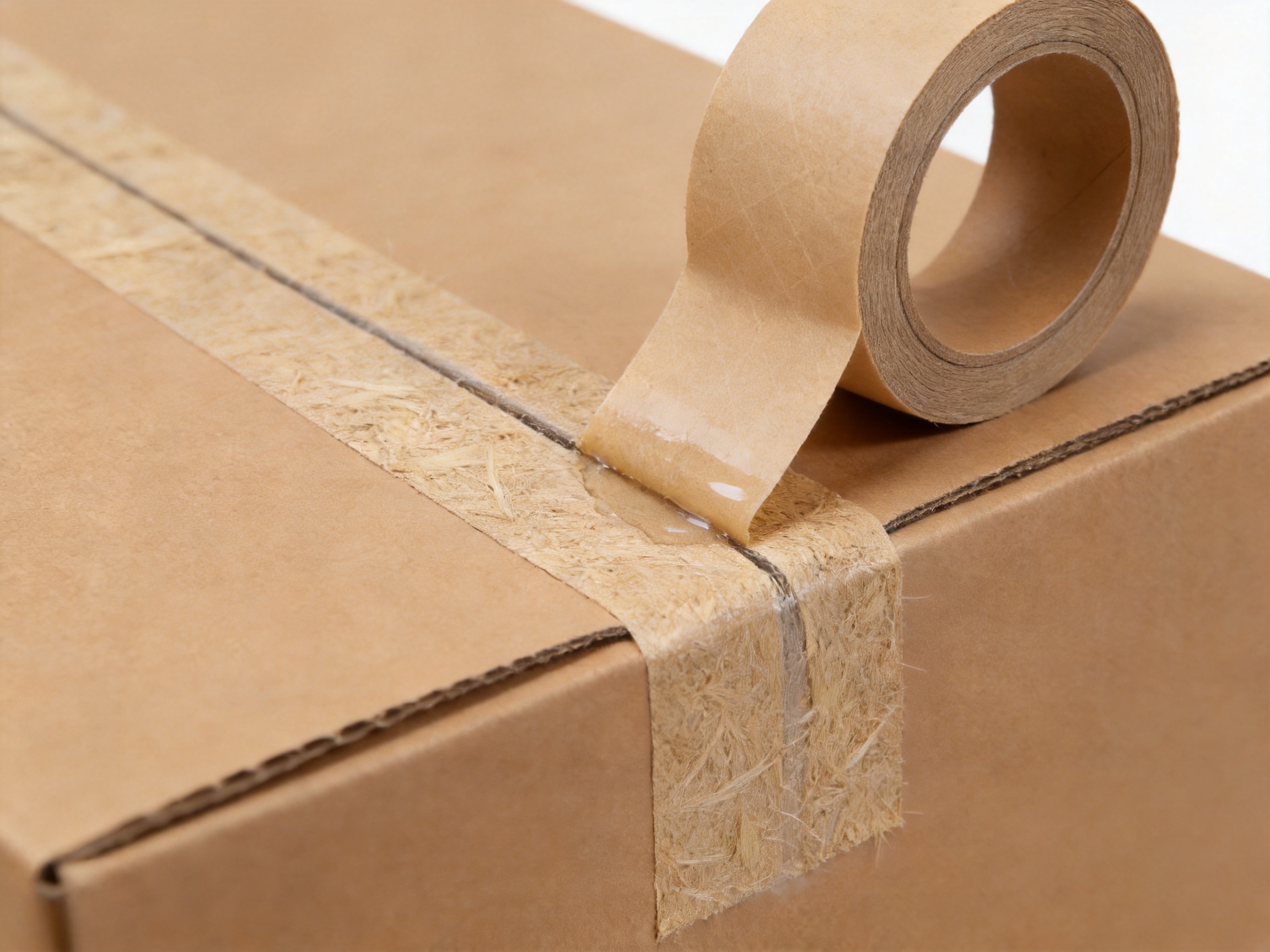
The bonding mechanism is different from that of pressure-sensitive BOPP tape. Plastic carton sealing tape generally depends on immediate pressure contact between a synthetic adhesive and the carton surface. Water-activated kraft paper tape relies on moisture to activate the adhesive. After application and drying, the adhesive penetrates and bonds with the carton fibers, creating a secure connection that resists edge lifting and peeling.
This construction gives the product two important characteristics. First, it remains easy to integrate into paper-based recycling systems. Second, it can provide a tamper-evident and structurally supportive seal because removing the tape often damages the carton surface rather than allowing the tape to be cleanly detached.
Product Structure and Key Materials
Reinforced Kraft Paper Substrate
The main substrate is kraft paper selected for its balance of strength, flexibility, printability, and compatibility with corrugated packaging. Available grammage options may range from approximately 80 to 120 gsm, depending on the required application and reinforcement level. A heavier or more strongly reinforced construction can be selected for large cartons, dense products, and long-distance transportation.
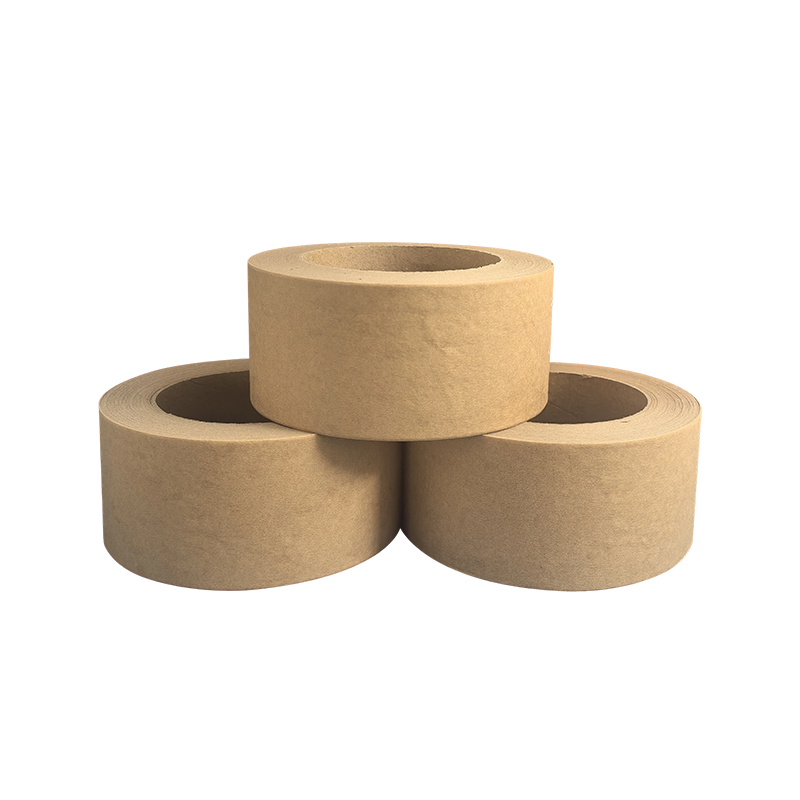
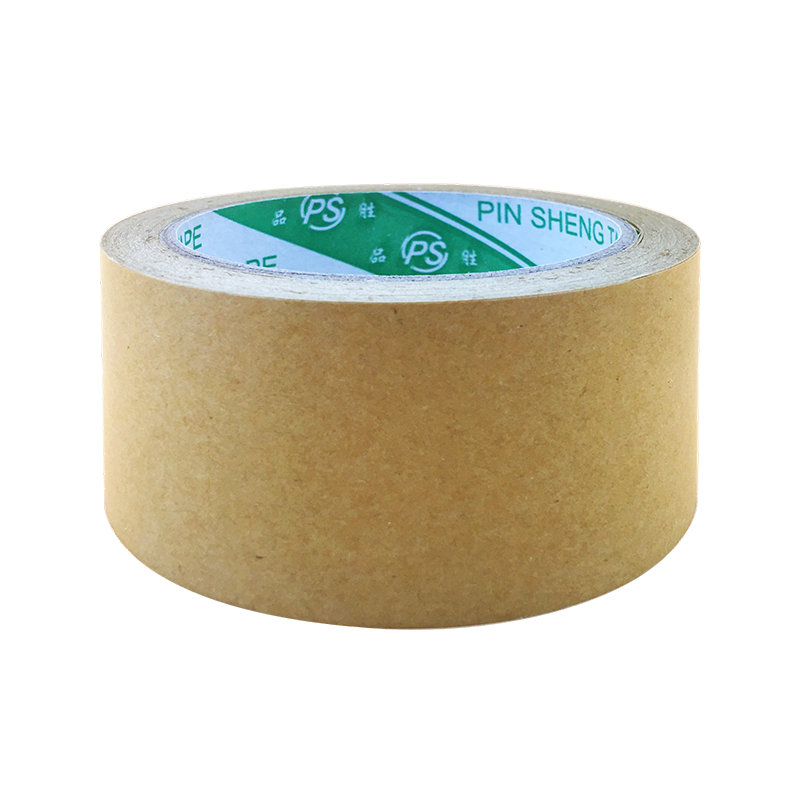
Kraft paper provides a natural brown appearance that fits current sustainability-oriented packaging designs. It can also support customized printing when customers want to display a company message, handling instruction, product information, or environmental statement. The paper surface offers a more integrated visual appearance than bright plastic tape when applied to brown corrugated cartons.
Embedded Reinforcement
The reinforcement system improves the tape’s resistance to tensile loading and tearing. Glass fiber or cotton thread may be incorporated into the paper structure in longitudinal, transverse, or grid patterns. This design helps the tape withstand the stresses generated when a carton is lifted, stacked, strapped, moved through a distribution center, or exposed to vibration during transportation.
Reinforcement is especially valuable when the tape is used on heavy cartons. A standard paper tape may be suitable for light or medium packaging, but large appliances, machinery components, building materials, industrial parts, and dense export products can create forces that exceed the capacity of an unreinforced substrate. The added fiber structure helps maintain seal integrity under these demanding conditions.
Water-Activated Plant-Starch Adhesive
The back coating is based on dry plant starch or another environmentally friendly water-activated adhesive system. In its dry state, the coating remains stable for storage and handling. When evenly moistened, it becomes tacky and ready to bond with the carton surface.
The adhesive is designed to work with the porous fiber structure of corrugated board. When the tape is pressed onto a clean carton, the activated adhesive interacts with the carton fibers. As the moisture evaporates, the bond develops and strengthens. This mechanism can produce a firm, lasting seal without relying on a plastic film backing.
Natural Kraft Color and Custom Printing
Natural kraft is the standard color, but customized printing may be available for approved orders. Printed tape can serve several purposes. It may identify the shipper, communicate a handling instruction, reinforce a sustainability message, or provide a visible security feature. Custom graphics can also improve brand consistency across shipping cartons without requiring a separate label for every package.
Core Performance Advantages
Strong Tensile and Tear Resistance
The most important performance benefit of the reinforced structure is its ability to resist pulling and tearing. Cartons are subjected to forces along the length and width of the seal. During manual handling, the package may be lifted from an imperfect position, causing stress around the top flaps. During transportation, vibration and compression can gradually challenge the carton closure. Reinforced kraft paper tape helps distribute these forces across the tape and the carton surface.
Embedded fibers or grid reinforcement help prevent a small cut or tear from rapidly spreading across the entire tape width. This is important for heavy-duty packaging, where loss of seal integrity may cause product damage, leakage, contamination, or a complete package failure.
Secure Bonding with Carton Fibers
When correctly moistened and applied, the adhesive forms a close bond with corrugated board. The tape does not merely sit on top of the carton surface. Instead, the activated starch coating can interact with the paper fibers and develop a strong bond as it dries. This helps reduce the risk of edge lifting, peeling, or accidental opening.
Correct application remains important. The carton surface should be clean and dry, and the adhesive side should be evenly wetted until it becomes glossy. The tape should then be positioned accurately and pressed firmly. Allowing approximately one to two minutes for curing helps the seal develop its intended strength.
Compatibility with Paper-Based Recycling
One of the product’s major advantages is its compatibility with corrugated packaging recycling. The kraft paper substrate and water-activated adhesive are designed to work within a paper-based packaging system. Because the tape is fiber-oriented rather than plastic-film-oriented, it can help reduce the need to separate plastic tape from cartons before recycling.
This characteristic is increasingly important for businesses serving markets with strict environmental expectations. Exporters may need to demonstrate responsible packaging choices to customers, retailers, regulators, or corporate procurement departments. A paper-based sealing solution can support sustainability goals while continuing to deliver the required packaging performance.
Biodegradable and Environmentally Friendly Design
The product uses a natural kraft paper base and a water-activated adhesive. Compared with petroleum-based plastic tape, this construction can reduce the amount of persistent plastic waste associated with carton sealing. Paper fibers can be recycled or decomposed under suitable conditions, while the starch-based adhesive supports the product’s environmentally friendly positioning.
Environmental performance should always be evaluated in relation to actual disposal infrastructure, contamination, printing, coating, and local recycling rules. Nevertheless, replacing conventional plastic sealing tape with a paper-based alternative can be a practical step toward reducing plastic consumption in shipping operations.
Tamper-Evident Carton Closure
Water-activated kraft paper tape can provide a visible indication when a carton has been opened or disturbed. If someone attempts to remove the tape after it has bonded with the carton fibers, the paper surface may tear or show damage. This makes unauthorized access easier to identify than with some removable plastic tapes.
For export shipments, electronics, premium goods, and controlled distribution channels, this feature adds value beyond simple closure. It can support package accountability and make it easier for receiving personnel to identify packages that may require inspection.
Clean and Professional Appearance
Natural kraft tape creates a coordinated appearance on brown corrugated cartons. The paper surface can look more refined and environmentally responsible than a mismatched plastic strip. For premium goods and consumer-facing shipments, this visual consistency may contribute to the perceived quality of the packaging.
When custom printing is used, the tape can become an integrated communication element. A printed message can remind handlers to keep the carton dry, identify the correct orientation, or communicate the shipper’s commitment to sustainable packaging.
Comparison with Conventional BOPP Plastic Tape
BOPP tape remains widely used because it is easy to apply, economical, and available in many sizes. However, reinforced water-activated kraft paper tape offers several important differences that may be advantageous in specific applications.
| Performance or Sustainability Factor | Water-Activated Reinforced Kraft Paper Tape | Conventional BOPP Plastic Tape |
| Primary Backing | Reinforced kraft paper | Polypropylene plastic film |
| Adhesive Activation | Activated with water before application | Normally pressure-sensitive and ready to use |
| Heavy-Duty Resistance | Enhanced by embedded fibers or grid reinforcement | Depends on film thickness and adhesive design |
| Carton Recycling Compatibility | Designed to integrate with paper-based packaging | May require removal or separation in some recycling systems |
| Tamper Evidence | Bond may damage carton fibers if removed | May be removable depending on adhesive and carton surface |
| Appearance | Natural paper appearance with printing options | Clear, colored, or printed plastic appearance |
| Environmental Positioning | Paper-based, recyclable, and biodegradable design | Plastic-based packaging material |
| Recommended Applications | Export cartons, heavy packages, sustainable packaging programs | General carton sealing and high-speed routine packaging |
The choice should depend on the packaging line, carton type, shipment conditions, sustainability requirements, and operating budget. Conventional plastic tape may remain appropriate for certain applications, especially where immediate pressure-sensitive application is essential. However, reinforced kraft paper tape becomes particularly attractive when environmental compliance, heavy-duty strength, paper recycling, and carton security are high priorities.
Applications in Export Packaging
Cross-Border Logistics
Export cartons may pass through multiple warehouses, ports, vehicles, customs checkpoints, and distribution centers. Each stage introduces opportunities for compression, impact, vibration, humidity changes, and rough handling. A strong carton closure is essential to maintain package integrity throughout the journey.
Water-activated reinforced kraft paper tape is suitable for export cartons where the shipper wants a paper-based packaging system. Its natural appearance can also communicate a responsible packaging approach to overseas customers. The tape is available in practical width and length ranges, including widths of approximately 12 to 72 millimeters and roll lengths of about 50 to 200 meters, subject to product configuration.
Heavy Cartons and Industrial Products
Heavy products generate greater stress at carton seams. A closure that works for lightweight consumer goods may not be sufficient for industrial components, machinery parts, tools, appliances, or construction materials. Reinforcement helps the tape remain stable when the carton is lifted or stacked.
For especially heavy items, tape should be used as part of a complete packaging system. Carton board strength, internal cushioning, pallet arrangement, strapping, corner protection, and load weight must all be considered. The tape can reinforce the top and bottom seams, secure flaps, and support the overall closure strategy.
Pallet Stabilization and Unitized Loads
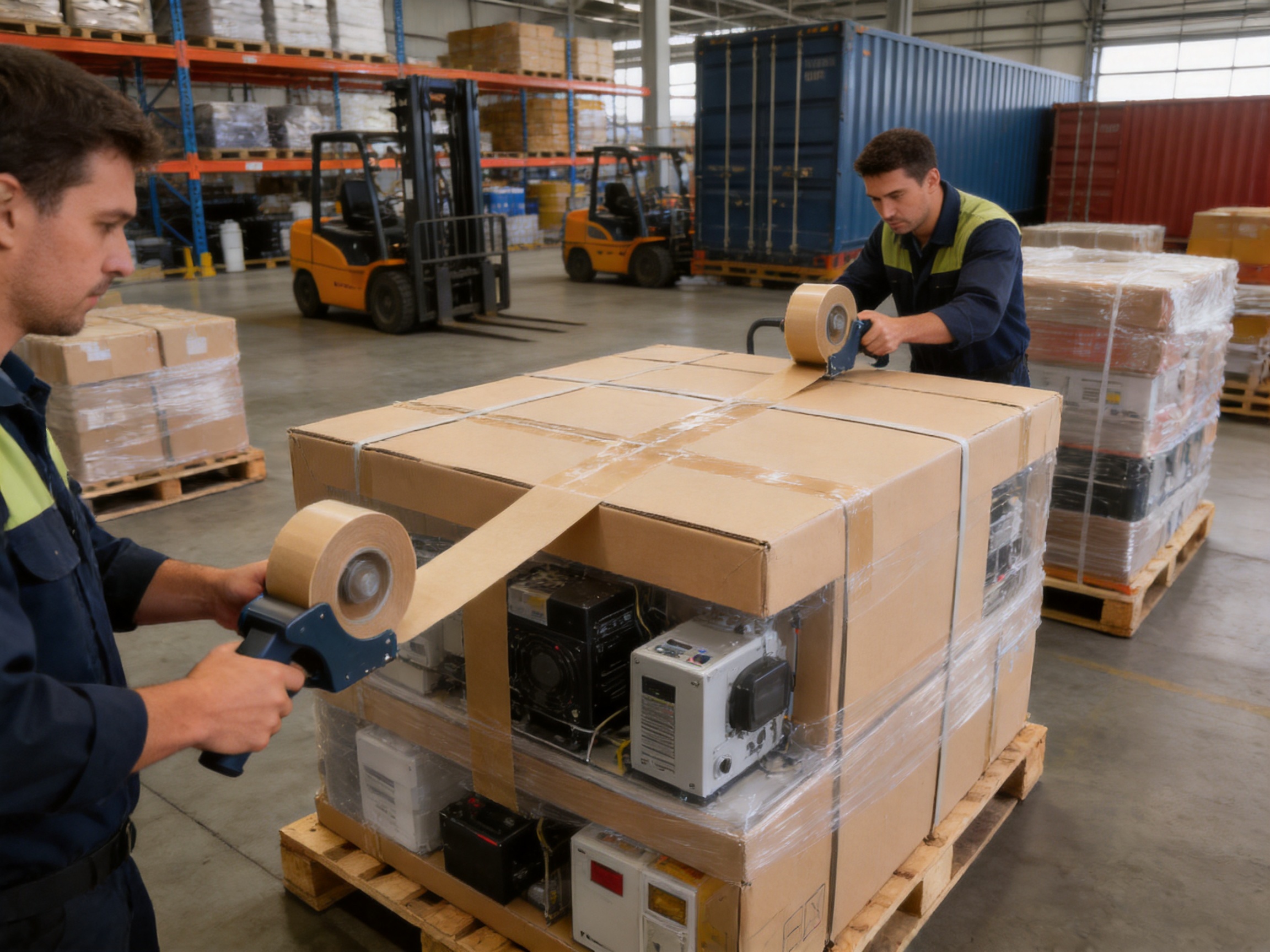
Palletized goods can shift when they are moved by forklifts or pallet trucks. Although stretch film and strapping are often used for primary load stabilization, reinforced kraft paper tape can provide additional carton closure and edge reinforcement. It may be applied across carton seams or around grouped packages where a paper-compatible solution is preferred.
Combining paper tape with suitable stretch film, PP strapping, or PET strapping can create a layered packaging approach. The tape secures individual cartons, while the outer load-stabilization materials maintain the position of the entire pallet. The correct combination depends on product weight, pallet dimensions, stacking height, and distribution conditions.
Electronics and Premium Goods
Electronics and premium products require packaging that protects the contents while presenting a clean and deliberate appearance. Natural kraft tape can support a minimalist aesthetic and provide a visible closure line. If the tape is printed, it can reinforce package identity and create a consistent presentation across multiple shipping channels.
The tamper-evident nature of a fiber-bonded closure is also useful where receiving teams need to identify potentially opened cartons. This does not replace security labels or controlled logistics procedures, but it can provide an additional visual indication of package disturbance.
Household Goods and Furniture Components
Household items, furniture components, fixtures, and home improvement products may be packaged in large or irregular cartons. The tape can be used to close long seams, reinforce corners, or help bundle protective paper and carton components. Its paper-based construction is especially suitable where the packaging program aims to reduce visible plastic materials.
Manufacturing Process and Quality Control
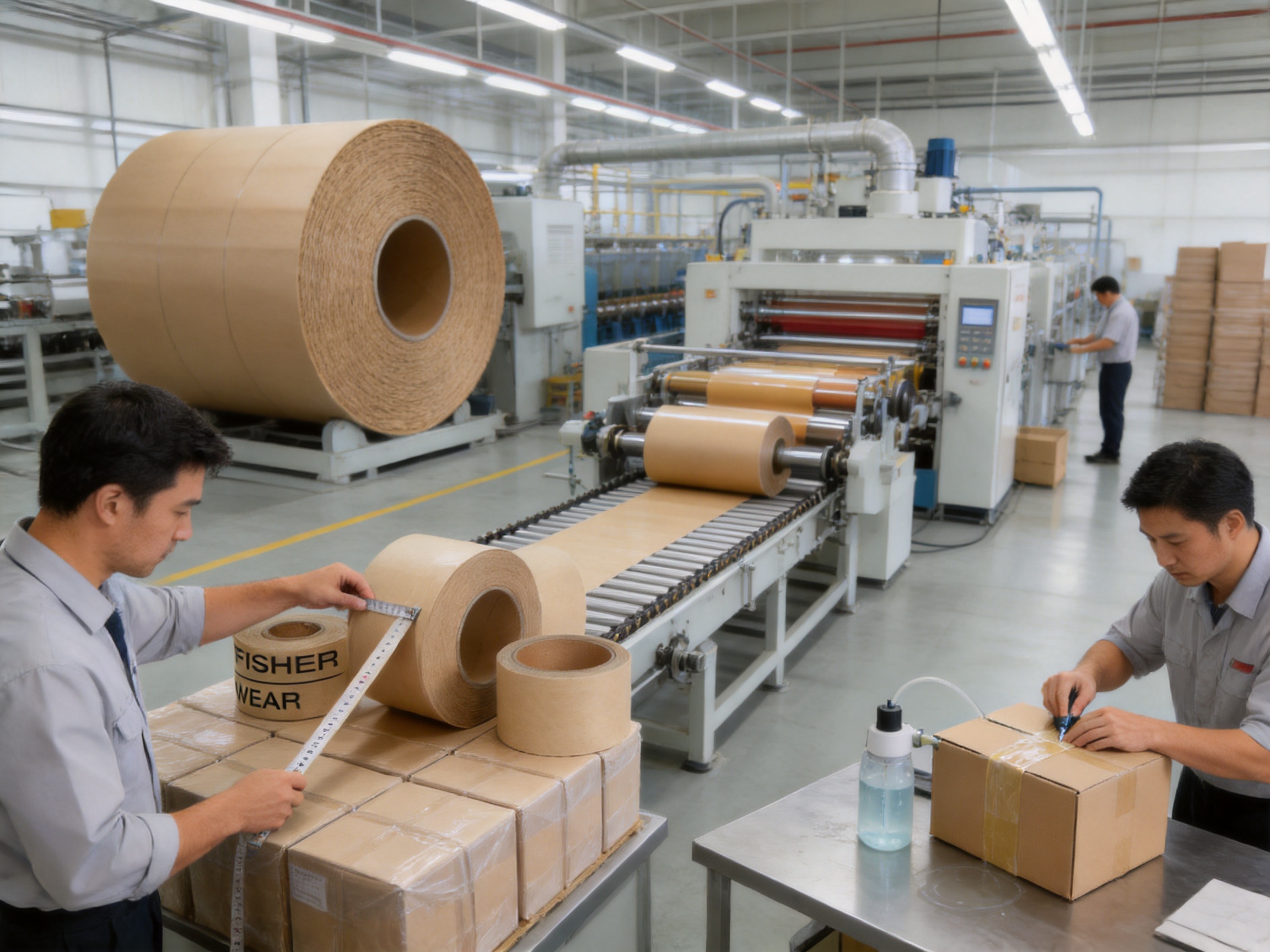
Reliable performance depends not only on the formula but also on manufacturing discipline. A professional packaging materials factory must control paper selection, reinforcement placement, adhesive preparation, coating uniformity, drying, slitting, rewinding, packaging, and final inspection.
Raw Material Selection
The manufacturing process begins with the selection of kraft paper, reinforcement fibers, and adhesive materials. The paper must provide suitable strength, flexibility, surface consistency, and moisture response. Reinforcement threads or grids must be compatible with the paper structure and positioned consistently throughout the roll.
Adhesive raw materials are selected according to activation behavior, bonding performance, drying characteristics, and environmental requirements. Stable raw material sourcing helps reduce variation between production batches and supports predictable performance for customers.
Reinforcement Integration
Reinforcement must be integrated into the paper in a controlled manner. Uneven thread spacing, poor alignment, or inconsistent tension may cause weak points, wrinkles, or differences in tensile performance. Production equipment and operating parameters are adjusted to maintain a stable reinforcement pattern along the entire roll.
Longitudinal reinforcement supports resistance to pulling along the tape direction. Transverse or grid reinforcement can improve resistance to crosswise tearing and help prevent damage from spreading. The final structure can be selected according to the expected carton weight and application requirements.
Adhesive Coating
The dry plant-starch adhesive is applied to the reverse side of the kraft paper. Coating uniformity is critical. If the adhesive layer is too light, the tape may not develop an adequate bond. If it is too heavy or uneven, the tape may be difficult to activate, dry slowly, or behave inconsistently in a dispenser.
A controlled coating process helps ensure that the tape becomes glossy and tacky when evenly moistened. It also supports stable adhesion across the full width of the roll. Production teams monitor coating conditions, drying parameters, and surface appearance to reduce defects.
Drying and Moisture Control
After coating, the tape must be dried to remove excess moisture while preserving the characteristics of the adhesive. Excessive heat or improper drying can affect paper dimensional stability, adhesive activation, or roll winding quality. Insufficient drying may lead to blocking, telescoping, or storage problems.
Because the product is water-activated, moisture management continues after production. Finished rolls should be stored in a cool, dry environment away from direct sunlight, heat, and damp conditions. Recommended storage conditions include a relative humidity of no more than approximately 65 percent and a temperature of about 5 to 30 degrees Celsius.
Slitting and Rewinding
Large master rolls are slit into customer-required widths. Common finished widths may range from approximately 12 to 72 millimeters, while roll lengths may range from around 50 to 200 meters. Slitting accuracy affects dispenser compatibility, application efficiency, and the appearance of the finished seal.
Rewinding tension must be carefully controlled. Excessive tension can deform the roll or create edge damage, while insufficient tension can cause loose winding and unstable dispensing. Properly finished rolls should have clean edges, consistent winding, and secure packaging for transportation.
Inspection and Testing
Quality control may include visual inspection, width measurement, roll-length verification, paper grammage checks, adhesive coating assessment, tensile testing, tear resistance evaluation, and carton adhesion testing. Finished products can be applied to representative corrugated board to confirm activation, bonding, and curing behavior.
Testing should reflect the customer’s actual use. A tape designed for light export cartons may require different performance verification from one intended for machinery packaging or pallet stabilization. Professional communication between the manufacturer and customer helps establish suitable specifications before production.
Manufacturing Strengths of an Experienced Packaging Materials Supplier
A capable supplier provides more than rolls of tape. The supplier should have the technical resources and production management systems needed to convert raw materials into consistent packaging performance.
Integrated Research, Development, and Production
A manufacturer with experience in multiple packaging products can evaluate reinforced kraft tape in relation to a wider packaging system. Product knowledge in BOPP tape, masking tape, high-temperature tape, metal tape, stretch film, PP strapping, and PET strapping can help customers select compatible materials for complete load protection.
Research and development work may focus on paper grammage, fiber configuration, adhesive activation, roll dimensions, printing, and application conditions. This supports product adaptation for different carton weights, climates, handling methods, and market expectations.
Modern Production Equipment
Advanced equipment contributes to coating consistency, reinforcement accuracy, clean slitting, stable rewinding, and efficient production. Automated or semi-automated controls can reduce variation caused by manual adjustment and improve repeatability between batches.
Equipment alone does not guarantee quality. It must be supported by trained operators, maintenance schedules, documented procedures, and inspection standards. A strong manufacturing system combines technology with practical process knowledge.
Strict Quality Management
Quality control should cover the entire production chain, beginning with incoming raw materials and continuing through finished-roll inspection. A disciplined approach helps identify problems early and reduces the risk of inconsistent adhesive activation, damaged edges, uneven reinforcement, or unstable roll winding.
For international customers, stable quality is especially important because products may be ordered repeatedly over long periods. Consistency makes it easier to standardize carton sealing procedures, train packaging staff, and forecast material consumption.
Broad Packaging Product Capability
A supplier that manufactures several categories of packaging materials can provide a more coordinated purchasing experience. In addition to kraft paper tape, the product range may include adhesive tapes and dispensers, strapping bands and tools, stretch film and accessories, protective films, and protective bags.
This broader capability allows customers to source complementary products from one experienced partner. For example, a distribution center may require reinforced kraft paper tape for carton closure, stretch film for pallet stabilization, and PET or PP strapping for high-load security. Coordinated supply can simplify specification, communication, quality tracking, and logistics planning.
Production Scale and Business Experience
The manufacturer described in the supplied company information has established a packaging materials operation in Zhejiang Province, China, with a focus on product research, manufacturing, sales, and service. Its annual output value has exceeded RMB 60 million, reflecting an established industrial base and the ability to support a range of customer requirements.
Its manufacturing experience covers logistics, express delivery, household products, electronics, construction and decoration, industrial manufacturing, cargo stabilization, and packaging protection. This application knowledge can help the company understand the practical differences between routine carton sealing and more demanding industrial packaging.
Application Procedure
Step One: Prepare the Carton Surface
The carton should be clean, dry, and free of dust, oil, loose fibers, and excessive surface contamination. Dirty or damp cartons may reduce the effectiveness of the adhesive. The flaps should be aligned before applying the tape, and the carton should not be overloaded beyond the capacity of its board and construction.
Step Two: Moisten the Adhesive Side
Use a sponge, brush, or suitable water-activated tape dispenser to wet the adhesive side evenly. The coating should become glossy, but it should not be saturated to the point that water runs from the tape. Uneven wetting can create areas with weak adhesion or delayed bonding.
Step Three: Apply and Press
Place the activated tape over the carton seam and press it firmly along its full length. Pay particular attention to the ends and edges. Firm pressure helps the adhesive make close contact with the corrugated surface and reduces the possibility of air gaps or lifted corners.
Step Four: Allow Curing Time
The seal should remain undisturbed for approximately one to two minutes to allow the adhesive to dry and develop full bonding strength. Actual curing time may vary according to temperature, humidity, carton absorbency, adhesive quantity, and tape construction.
Step Five: Inspect the Finished Seal
Check that the tape is centered, fully bonded, and free from lifted edges. For heavy cartons, inspect the bottom seam and any reinforced corners before the package is moved. If a seam is poorly applied, adding a second strip may be more effective than attempting to reposition partially dried tape.
Storage, Handling, and Operating Conditions
Finished rolls should be stored indoors in a cool, dry location. Keep them away from direct sunlight, heaters, open water, condensation, and areas with rapid temperature changes. The recommended storage temperature is approximately 5 to 30 degrees Celsius, with humidity preferably maintained at or below 65 percent.
Do not place heavy objects on top of finished rolls, as crushing can deform the cores or edges. Store rolls in their original packaging until they are ready for use. Allow material that has been exposed to a substantially different environment to acclimatize before application where practical.
The stated operating temperature range is approximately -5 to 50 degrees Celsius. Performance may vary outside this range or under conditions involving persistent moisture, frost, contaminated surfaces, or highly absorbent cartons. Testing on the customer’s actual carton material is recommended before full-scale adoption.
The tape is primarily intended for corrugated paper and other porous fiber-based surfaces. It is not recommended for long-term bonding to non-porous materials such as plastic or metal. For those surfaces, a pressure-sensitive adhesive tape or another specialized product may be more suitable.
How the Product Supports Sustainable Packaging Programs
Sustainable packaging is not limited to using less material. It also involves selecting materials that fit existing recovery systems, reducing unnecessary plastic combinations, minimizing package failure, and improving the efficiency of logistics operations. Reinforced kraft paper tape contributes to these objectives in several ways.
First, its paper-based construction can reduce dependence on plastic film tape for carton closure. Second, its compatibility with corrugated packaging can simplify the recycling pathway in systems that process paper cartons together with attached paper tape. Third, its strength can reduce the risk of carton failure and product damage, which otherwise creates additional waste.
Fourth, the tape can support more coherent package design. A carton sealed with a matching paper tape may require fewer additional labels or plastic strips. Fifth, custom printing can place handling or recycling information directly on the closure material, potentially reducing the need for separate communication elements.
Environmental claims should be communicated accurately. Recyclability depends on local facilities, contamination levels, adhesive composition, printing, and applicable standards. Customers should confirm local requirements and conduct trials with their recycling partners when necessary. Even with these considerations, a reinforced paper tape can be an important component of a broader plastic-reduction strategy.
Economic and Operational Considerations
When comparing packaging tapes, purchase price is only one factor. A complete evaluation should include application speed, labor requirements, dispenser compatibility, carton failure rates, material consumption, storage conditions, disposal procedures, and customer sustainability expectations.
Water-activated tape may require a dispenser or a manual wetting step, which creates an operational difference compared with ready-to-use pressure-sensitive tape. However, the stronger bond and tamper-evident closure may reduce rework, package opening, and product loss in suitable applications. The paper-based design may also help companies meet internal procurement policies or customer requirements related to plastic reduction.
For high-volume facilities, a water-activated tape dispenser can improve consistency by controlling wetting, length, and cutting. For lower-volume operations, a sponge or brush may be sufficient. Selecting the right application method allows the business to balance investment, throughput, and packaging quality.
Customization and Supply Support
Different customers may require different paper grammages, reinforcement structures, widths, lengths, core sizes, colors, or printing designs. A professional manufacturer can review the application and recommend a suitable configuration rather than offering only a fixed standard product.
Customization may include printed logos, handling messages, language-specific instructions, repeated patterns, or security-related wording. Before printing, customers should confirm artwork dimensions, ink requirements, repeat length, color expectations, and approval procedures. Print quality should be evaluated together with adhesive performance and carton contact.
Supply support also includes order planning, packaging configuration, delivery coordination, documentation, and technical communication. Export customers may need stable specifications across multiple shipments. Clear product records help ensure that repeat orders maintain the same width, length, grammage, reinforcement, adhesive behavior, and printing requirements.
Selection Guide for Buyers
Buyers should begin by identifying the package weight, carton dimensions, board grade, sealing method, transport route, and expected environmental conditions. A small parcel for domestic distribution may need a different tape from a heavy export carton traveling by sea.
Important questions include whether the tape will be applied manually or mechanically, whether a water-activated dispenser is available, whether the carton surface is porous and clean, and whether the package must remain compatible with a paper recycling stream.
The required width and length should be selected according to seam dimensions and packaging volume. Narrow tape may be suitable for smaller cartons, while wider tape can provide better coverage on broad seams and heavy packages. Reinforcement level should reflect the load rather than being selected solely by price.
Customers should also request representative samples and conduct practical trials. A useful trial includes application at the intended production speed, storage of sealed cartons under expected conditions, simulated stacking, manual handling, and inspection after transportation or vibration exposure. The purpose is to confirm that the tape works with the complete packaging system.
Frequently Asked Questions
What does “water-activated” mean?
Water-activated means that the adhesive is dry during storage and becomes bondable when moistened. The adhesive side should be wetted evenly before the tape is applied to the carton.
Is reinforced kraft paper tape suitable for heavy cartons?
Yes. The embedded glass fiber, cotton thread, or grid reinforcement improves tensile and tear resistance, making the tape suitable for heavy cartons, industrial packaging, export shipments, and load reinforcement. The correct tape construction should be selected according to carton weight and transportation conditions.
Can the tape be used on plastic or metal?
It is primarily designed for porous paper and corrugated carton surfaces. It is not recommended for long-term bonding to non-porous surfaces such as plastic or metal. A specialized pressure-sensitive or industrial adhesive product may be more suitable for those materials.
Does the tape support carton recycling?
The kraft paper substrate and water-activated adhesive are designed to be compatible with paper-based packaging and recycling processes. Actual recycling results depend on local facilities, carton contamination, coatings, printing, and applicable recycling rules.
How long does the bond take to develop?
After the tape is moistened and firmly pressed onto the carton, approximately one to two minutes of curing time is recommended before full handling. Temperature, humidity, carton absorbency, and wetting level can affect the actual time.
Can the tape be printed?
Customized printing may be available. Customers can use printing for identification, handling instructions, sustainability communication, or package security. Artwork and technical details should be confirmed before production.
What widths and lengths are available?
Standard product configurations may include widths from approximately 12 to 72 millimeters and roll lengths from about 50 to 200 meters. Exact specifications can be adjusted according to application requirements and production capability.
What is the recommended storage environment?
Store the tape in a cool, dry place away from heat, moisture, and direct sunlight. A recommended environment is approximately 5 to 30 degrees Celsius with relative humidity of no more than about 65 percent.
Can the tape replace all plastic carton sealing tape?
It can replace plastic tape in many carton-sealing applications, especially where paper compatibility, heavy-duty reinforcement, and environmental positioning are important. However, each operation should consider application equipment, carton type, production speed, climate, and required performance before making a complete conversion.
What makes the reinforced version different from ordinary kraft paper tape?
The reinforced version contains embedded fibers or a grid structure that improves resistance to pulling and tearing. This makes it more suitable for heavier cartons and demanding logistics conditions than an ordinary unreinforced paper tape.
Conclusion
Water-activated reinforced kraft paper tape is a practical solution for businesses seeking stronger, more sustainable carton sealing. Its combination of reinforced kraft paper, plant-starch adhesive, fiber compatibility, and tamper-evident bonding gives it a clear role in export packaging, industrial logistics, palletized loads, electronics, premium goods, and heavy-duty carton reinforcement.
Compared with conventional BOPP plastic tape, the product offers important advantages in paper recycling compatibility, biodegradable material positioning, natural appearance, and structural reinforcement. Its application method requires controlled wetting and firm pressing, but the resulting bond can provide dependable carton closure and support package security.
The value of the product is strengthened when it is manufactured through disciplined processes covering raw material selection, reinforcement integration, adhesive coating, drying, slitting, rewinding, inspection, and packaging. A supplier with broader expertise in adhesive tapes, stretch film, strapping, protective film, and protective bags can also help customers develop coordinated packaging systems rather than selecting isolated materials.
For companies looking to reduce plastic use without sacrificing package strength, reinforced water-activated kraft paper tape offers a balanced path between environmental responsibility and industrial performance. Proper specification, storage, application, and quality control will allow the product to deliver the greatest value across domestic and international supply chains.
References
1. Product technical information for water-activated reinforced kraft paper tape, including substrate, adhesive, reinforcement, dimensions, application, and storage guidance.
2. Corrugated packaging handling principles concerning carton closure, seam integrity, stacking, transport vibration, and load stabilization.
3. General guidance on paper-based packaging recovery, fiber recycling compatibility, and the role of adhesive materials in corrugated packaging systems.
4. Packaging material quality-control practices covering raw material inspection, adhesive coating uniformity, tensile strength, tear resistance, slitting, and roll winding.
5. Industrial packaging design principles for export cartons, heavy-duty packages, palletized goods, electronics, household products, and machinery components.
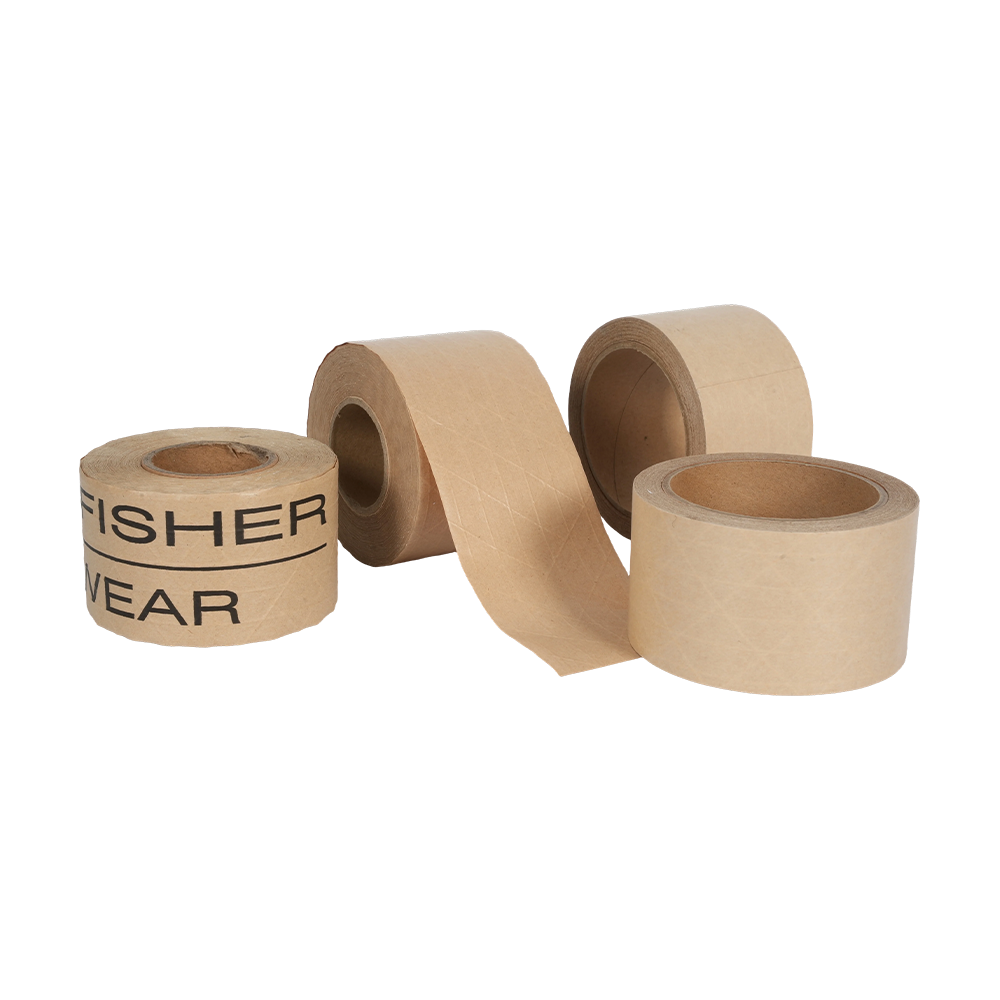
Wet water reinforced kraft paper tape
Product: Wet water reinforced kraft paper tape

LATEST POST
Let’s create something amazing together
contact us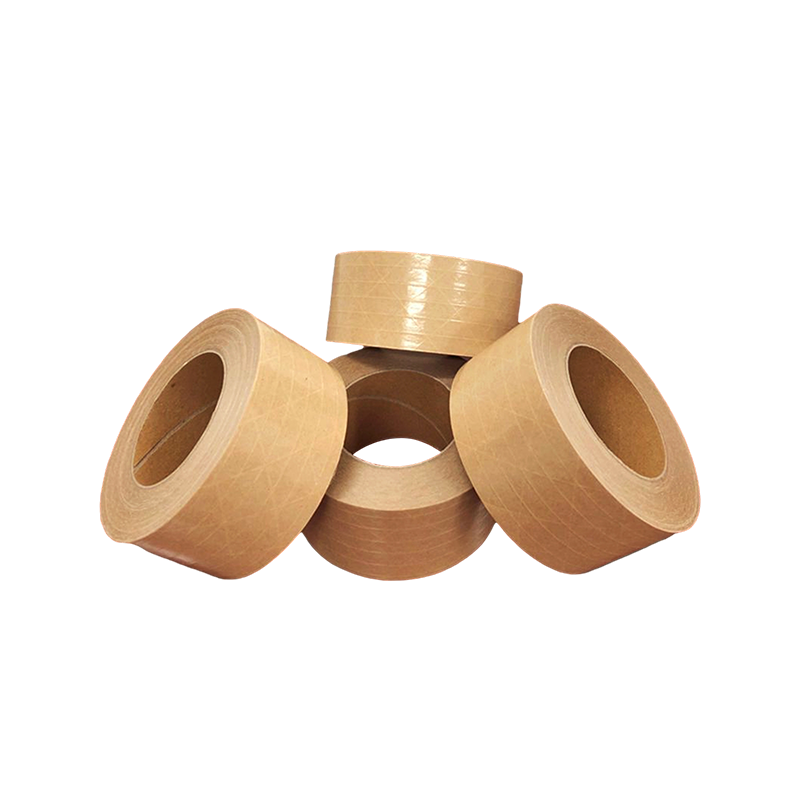
CONTACT DETAILS
- Address:No. 241, Yaojiafan, Zhangpanqiao, Shushan Street, Xiaoshan District, Hangzhou City, Zhejiang Province, China
- TEL:+86-0571-83175630
- Phone:+86-13336160217
- Email:jeffrey@grtpk.com
- WeChat/WhatsApp:+86-18058115265
PRODUCTS
NEWS CENTER
MOBILE TERMINAL
Copyright© Zhejiang Geruite Packaging Materials Co., Ltd. All Rights Reserved.
Privacy Wholesale industrial packaging tape Manufacturers