


 English
  Español
  عربى
عربى 
PE Hand-Held Stretch Wrap for Secure Industrial Packaging
Content
- 1 1. Product Overview: What Is PE Hand-Held Stretch Wrap?
- 2 2. Why Manual Stretch Film Remains Essential
- 3 3. Core Product Specifications
- 4 4. Main Advantages of PE Hand-Held Stretch Wrap
- 4.1 4.1 Strong Fixation for Palletized Goods
- 4.2 4.2 Dustproof, Moistureproof, and Oil-Resistant Protection
- 4.3 4.3 Surface-Safe Wrapping
- 4.4 4.4 High Adaptability for Regular and Irregular Products
- 4.5 4.5 Transparent Appearance for Easy Identification
- 4.6 4.6 Manual Operation Without Equipment Investment
- 5 5. Advantages Compared with Competing Packaging Solutions
- 6 6. Material Strength: Why Pure Polyethylene Matters
- 7 7. Thickness Selection and Performance Balance
- 8 8. Width Selection: 45 cm and 50 cm Options
- 9 9. Cling, Stretch, and Containment Force
- 10 10. Protection for Irregularly Shaped Products
- 11 11. Application Scenarios
- 12 12. Advanced Manufacturing Processes Behind Quality Film
- 13 13. Manufacturing Strengths of Zhejiang Geruite Packaging Materials Co., Ltd.
- 14 14. Quality Control as a Competitive Advantage
- 15 15. Customization for Real Usage Scenarios
- 16 16. Practical Use Recommendations
- 17 17. Storage Recommendations
- 18 18. Cost Efficiency and Total Packaging Value
- 19 19. Sustainability and Responsible Material Use
- 20 20. How This Product Supports Safer Logistics
- 21 21. Why Choose a Specialized Packaging Manufacturer
- 22 22. Purchasing Considerations
- 23 23. Common Mistakes to Avoid
- 24 24. Q&A Section
- 24.1 Q1: What is PE hand-held stretch wrap mainly used for?
- 24.2 Q2: What material is this stretch wrap made from?
- 24.3 Q3: What thickness options are available?
- 24.4 Q4: What widths are commonly available?
- 24.5 Q5: Can the length and roll weight be customized?
- 24.6 Q6: Why is transparent film useful?
- 24.7 Q7: Is this film suitable for irregularly shaped goods?
- 24.8 Q8: Does it require a wrapping machine?
- 24.9 Q9: How should the film be stored?
- 24.10 Q10: How does it compare with strapping?
- 24.11 Q11: Why choose a manufacturer with multiple packaging product lines?
- 24.12 Q12: What makes this product competitive against low-grade stretch film?
- 25 25. Conclusion
- 26 References
- 27 Product: PE Hand-held stretch wrap
In modern logistics, warehousing, manufacturing, retail distribution, and export packaging, the stability of a pallet can determine whether goods arrive safely or become a source of damage, delay, and cost. PE hand-held stretch wrap is a practical, efficient, and widely adaptable packaging film designed for manual pallet wrapping and surface protection. Made from pure polyethylene, it combines stretchability, cling, transparency, and flexibility to secure cartons, bundled products, irregular items, building materials, and industrial components during storage and transportation.
This article focuses on PE hand-held stretch wrap as a high-performance manual packaging solution. It explains its functional value, product advantages, competitive strengths, manufacturing considerations, application scenarios, storage recommendations, and the production capabilities behind consistent quality. It also highlights the expertise of Zhejiang Geruite Packaging Materials Co., Ltd., a China-based packaging materials manufacturer with an established product portfolio covering adhesive tapes, PE stretch film, PP strapping, and PET strapping.
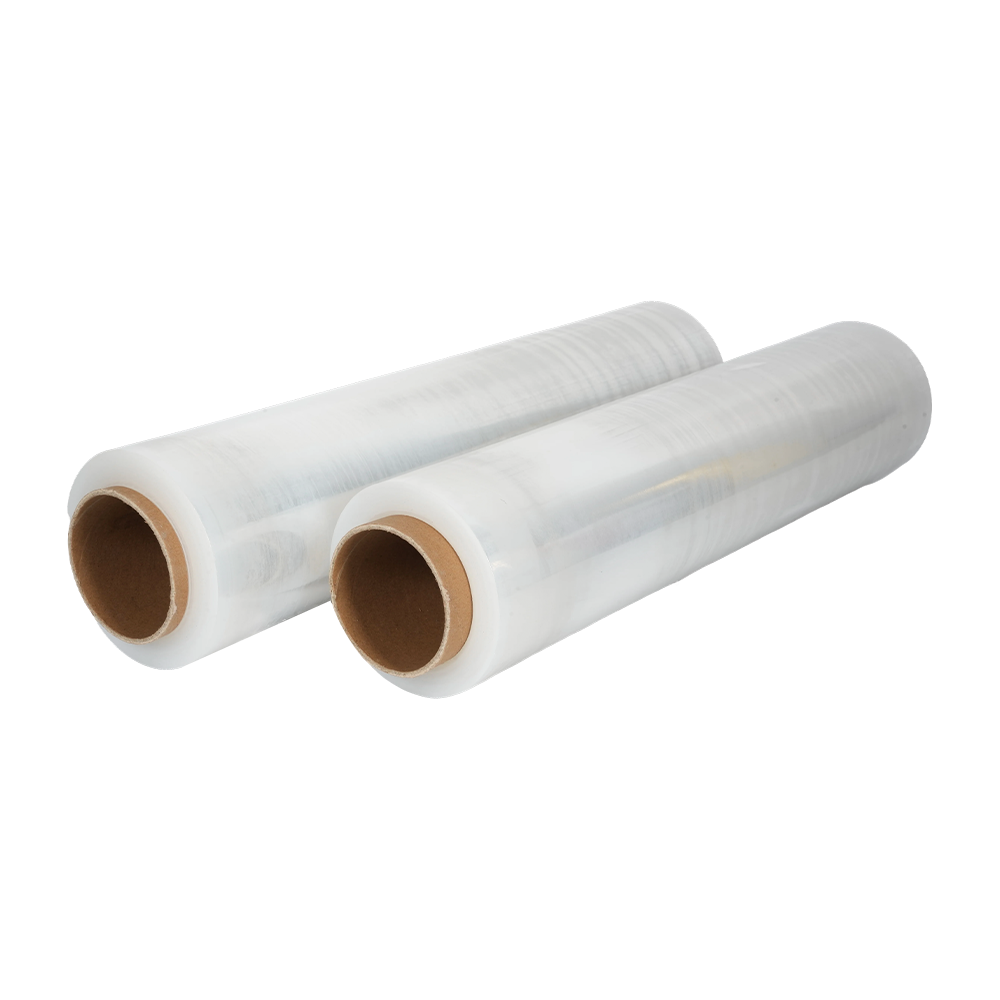
PE Hand-held stretch wrap
1. Product Overview: What Is PE Hand-Held Stretch Wrap?
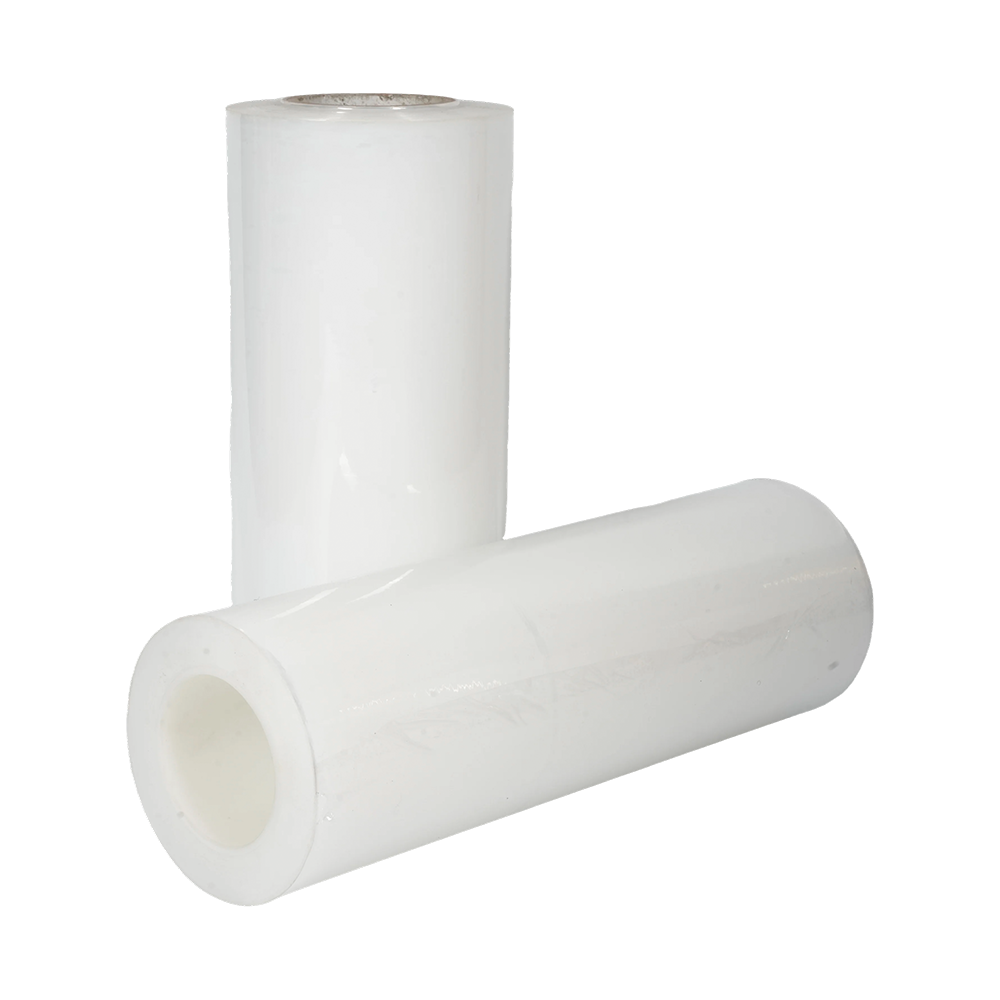
PE hand-held stretch wrap is a flexible plastic film used to wrap, bundle, stabilize, and protect products manually. Unlike machine stretch film, which is applied by automated or semi-automated wrapping equipment, hand-held stretch wrap is designed for direct operation by workers. It can be pulled, stretched, and wound around pallets, cartons, pipes, cables, doors, windows, metal parts, furniture, and other goods without requiring complex tools or machinery.
The product is made from pure polyethylene, commonly known as PE. Polyethylene is valued in packaging because it is lightweight, flexible, moisture-resistant, and suitable for producing thin films with reliable mechanical performance. In stretch wrap applications, PE provides the basic properties needed for strong containment: elongation, cling, toughness, and surface conformity.
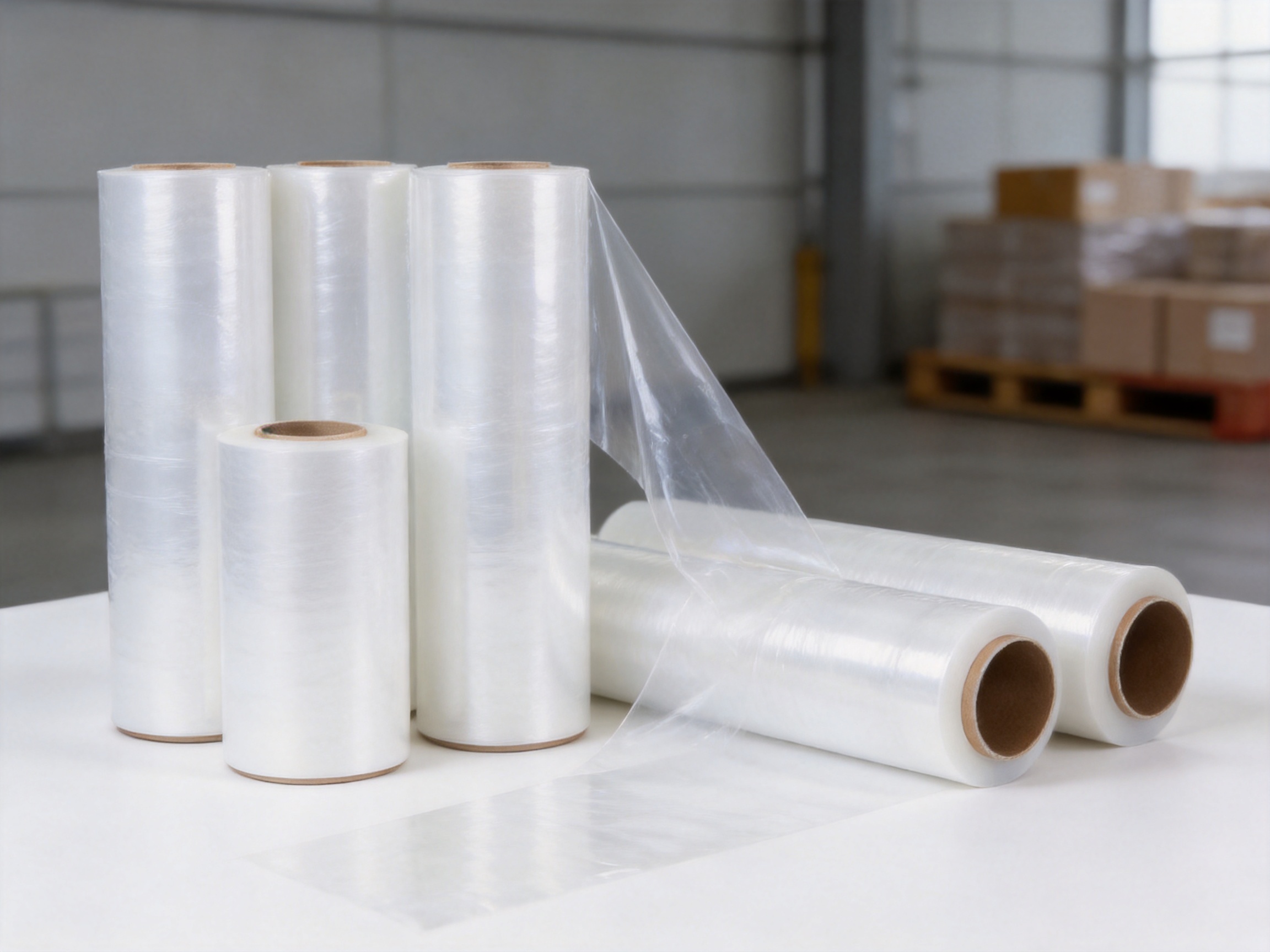
The product supplied by Zhejiang Geruite Packaging Materials Co., Ltd. is available in common heights of 45 cm and 50 cm, with thickness options ranging from 0.015 mm to 0.045 mm. Length and roll weight can be customized according to the user’s application scenario. The film is transparent, allowing workers to identify labels, cartons, barcodes, and product information without removing the wrap.
Its purpose is straightforward but highly important: it keeps loads together. When cartons are stacked on a pallet, vibration, acceleration, braking, turning, forklift movement, warehouse handling, and long-distance transportation can cause boxes to shift or scatter. PE hand-held stretch wrap applies containment force around the load, reducing movement and improving stability. At the same time, it helps block dust, moisture, oil contamination, and surface abrasion.
2. Why Manual Stretch Film Remains Essential
In many modern factories and logistics centers, automated packaging equipment is increasingly common. However, hand-held stretch wrap remains essential because many packaging operations require flexibility. Not all goods are uniform. Not all facilities process large enough quantities to justify a machine. Not all loads have standard pallet dimensions. Workers often need a fast, simple, and low-investment solution that can be used anywhere in the warehouse.
Manual stretch film is especially useful in mixed-product shipments, small-batch production, temporary packaging, maintenance operations, warehouse transfers, sample shipments, and irregular cargo protection. If a load is too tall, too narrow, unusually shaped, or located away from a wrapping machine, hand wrap becomes the most practical choice.
Compared with many alternatives such as rope, paper wrapping, ordinary plastic sheet, or adhesive tape alone, PE hand-held stretch wrap offers a better balance of speed, protection, and load stability. It can cover a large surface quickly, adapt to the load shape, and provide uniform pressure around the goods. It also avoids direct adhesive contact with the packaged items, reducing the risk of residue or surface damage.
For companies seeking packaging materials that are economical, efficient, and adaptable, hand stretch film remains one of the most effective options. It is simple enough for everyday use yet technical enough to make a measurable difference in transportation safety and warehouse organization.
3. Core Product Specifications
The following table summarizes the key specifications of the PE hand-held stretch wrap described in the product information.
| Parameter | Specification | Practical Meaning |
| Material | Pure Polyethylene, PE | Provides flexibility, stretchability, moisture resistance, and reliable cling performance. |
| Height | 45 cm, 50 cm | Suitable for common manual pallet wrapping and general industrial packaging operations. |
| Thickness | 0.015 mm to 0.045 mm | Allows users to choose lighter film for regular cartons or heavier film for demanding loads. |
| Length and Weight | Customizable | Can be adjusted according to wrapping frequency, worker handling preference, and usage scenario. |
| Color | Transparent | Enables easy identification of labels, contents, barcodes, and shipment marks. |
| Operation | Manual application | No machine is required, making it suitable for flexible and mobile packaging tasks. |
| Main Uses | Pallet stabilization, product bundling, dustproof protection, moisture protection, surface protection | Covers logistics, warehousing, industrial packaging, and commercial packaging needs. |
4. Main Advantages of PE Hand-Held Stretch Wrap
4.1 Strong Fixation for Palletized Goods
The primary advantage of PE hand-held stretch wrap is its ability to stabilize goods. When the film is stretched around a pallet or product group, it generates holding force. This force helps bind cartons or items together, reducing the risk of load collapse, corner shifting, product scattering, and pallet deformation during movement.
This is especially important for transportation. Loads may experience vibration from road conditions, impact during forklift handling, and pressure from stacked storage. Without proper wrapping, even well-stacked cartons can gradually loosen. PE stretch wrap helps maintain pallet integrity and keeps the load compact.
4.2 Dustproof, Moistureproof, and Oil-Resistant Protection
Packaging is not only about holding products in place. It is also about protecting them from the environment. PE hand-held stretch wrap provides a physical barrier against dust, moisture, and oil contamination. This is valuable in warehouses, workshops, construction material storage areas, logistics hubs, and transportation vehicles where goods may be exposed to airborne particles, humidity, or accidental contact with oily surfaces.
For electronics, building materials, furniture components, metal products, and cartons containing consumer goods, this protective function can reduce cleaning work, prevent packaging stains, and improve the final appearance of delivered goods.
4.3 Surface-Safe Wrapping
Many packaging materials can scratch, mark, or damage sensitive surfaces. PE stretch film is flexible and conformable. It wraps tightly around objects without hard edges or abrasive contact points. Because it does not require adhesive to touch the product surface directly, it is suitable for doors, windows, furniture, metal parts, plastic components, pipes, and other items requiring temporary surface protection.
For irregularly shaped products, the film conforms to protrusions, curves, and corners better than rigid packaging sheets. This reduces the need for complex wrapping methods and helps protect product appearance.
4.4 High Adaptability for Regular and Irregular Products
PE hand-held stretch wrap can be used on standard cartons, palletized goods, long cylindrical materials, cables, pipes, doors, windows, boards, furniture, and mixed cargo. Its adaptability is one reason it is common across many industries. A worker can use the same type of film for a wide range of wrapping tasks, reducing the need to stock many different packaging materials.
In warehouse operations, flexibility translates into efficiency. When packaging staff can use one product for multiple tasks, they can respond quickly to changing shipment requirements.
4.5 Transparent Appearance for Easy Identification
The transparent appearance of PE hand-held stretch wrap allows labels, barcodes, cartons, product marks, and shipment information to remain visible. This is important in logistics and warehousing, where identification errors can cause delays, misrouting, or inventory confusion.
Transparent film also allows supervisors to visually inspect load condition after wrapping. Workers can check whether cartons are correctly arranged, whether labels are facing outward, and whether the correct goods are being shipped.
4.6 Manual Operation Without Equipment Investment
One of the most practical benefits is that no wrapping machine is required. Workers can use the film directly by hand or with a simple dispenser. This lowers equipment investment and makes the film suitable for small warehouses, factories, distribution centers, temporary job sites, and shipping departments with variable production volumes.
Manual operation also makes it easy to wrap goods at different locations. A roll can be taken to the pallet, rather than moving the pallet to a fixed machine. This saves time when loads are heavy, large, fragile, or difficult to reposition.
5. Advantages Compared with Competing Packaging Solutions
5.1 Compared with Ordinary Plastic Film
Ordinary plastic film may cover products, but it usually lacks the cling and stretch performance required for secure load stabilization. PE hand-held stretch wrap is designed to stretch and contract around the load, creating containment force. This makes it more suitable for pallet wrapping than loose plastic sheets.
Ordinary film may require tape, knots, or additional fasteners to stay in place. Stretch wrap uses its own cling and tension, allowing faster application and cleaner packaging. This helps reduce labor steps and improves overall appearance.
5.2 Compared with Adhesive Tape Alone
Adhesive tape is excellent for sealing cartons, but it is not ideal for wrapping large pallet surfaces or securing a full load. Tape can leave residue, damage surfaces, or fail to provide uniform pressure around goods. PE stretch wrap covers more area and binds the entire load together.
In many packaging systems, tape and stretch wrap work together. Tape seals each carton, while stretch wrap secures the assembled pallet. Zhejiang Geruite Packaging Materials Co., Ltd. supplies both adhesive tape products and stretch film, giving customers access to complementary packaging materials from one experienced manufacturer.
5.3 Compared with Strapping Alone
PP strapping and PET strapping are useful for strong bundling and heavy-load reinforcement. However, strapping applies force along narrow bands, while stretch wrap covers the full load surface. For cartons or products that need dust and moisture protection, stretch film offers broader coverage.
In demanding applications, strapping and stretch film can be combined. Strapping provides high tensile reinforcement, while stretch wrap improves surface containment and environmental protection. As a company involved in PE stretch film, PP strapping, and high-strength PET strapping, Zhejiang Geruite Packaging Materials Co., Ltd. can support integrated packaging strategies.
5.4 Compared with Shrink Film
Shrink film typically requires heat to contract around products. This can provide tight packaging, but it also requires heat equipment and may not be suitable for heat-sensitive goods. PE hand-held stretch wrap does not require heat. It is applied by tension and cling, making it safer and simpler for many warehouse environments.
For fast pallet stabilization, stretch wrap is often more convenient than shrink packaging. It reduces equipment requirements and avoids the risks associated with heat sources.
5.5 Compared with Low-Grade Stretch Film
Not all stretch film performs the same. Low-grade films may tear easily, have inconsistent thickness, poor cling, weak puncture resistance, or uneven winding. These problems increase film consumption, slow down workers, and create unstable pallets.
The PE hand-held stretch wrap described here is made from pure polyethylene and produced with attention to stable performance. The available thickness range allows customers to select the right film for different load conditions. Customizable length and weight options further help match real packaging needs. Reliable manufacturing and quality control are essential advantages over inconsistent, low-cost alternatives.
6. Material Strength: Why Pure Polyethylene Matters
Pure polyethylene is important because stretch film performance depends heavily on raw material quality. PE contributes to flexibility, toughness, elongation, impact resistance, and moisture resistance. When the material base is stable, the film is more likely to stretch evenly, cling effectively, and resist tearing during wrapping.
In packaging, failure often occurs at the weakest point. A small tear near a pallet corner can expand as the worker stretches the film. Inconsistent film thickness can cause uneven tension. Poor cling can cause film tails to loosen after wrapping. A high-quality PE base helps reduce these risks.
Polyethylene also has a smooth surface feel that is suitable for protecting finished goods. It can wrap around cartons, plastic parts, wood products, and metal components without adding hard contact pressure. For customers handling mixed goods, this material reliability is highly valuable.
7. Thickness Selection and Performance Balance
The product thickness range of 0.015 mm to 0.045 mm gives users flexibility. A thinner film may be suitable for light cartons, short-distance storage, or regular products with smooth surfaces. A thicker film may be preferable for heavier loads, sharp corners, irregular products, long-distance transport, or rough handling environments.
Selecting the right thickness is not simply about choosing the thickest option. It is about balancing containment strength, film consumption, labor comfort, and cost. Excessive thickness can increase material use unnecessarily, while insufficient thickness may lead to tearing and load instability. A suitable supplier should be able to help customers match thickness to the real application.
Zhejiang Geruite Packaging Materials Co., Ltd. offers customizable length and weight options according to customer usage scenarios. This is practical because packaging operations vary. Some customers prioritize lightweight rolls for easier manual handling, while others prefer longer rolls for fewer roll changes. Customization improves work efficiency and helps reduce waste.
8. Width Selection: 45 cm and 50 cm Options
Common hand stretch film widths include 45 cm and 50 cm. These sizes are widely used because they provide a good balance between coverage and operator control. A wider film covers more surface area per wrap, reducing the number of revolutions needed around a pallet. At the same time, it remains manageable for hand operation.
A 45 cm roll may be preferred for smaller loads, operators who want lighter handling, or applications involving irregular products. A 50 cm roll may be suitable for standard pallet wrapping where faster coverage is desired. Both widths are practical in logistics, warehousing, and industrial packaging.
9. Cling, Stretch, and Containment Force
Three performance factors are especially important in stretch film: cling, stretch, and containment force. Cling refers to the film’s ability to adhere to itself after wrapping. Stretch refers to the degree to which the film can elongate under tension. Containment force refers to the holding power applied to the load after the stretched film contracts slightly.
A good hand stretch film must balance these factors. If cling is too weak, the film end may loosen. If stretch is poor, the worker may use more film to achieve stability. If containment force is too low, the pallet may shift. If the film is too stiff, manual application becomes tiring and inconsistent.
PE hand-held stretch wrap is designed to provide reliable stretchability and cling properties for manual use. This allows workers to wrap loads firmly while maintaining practical handling comfort.
10. Protection for Irregularly Shaped Products
Many industrial products do not fit neatly into cartons. Pipes, cables, metal profiles, doors, windows, building materials, furniture parts, and machinery components often have unusual shapes. Traditional packaging methods may require multiple materials and complicated labor. PE hand-held stretch wrap simplifies the process by conforming to surfaces and holding items together.
For long products such as pipes and cables, stretch film can bundle several pieces into a compact unit. For doors and windows, it can provide temporary surface protection against dust and light contamination. For furniture and building materials, it can help reduce abrasion during handling. For metal parts, it can prevent scattered movement and surface contact.
The flexible, non-abrasive nature of the film is especially useful for these applications. It reduces the risk of scratching and does not require direct adhesive contact with finished surfaces.
11. Application Scenarios
11.1 Logistics and Transportation
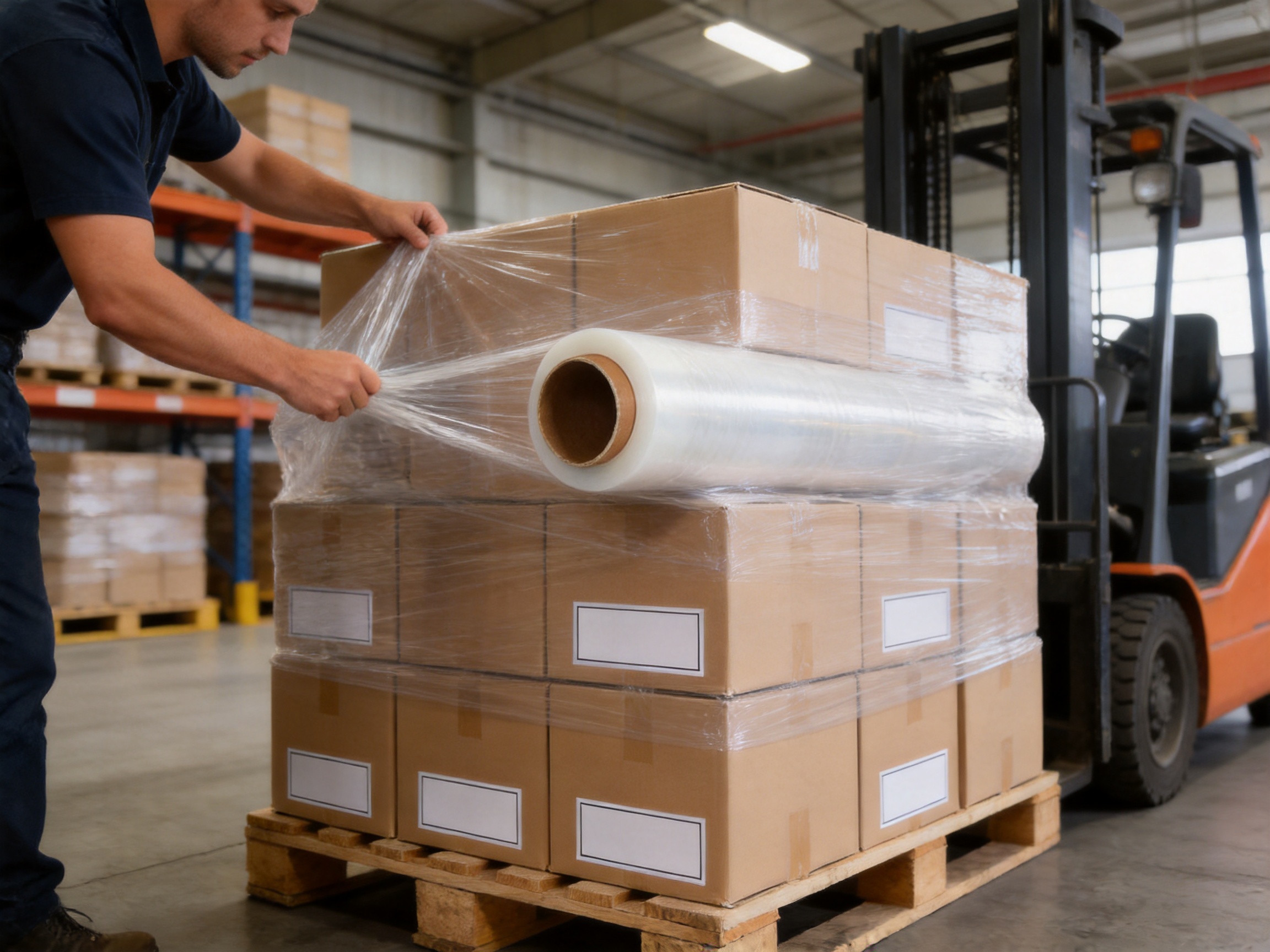
In logistics, PE hand-held stretch wrap is used to stabilize and unitize carton pallets. A stable pallet is easier to load, unload, stack, scan, and transport. Wrapped pallets are less likely to lose cartons during forklift movement or vehicle vibration.
Transparent film is useful for logistics because labels remain visible. Workers can read shipping marks, destination labels, and barcode information without opening or damaging the package.
11.2 Warehousing and Inventory Storage
Warehouses require goods to remain organized over time. Dust, humidity, accidental handling, and repeated movement can affect product condition. PE stretch film helps protect stored goods and keeps items grouped together.
For electronics, building materials, cartons, and mixed inventory, the film acts as a simple barrier while maintaining visual identification. It is useful for both short-term staging and longer storage periods.
11.3 Industrial Packaging
Industrial packaging often involves heavier, sharper, or more irregular products than ordinary retail distribution. Pipes, cables, metal parts, plastic profiles, boards, and machinery components may require flexible bundling and protective coverage. PE hand-held stretch wrap provides a practical solution because workers can apply it directly around the goods.
For industrial facilities, the ability to customize roll length, weight, and film thickness can improve packaging efficiency. Different production lines may require different roll formats depending on load size and worker handling conditions.
11.4 Commercial Packaging
Retailers, furniture suppliers, construction material sellers, and service companies may use hand stretch film for temporary protection. Doors, windows, furniture, display items, and large packaged goods can be wrapped quickly before delivery or storage.
Because the film is transparent, it does not hide product identification completely. This is helpful when multiple similar items must be stored or delivered together.
11.5 Internal Factory Transfer
Not all packaging is for external shipping. Many factories move semi-finished goods between workshops, production lines, or storage areas. PE hand-held stretch wrap can stabilize parts during internal movement and reduce contamination before final assembly.
This is valuable in manufacturing environments where dust, oil, and material mixing can affect production quality. Simple wrapping can prevent unnecessary rework and improve housekeeping.
12. Advanced Manufacturing Processes Behind Quality Film
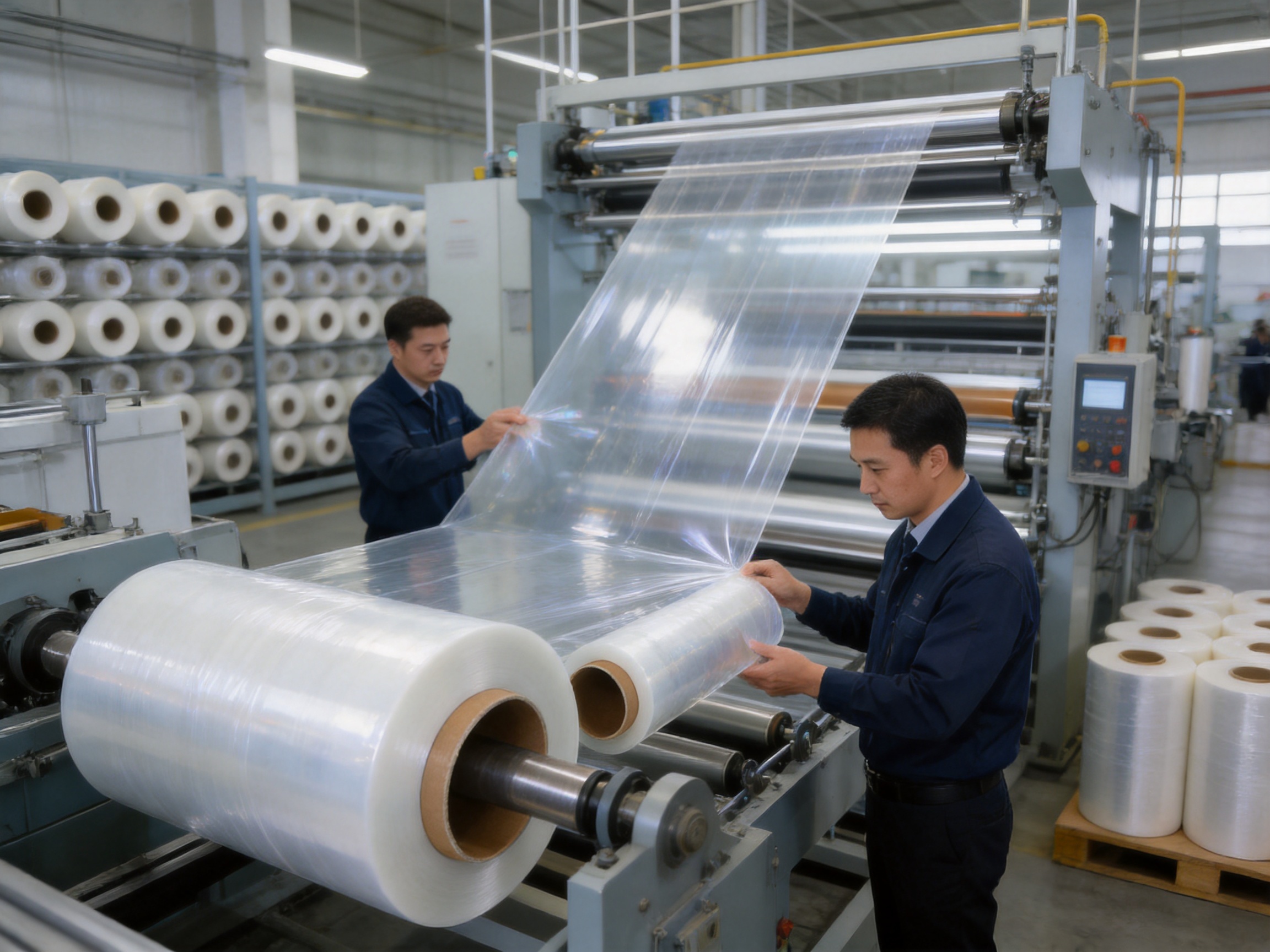
The performance of stretch film depends not only on the material but also on the manufacturing process. High-quality PE hand-held stretch wrap requires controlled production conditions, stable raw material handling, accurate film thickness control, proper cooling, clean winding, and careful inspection.
Although different factories may use different production configurations, modern stretch film production generally involves several key stages. First, polyethylene resin is selected according to the desired film properties. The material must support stretchability, cling, transparency, and mechanical strength. Next, the resin is melted and formed into a thin film through extrusion. During extrusion, temperature control is essential because uneven melting can affect film clarity and thickness uniformity.
After extrusion, the film must be cooled and stabilized. Cooling conditions influence film structure, surface quality, and mechanical behavior. The film is then stretched, trimmed, wound, and prepared into rolls. Winding quality matters because hand stretch film must unwind smoothly during use. Poor winding can lead to roll deformation, edge damage, and worker frustration.
Quality inspection is also critical. Thickness consistency, roll weight, width accuracy, clarity, stretch behavior, cling, edge condition, and appearance should be monitored. Stable quality reduces problems at the customer’s packaging site and helps workers use the film efficiently.
13. Manufacturing Strengths of Zhejiang Geruite Packaging Materials Co., Ltd.
Zhejiang Geruite Packaging Materials Co., Ltd. is located in Zhejiang Province, China, an area recognized for developed manufacturing capabilities and an active industrial economy. The company focuses on research, development, production, and sales of packaging materials, including BOPP tapes, kraft paper tapes, masking tapes, high-temperature resistant tapes, metal tapes, PE stretch film, PP strapping, and high-strength PET strapping.
This broad product portfolio is an advantage because modern packaging often requires a combination of materials. Customers may need carton sealing tape, surface protection materials, stretch film, and strapping products for the same logistics system. A manufacturer with experience across multiple packaging categories can better understand the complete packaging workflow.
The company emphasizes product quality as a core principle. From raw material procurement to production and final inspection, strict control helps maintain stable performance. Advanced production equipment supports efficiency and consistency, while ongoing attention to research and innovation helps the company respond to changing customer needs.
With an annual output value of over RMB 60 million, the company has developed a strong operating foundation. This scale indicates the ability to support regular supply, diverse orders, and long-term customer cooperation. For PE hand-held stretch wrap users, dependable supply is important because film is a daily consumable in packaging operations.
14. Quality Control as a Competitive Advantage
Quality control is one of the main differences between reliable stretch film and low-grade alternatives. Inconsistent film creates hidden costs. If a roll tears frequently, workers waste time restarting the wrap. If the thickness varies, pallets may receive uneven containment. If cling is poor, film ends may loosen during transport. If roll weight is inaccurate, purchasing calculations become unreliable.
A strong quality system reduces these risks. Important checks may include raw material verification, production parameter monitoring, thickness measurement, roll dimension inspection, winding evaluation, appearance review, and practical performance testing. By controlling each stage, a manufacturer can deliver film that performs predictably in real packaging conditions.
For customers, predictable performance is often more valuable than the lowest unit price. A slightly cheaper film can become more expensive if it requires more layers, causes load failures, increases labor time, or leads to product damage. Reliable PE hand-held stretch wrap helps reduce total packaging cost by improving stability, reducing waste, and supporting efficient work.
15. Customization for Real Usage Scenarios
Packaging requirements vary by industry and customer. A furniture supplier may need film that protects large finished surfaces. A logistics company may need fast pallet wrapping for cartons. A metal parts manufacturer may need stronger puncture resistance. A warehouse may prefer lighter rolls for frequent manual use. A construction material supplier may require thicker film for heavy or rough products.
Customization helps solve these differences. Adjustable length and roll weight allow customers to match the product to their labor process. Thickness options from 0.015 mm to 0.045 mm allow selection based on load weight and risk level. Width options such as 45 cm and 50 cm cover common manual wrapping needs.
Customization also supports cost optimization. Instead of buying a standard product that is too heavy, too thin, too short, or too difficult to handle, customers can work with the manufacturer to identify a better specification. This reduces waste and improves operator satisfaction.
16. Practical Use Recommendations
To achieve the best performance from PE hand-held stretch wrap, users should apply it correctly. Before wrapping, goods should be arranged securely on the pallet. Heavier cartons should be placed at the bottom, and the load should be stacked as evenly as possible. Sharp protrusions should be avoided or protected with corner boards, cardboard, or padding when necessary.
The worker should anchor the film at the base of the pallet or load. Wrapping should begin around the lower section to connect the goods firmly to the pallet. Several initial turns at the base can improve stability. The worker should then move upward with overlapping layers, maintaining consistent tension. After reaching the top, the worker may wrap downward again if additional containment is needed.
For irregular products, attention should be paid to corners and protruding areas. The film should be stretched enough to hold the product but not so aggressively that it tears or deforms lighter goods. When wrapping is complete, the film tail should be pressed against the previous layer so it clings securely.
17. Storage Recommendations
Proper storage helps maintain film performance. PE hand-held stretch wrap should be stored in a cool, dry place away from direct sunlight and high heat sources. A recommended temperature range is approximately 15°C to 25°C. Excessive heat may affect roll shape, cling behavior, and film handling. Prolonged sunlight exposure can also reduce plastic performance over time.
When not in use, packaging should remain sealed where possible to prevent dust contamination and preserve surface quality. Rolls should be stored upright or in a way that prevents deformation. Damaged edges should be avoided because edge nicks can cause tearing during wrapping.
Good storage practices are simple but important. They help ensure that the film performs as expected when workers need it.
18. Cost Efficiency and Total Packaging Value
When evaluating stretch film, it is important to consider total packaging value rather than only roll price. The total cost includes material consumption, labor time, damage prevention, transport stability, warehouse efficiency, waste generation, and customer satisfaction.
A film with better stretch and cling may require fewer layers to achieve stable wrapping. A film with consistent thickness may reduce tearing. A film with appropriate roll weight may improve worker speed and comfort. A transparent film may reduce identification errors. A reliable supplier may reduce inventory risk and order delays.
For companies that ship goods daily, these small advantages accumulate. Reduced damage claims, faster wrapping, improved pallet appearance, and stable supply can create meaningful savings over time. PE hand-held stretch wrap is therefore not just a consumable material; it is part of the overall logistics quality system.
19. Sustainability and Responsible Material Use
Packaging sustainability is increasingly important for manufacturers, logistics providers, and end users. PE stretch film is lightweight and efficient because a thin layer can provide meaningful protection and stabilization. By preventing product damage, it can also reduce the environmental cost associated with replacement goods, returns, and wasted inventory.
Responsible use begins with choosing the correct film thickness and applying it efficiently. Over-wrapping wastes material, while under-wrapping may lead to product damage. The best approach is to match film specification to load requirements and train workers in proper wrapping methods.
Manufacturing consistency also supports responsible material use. When film performs predictably, customers can avoid excessive layers and reduce scrap caused by tearing or roll defects. Quality production and correct application work together to improve efficiency.
20. How This Product Supports Safer Logistics
Load stability is also a safety issue. Unstable pallets can collapse during forklift movement, truck loading, storage stacking, or manual handling. Falling cartons may damage goods and create hazards for workers. PE hand-held stretch wrap helps reduce this risk by keeping products grouped and contained.
Good wrapping also improves forklift handling. A compact load is easier to move and less likely to shift on the pallet. In transport, stable loads help reduce movement inside vehicles. This contributes to smoother logistics operations and fewer accident risks related to loose cargo.
Safety depends on correct use, suitable film selection, and proper stacking. Stretch wrap is not a substitute for good palletizing practice, but it is a key part of a safe and effective packaging system.
21. Why Choose a Specialized Packaging Manufacturer
Choosing a specialized manufacturer offers several advantages. First, a packaging-focused company understands the relationship between film, tape, strapping, cartons, pallets, and logistics handling. Second, it can provide product recommendations based on real usage scenarios. Third, it is more likely to maintain production consistency and quality inspection routines.
Zhejiang Geruite Packaging Materials Co., Ltd. has built its business around packaging materials. Its product range includes multiple tape types, PE stretch film, and strapping products. This gives the company insight into different packaging challenges across logistics, household goods, electronics, construction and decoration, industrial manufacturing, cargo stabilization, and packaging protection.
For customers, this means more than buying a roll of film. It means working with a supplier that can understand broader packaging needs and support practical, cost-effective solutions.
22. Purchasing Considerations
Before purchasing PE hand-held stretch wrap, customers should evaluate several factors. These include load weight, pallet size, product shape, transport distance, storage environment, handling method, required protection level, worker preference, and budget. The ideal film specification should match these conditions.
For light cartons and short storage, thinner film may be adequate. For heavy or irregular goods, thicker film may be necessary. For high-frequency manual wrapping, roll weight should be comfortable for workers. For barcode-based logistics, transparency is important. For dusty or humid warehouses, full surface coverage should be prioritized.
Customers should also consider supplier reliability. Consistent delivery, clear specifications, stable quality, and responsive communication are important for packaging materials that are used continuously.
23. Common Mistakes to Avoid
One common mistake is choosing film only by price. Low-cost film may have poor stretch, weak cling, or inconsistent thickness, leading to higher consumption and greater risk of load failure. Another mistake is using the same film thickness for all loads. Different products may require different specifications.
Overstretching is another issue. While stretch film is designed to elongate, excessive manual tension can cause tearing, especially around sharp corners. Workers should apply firm but controlled tension. Sharp protrusions should be protected before wrapping.
Poor storage can also reduce performance. Rolls left in direct sunlight, high temperatures, or dusty environments may become harder to use. Keeping film sealed and stored in appropriate conditions helps maintain quality.
24. Q&A Section
Q1: What is PE hand-held stretch wrap mainly used for?
It is mainly used for manually wrapping pallets, cartons, industrial goods, irregular products, and stored items. Its purpose is to stabilize loads, prevent scattering, and protect goods from dust, moisture, oil contamination, and light surface abrasion.
Q2: What material is this stretch wrap made from?
It is made from pure polyethylene, commonly known as PE. This material provides flexibility, stretchability, cling performance, and moisture resistance.
Q3: What thickness options are available?
The product is available in thicknesses from 0.015 mm to 0.045 mm. Thinner options are suitable for lighter packaging tasks, while thicker options can be used for heavier or more demanding loads.
Q4: What widths are commonly available?
Common product heights include 45 cm and 50 cm. These sizes are suitable for manual wrapping because they provide good coverage while remaining manageable for workers.
Q5: Can the length and roll weight be customized?
Yes. Length and weight can be customized according to the customer’s usage scenario, wrapping frequency, worker handling requirements, and packaging process.
Q6: Why is transparent film useful?
Transparent film allows workers to see labels, barcodes, shipment marks, and product information after wrapping. This improves warehouse identification and reduces logistics errors.
Q7: Is this film suitable for irregularly shaped goods?
Yes. PE hand-held stretch wrap is flexible and conformable, making it suitable for pipes, cables, doors, windows, furniture parts, metal components, and other irregular products.
Q8: Does it require a wrapping machine?
No. It is designed for manual operation and can be applied by hand or with a simple dispenser. This makes it suitable for flexible packaging tasks and locations without automated equipment.
Q9: How should the film be stored?
It should be stored in a cool, dry place away from direct sunlight and high heat sources. A recommended storage temperature is approximately 15°C to 25°C. Keeping packaging sealed when not in use helps prevent dust contamination.
Q10: How does it compare with strapping?
Stretch wrap covers the load surface and provides dust and moisture protection, while strapping applies strong force along narrow bands. For some heavy-duty applications, both materials can be used together for better load security.
Q11: Why choose a manufacturer with multiple packaging product lines?
A manufacturer that produces tapes, stretch film, and strapping can better understand full packaging systems. This helps customers select compatible materials for carton sealing, pallet stabilization, bundling, and product protection.
Q12: What makes this product competitive against low-grade stretch film?
Its pure PE material, suitable thickness range, customizable roll format, transparent appearance, and quality-focused manufacturing support stable performance. Reliable film reduces tearing, improves wrapping efficiency, and helps lower total packaging costs.
25. Conclusion
PE hand-held stretch wrap is a practical and versatile packaging material for modern logistics, warehousing, industrial packaging, and commercial protection. Its pure polyethylene base provides stretchability, cling, flexibility, and moisture resistance. Its transparent appearance supports easy identification, while its manual application makes it suitable for diverse packaging environments without machine investment.
The product offers strong fixation, dustproof protection, moisture protection, oil resistance, surface-safe wrapping, and adaptability for regular and irregular goods. Compared with ordinary plastic film, adhesive tape alone, strapping alone, shrink film, and low-grade stretch wrap, it delivers a balanced combination of convenience, protection, and load stability.
Zhejiang Geruite Packaging Materials Co., Ltd. strengthens the value of this product through manufacturing experience, advanced production equipment, quality control, customization capabilities, and a broad packaging material portfolio. For customers seeking reliable pallet stabilization and flexible product protection, PE hand-held stretch wrap is an efficient solution that supports safer transport, cleaner storage, and better packaging performance.
References
1. Soroka, W. Fundamentals of Packaging Technology. Institute of Packaging Professionals.
2. Yam, K. L. The Wiley Encyclopedia of Packaging Technology. John Wiley & Sons.
3. Robertson, G. L. Food Packaging: Principles and Practice. CRC Press.
4. Han, J. H. Innovations in Food Packaging. Academic Press.
5. ASTM International. Standard Test Methods for Tensile Properties of Thin Plastic Sheeting.
6. ASTM International. Standard Guide for Packaging and Shipping Practices for Industrial Goods.
7. Modern Packaging Materials Handbook. Industrial Packaging Technical Publications.
8. Polyethylene Film Processing and Applications. Plastics Engineering Reference Series.
Product: PE Hand-held stretch wrap

LATEST POST
Let’s create something amazing together
contact us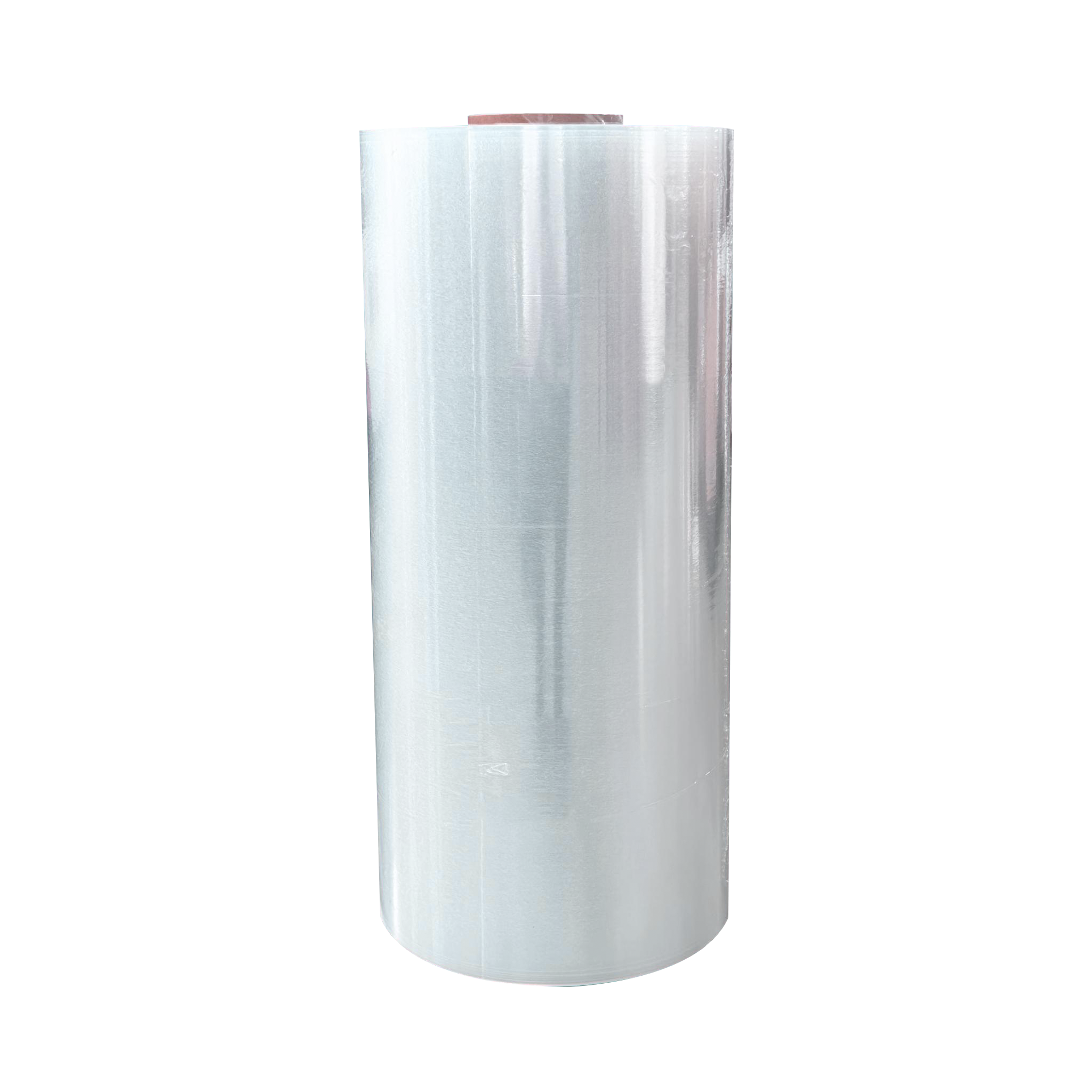

CONTACT DETAILS
- Address:No. 241, Yaojiafan, Zhangpanqiao, Shushan Street, Xiaoshan District, Hangzhou City, Zhejiang Province, China
- TEL:+86-0571-83175630
- Phone:+86-13336160217
- Email:anqiaocun@163.com
PRODUCTS
NEWS CENTER
MOBILE TERMINAL
Copyright© Zhejiang Geruite Packaging Materials Co., Ltd. All Rights Reserved.
Privacy Wholesale industrial packaging tape Manufacturers