


 English
  Español
  عربى
عربى 
Colored Stretch Wrap for Smarter Industrial Packaging and Load Security
Content
- 1 Understanding Colored Stretch Wrap
- 2 Product Specifications and Practical Options
- 3 Core Advantages Over Ordinary Packaging Options
- 4 Advanced Manufacturing Processes Behind Reliable Performance
- 5 Company Strengths Supporting Product Reliability
- 6 Applications in Logistics, Manufacturing, and Warehouse Management
- 7 How Colored Stretch Wrap Compares with Competing Solutions
- 8 Selection Guidance for Different Packaging Needs
- 9 Usage Recommendations for Better Results
- 10 Storage and Handling Notes
- 11 Sustainability and Material Efficiency Considerations
- 12 Why Manufacturing Expertise Matters to Buyers
- 13 Practical Case Examples
- 14 Frequently Asked Questions
- 14.1 What is colored stretch wrap mainly used for?
- 14.2 How is colored stretch wrap different from clear stretch film?
- 14.3 What thickness should be selected?
- 14.4 Can the roll length and weight be customized?
- 14.5 What colors are available?
- 14.6 Can colored stretch wrap be used for irregularly shaped products?
- 14.7 Is colored stretch wrap suitable for food or chemical industry packaging?
- 14.8 How should colored stretch wrap be stored?
- 14.9 Why is manufacturer quality control important?
- 14.10 Can colored stretch wrap replace strapping?
- 15 Conclusion
- 16 References
Industrial packaging is no longer only about enclosing goods before shipment. In modern logistics, packaging must stabilize palletized loads, protect surfaces, improve warehouse identification, reduce handling errors, and help businesses control total operating costs. Colored stretch wrap is designed to meet these practical needs with a simple but highly effective material: a flexible, stretchable polyethylene-based film that clings tightly around cartons, pallets, pipes, cables, doors, windows, metal parts, and many other regular or irregular products. With thickness options from 0.015 mm to 0.045 mm and common heights such as 45 cm and 50 cm, this type of film offers a strong balance of protection, visual management, material efficiency, and application versatility.
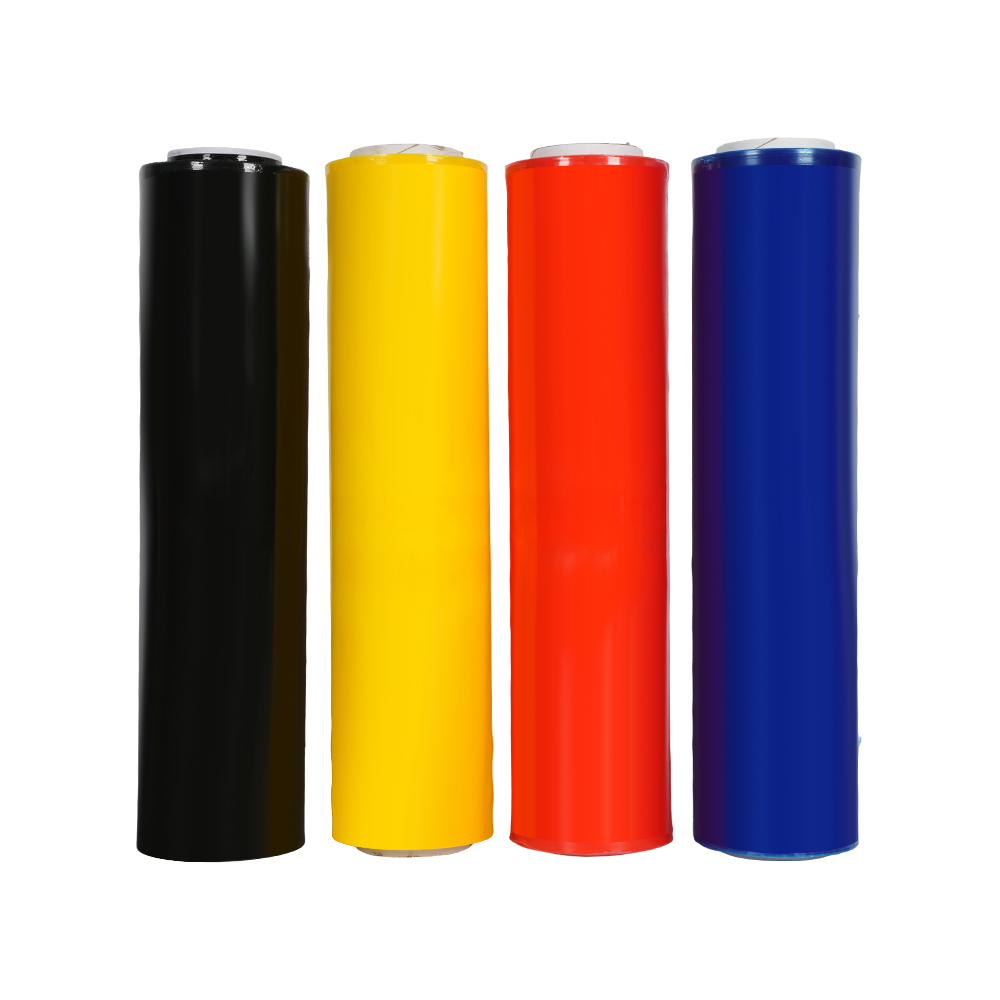
Unlike standard clear stretch film, colored stretch wrap adds an important management function to packaging. Different colors, including red, yellow, blue, black, white, and other customized options, can be used to distinguish product batches, shipping destinations, inventory categories, storage zones, inspection status, or priority levels. In fast-moving warehouses and production sites, this visible differentiation can reduce sorting mistakes and improve workflow efficiency. At the same time, the film provides fundamental protection against dust, moisture, oil stains, surface abrasion, and load displacement during handling, stacking, and transportation.
For manufacturers, distributors, logistics companies, and industrial users, the value of colored stretch wrap comes from its combination of low unit cost and broad performance. It can be used by hand or with mechanical stretch wrap dispensers, adapting to small workshops, medium-sized warehouses, and large-scale packaging lines. When produced by an experienced packaging material manufacturer with advanced film-forming equipment, strict quality control, and stable raw material management, colored stretch wrap becomes a dependable tool for improving cargo safety and packaging consistency.
Understanding Colored Stretch Wrap
Colored stretch wrap is a plastic film material commonly made from polyethylene, including linear low-density polyethylene formulations that provide stretchability, cling, flexibility, and puncture resistance. During application, the film is stretched and wrapped around goods. As it attempts to return to its original state, it generates holding force around the load. This holding force is what keeps cartons together on a pallet, prevents loose items from shifting, and reduces the risk of goods scattering during transportation.
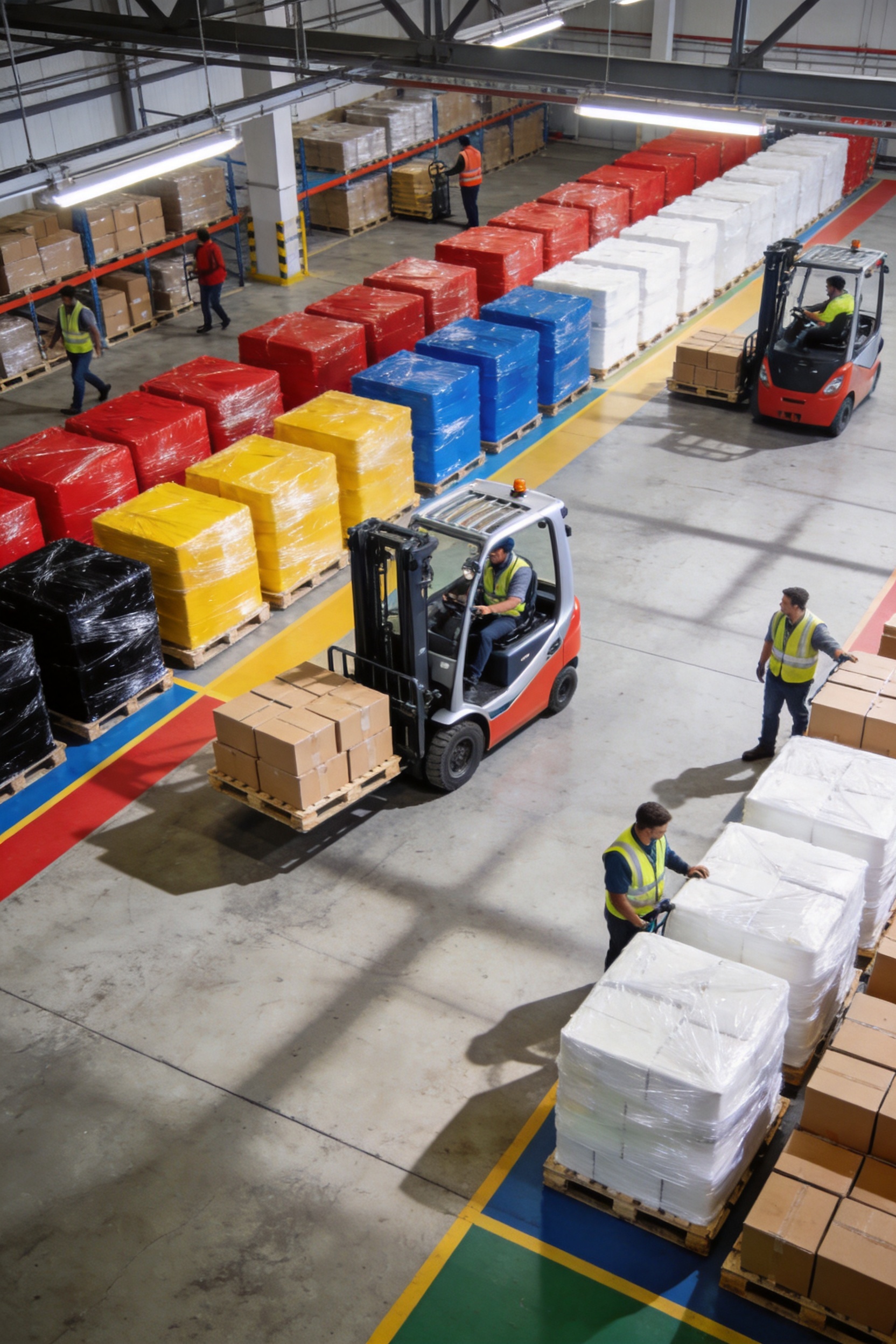
The color component does not replace the basic packaging function of stretch film; instead, it expands the film’s usefulness. A blue film may identify export goods, a red film may indicate urgent shipment, a yellow film may mark inspected inventory, a black film may conceal high-value or sensitive products, and a white film may create a clean, uniform appearance. The exact color management system can be customized by each user according to internal procedures.
This product is especially valuable in industrial environments where speed and clarity matter. Workers do not need to read small labels from a distance when the whole pallet has a visible color code. Forklift operators, warehouse supervisors, quality inspectors, and dispatch teams can recognize different cargo groups immediately. In large storage areas, visual cues can prevent goods from being placed in the wrong zone or loaded onto the wrong truck.
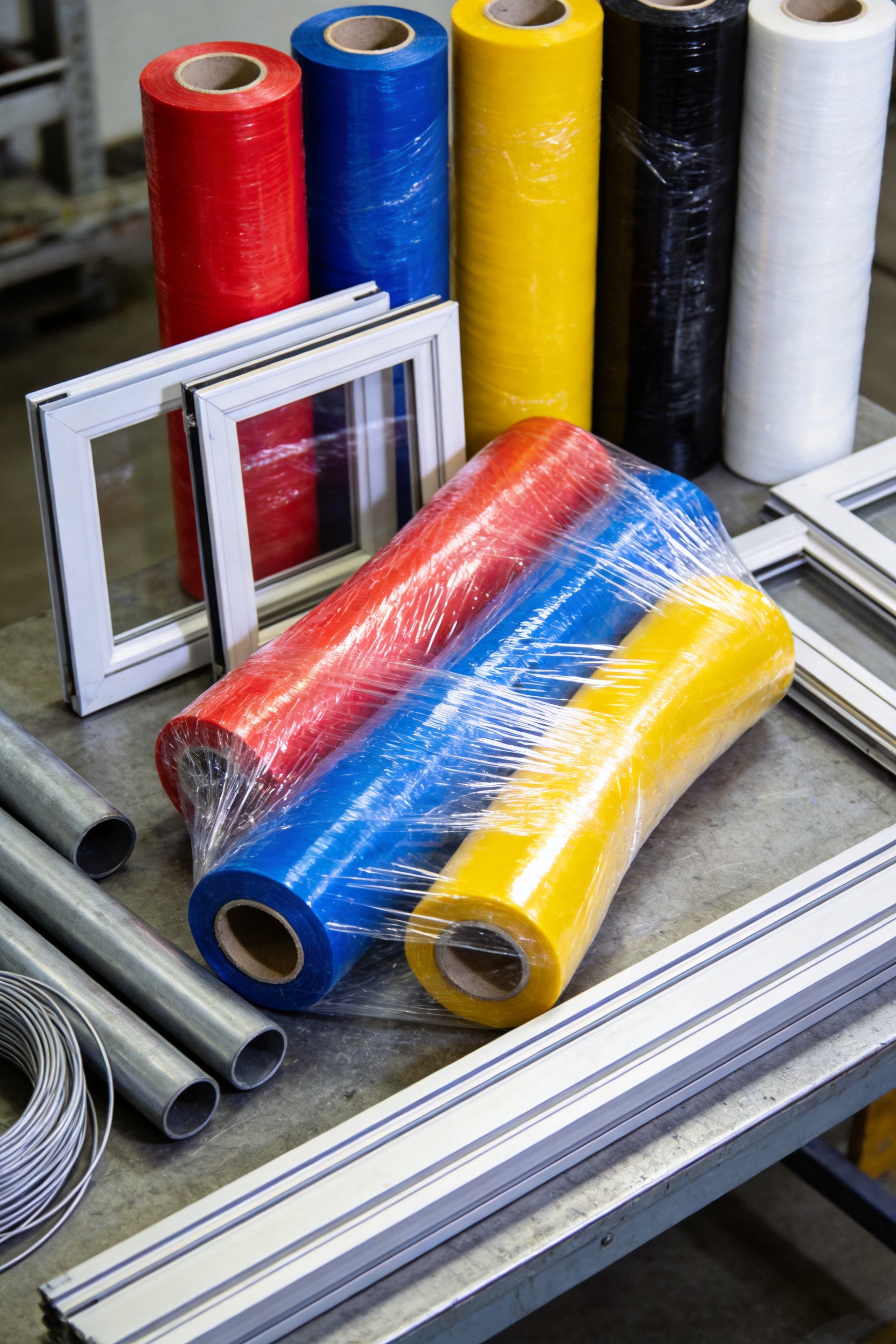
At the same time, colored stretch wrap remains a protective packaging material. It helps keep carton surfaces cleaner, reduces exposure to dust and splashes, and offers a moisture barrier suitable for general storage and transit conditions. It also reduces direct friction between goods and the external environment. When used to wrap irregular items such as pipes, cables, door frames, window frames, or long metal components, it can reduce surface scratches caused by movement during handling.
Product Specifications and Practical Options
Colored stretch wrap is available in multiple specifications to suit different packaging scenarios. The product described here is offered in thicknesses from 0.015 mm to 0.045 mm, giving users flexibility in selecting a film according to required strength, wrapping method, load weight, and cost target. Lighter loads may use thinner film for better material economy, while heavier or sharper-edged goods may require thicker film for improved puncture resistance and holding force.
Standard heights include 45 cm and 50 cm, which are widely used for pallet wrapping and general industrial packaging. These widths allow efficient coverage while remaining convenient for manual use. Roll length and roll weight can be customized according to customer usage scenarios. This matters because different users may prioritize different handling conditions. A manual packaging station may prefer a roll weight that reduces worker fatigue, while a machine wrapping process may require longer rolls to reduce replacement frequency.
| Parameter | Available Value or Description | Practical Benefit |
| Product Type | Colored stretch wrap | Combines load stabilization, surface protection, and visual identification |
| Material | Polyethylene-based film | Offers flexibility, stretchability, cling, and general moisture resistance |
| Thickness | 0.015 mm to 0.045 mm | Supports different load weights, protection levels, and cost requirements |
| Height | 45 cm and 50 cm | Suitable for common pallet wrapping and industrial bundling applications |
| Length and Weight | Customizable according to usage scenario | Improves efficiency for manual wrapping or machine wrapping operations |
| Available Colors | Red, yellow, blue, black, white, and other options | Enables batch identification, destination coding, privacy, and warehouse management |
| Applications | Carton pallets, pipes, cables, doors, windows, metal parts, industrial products | Provides broad adaptability for regular and irregular products |
The availability of different colors and specifications makes this film suitable for a wide variety of industries. Food and chemical sectors can use it for external dust and moisture protection. Logistics companies can use it to separate shipment routes. Manufacturers can use it to protect semi-finished goods during internal transfer. Building material suppliers can use it to bundle long profiles, frames, tubes, and panels. Electronics distributors can use it to stabilize cartons and create clear inventory zones.
Core Advantages Over Ordinary Packaging Options
Visual Management That Reduces Mistakes
One of the clearest advantages of colored stretch wrap is the ability to turn packaging into a visual management tool. Clear film provides protection, but it does not create immediate visual separation between different goods. Labels can help, but labels may be small, damaged, hidden, or difficult to read from a distance. Colored film covers the entire wrapped surface, making identification immediate and obvious.
This advantage is especially important when warehouses handle many stock keeping units, mixed pallets, urgent orders, or goods moving through multiple processing stages. A simple color system can help staff identify whether a pallet is awaiting inspection, approved for shipment, reserved for a certain customer, or assigned to a particular route. In many cases, reducing one loading mistake can save far more than the cost of the film used across multiple pallets.
Compared with printed labels, colored stretch wrap also has the benefit of continuous visibility. Even if a pallet is rotated, stacked, or partially blocked, the color remains visible. This makes it useful in crowded warehouses and during loading operations where decisions must be made quickly. For businesses working under time pressure, such small improvements in visibility can create meaningful operational benefits.
Load Stability During Transportation
The primary role of stretch wrap remains load stabilization. During transportation, cartons and products can experience vibration, acceleration, braking, turning, forklift movement, stacking pressure, and uneven road conditions. Without proper securing, cartons may shift, lean, fall, or become damaged. Colored stretch wrap helps unitize separate cartons into one more stable pallet load.
When applied with proper tension, the film creates a continuous holding force around the load. It helps prevent boxes from spreading outward or sliding off the pallet. This can reduce product loss, customer complaints, rework, and safety risks. Compared with loose rope or simple banding alone, stretch wrap distributes force over a broad surface area, reducing concentrated pressure points on cartons.
For irregular products, the film’s flexibility is a major advantage. Pipes, cables, frames, and other elongated items can be difficult to secure using rigid packaging. Stretch film adapts to the shape of the item and holds multiple pieces together. It can also protect surfaces from dust and light abrasion during handling. This combination of bundling and protection makes colored stretch wrap more versatile than many single-purpose packaging materials.
Protection Against Dust, Moisture, and Surface Contamination
Industrial goods are often stored in warehouses, workshops, temporary staging areas, trucks, containers, and distribution centers. In these environments, products may be exposed to dust, moisture, oil mist, dirt, and other contaminants. Colored stretch wrap forms a protective external layer that helps keep goods cleaner during storage and transit. While it is not a substitute for specialized waterproof packaging in extreme conditions, it provides practical protection for many common industrial scenarios.
For cartons, the film helps reduce surface contamination and minor moisture exposure. For metal parts, pipes, and hardware, it helps limit contact with dust and fingerprints. For doors, windows, and decorative profiles, it can reduce scratches and surface marks. For chemical or food-related outer packaging, the film helps create a cleaner appearance and supports basic storage hygiene.
Black or opaque colored film can provide an additional benefit by concealing the contents of the pallet. This is useful for high-value goods, branded products, confidential shipments, or items that should not be visually exposed during transport. Compared with clear film, colored film can improve privacy and reduce casual attention while still delivering stretch wrap performance.
Cost-Effectiveness Across Daily Packaging Operations
Packaging decisions are always influenced by cost. Colored stretch wrap offers a favorable balance because it provides several functions in one material: securing, protecting, identifying, and sometimes concealing goods. Instead of using separate color tags, additional dust covers, light bundling materials, and identification markers, companies can use colored film as part of a simplified packaging system.
The product’s thickness range allows users to choose the most economical grade for each application. A light pallet with stable carton geometry may use a thinner film, while a heavy or irregular load may need a thicker option. This flexible selection reduces waste and helps avoid over-packaging. Custom roll length and weight further improve efficiency by matching the film format to actual working conditions.
When used with dispensers or machines, stretch wrap can also improve labor efficiency. Workers can wrap loads more evenly and quickly, reducing rework caused by loose or uneven film. Machine wrapping can create more consistent stretch ratios and holding force, lowering material consumption per pallet while improving packaging reliability. These process improvements contribute to lower total packaging cost, not simply lower material cost.
Advanced Manufacturing Processes Behind Reliable Performance
The performance of colored stretch wrap depends not only on the raw material but also on manufacturing control. A film may look simple, but stable thickness, consistent color, good stretchability, reliable cling, and puncture resistance require careful processing. Zhejiang Geruite Packaging Materials Co., Ltd. focuses on research, development, production, and sales of packaging materials, including PE stretch film, adhesive tapes, PP strapping, PET strapping, and other industrial packaging products. Its experience across multiple packaging categories supports a comprehensive understanding of industrial packaging requirements.
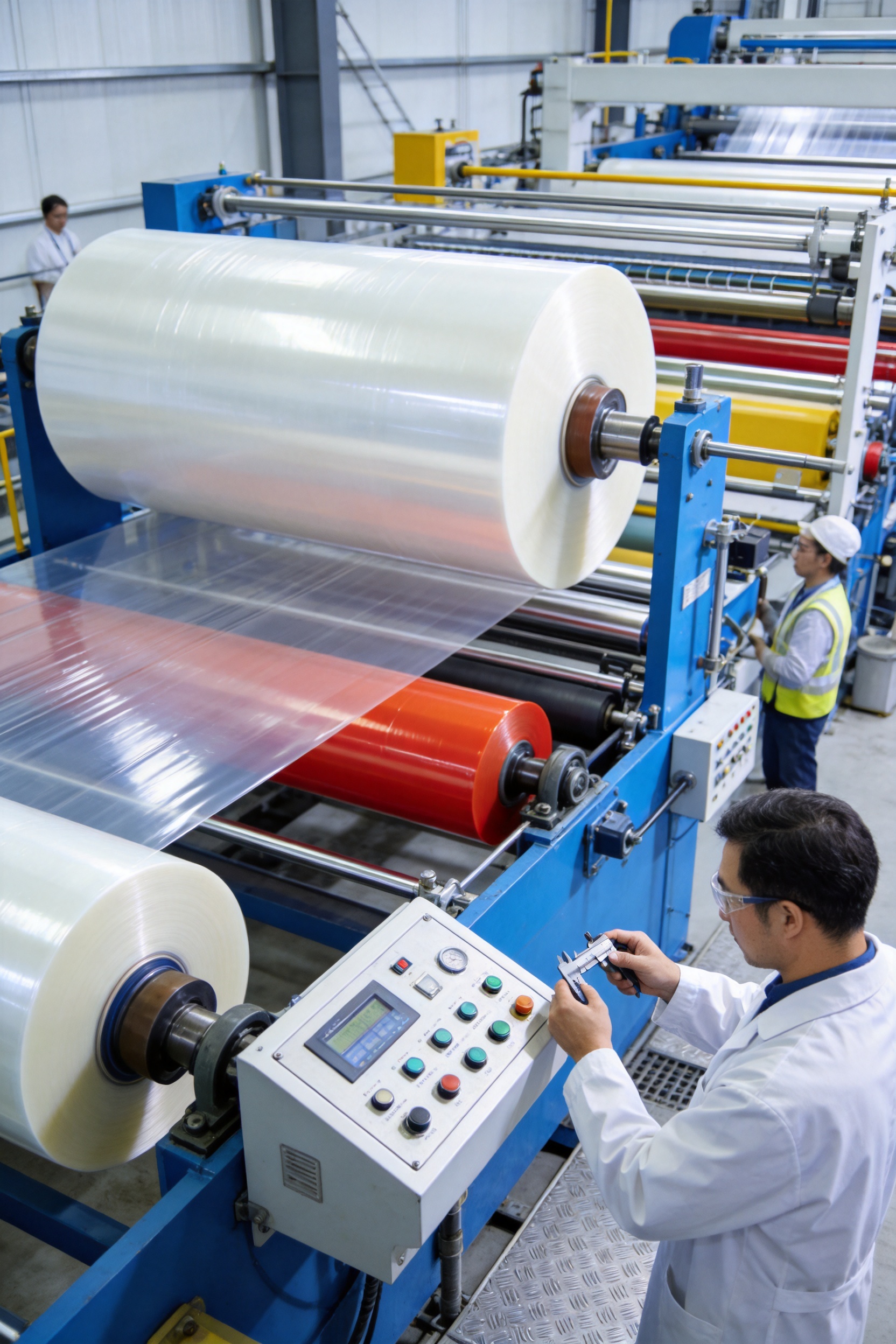
Colored stretch wrap can be manufactured through processes such as polyethylene blow molding or casting. Both process routes require accurate control over raw material mixing, extrusion temperature, film formation, cooling, winding tension, and final inspection. The selected resin formulation must provide the right balance of elongation, tensile strength, cling, clarity or opacity, and puncture resistance. Color masterbatch must be dispersed evenly to create consistent color without compromising mechanical performance.
In high-quality production, thickness uniformity is a critical indicator. If the film is too thin in some areas, it may tear during stretching or puncture during use. If it is too thick in other areas, material is wasted and roll consistency is reduced. Advanced extrusion control helps maintain stable gauge across the film width and along the roll length. Stable gauge gives users predictable performance and helps them calculate packaging consumption more accurately.
Winding quality is also important. A roll with uneven winding, wrinkles, loose edges, or excessive telescoping can cause problems during application. Workers may experience film breaks, uneven stretching, or wasted material. Machine wrapping equipment may stop frequently if the roll is unstable. Proper winding tension and edge control help ensure smooth unwinding, whether the film is used manually or mechanically.
Raw Material Management and Formulation Control
Raw material quality is the foundation of stretch film performance. Polyethylene resins must be selected according to the desired level of stretch, toughness, and cling. Additives and color masterbatches must be compatible with the base resin. For colored stretch wrap, different pigments may slightly influence film behavior, so formulation control is especially important. A responsible manufacturer confirms technical parameters when customers have specific strength, UV resistance, opacity, or color requirements.
Geruite’s manufacturing strength is supported by a quality-focused approach covering raw material procurement, production, and final inspection. This full-process control helps ensure that customers receive film with stable properties rather than inconsistent rolls from batch to batch. In industrial packaging, consistency is often as important as peak strength. A warehouse team needs every roll to perform predictably because packaging operations are repeated hundreds or thousands of times.
For applications requiring stronger puncture resistance or higher holding force, the formulation can be adjusted within the product’s specification range. For applications where visual identification is the primary function and loads are light, the film can be optimized for cost efficiency. This ability to match formulation and specification to real usage scenarios is a competitive advantage over suppliers that only offer standard products without technical guidance.
Film Forming, Cooling, and Thickness Stability
During film forming, molten polyethylene is shaped into a thin film and then cooled under controlled conditions. The cooling process influences film strength, stretch behavior, surface quality, and winding stability. If cooling is uneven, the film may develop weak points or dimensional instability. If extrusion conditions fluctuate, the film may show inconsistent thickness or surface defects.
Advanced production equipment helps reduce these risks by maintaining stable process parameters. Temperature control, screw speed, die adjustment, air flow or casting roll conditions, and line speed must work together. The goal is not only to produce film quickly, but to produce film that performs reliably during stretching and wrapping. A film that stretches smoothly without sudden breakage saves labor, reduces waste, and improves load security.
Color consistency is another key factor. In visual management applications, the meaning of color depends on reliable recognition. If one batch of blue film is very different from another batch, warehouse identification may become confusing. Uniform pigment dispersion and batch control help maintain color stability, improving the professional appearance and management function of the packaging.
Inspection Systems and Quality Assurance
Quality assurance for colored stretch wrap may include checks for thickness, width, roll weight, appearance, tensile performance, elongation, puncture resistance, cling, winding condition, and color consistency. These checks help identify deviations before products reach customers. For industrial users, receiving stable rolls reduces downtime and improves confidence in packaging procedures.
Geruite’s broader product portfolio, including BOPP tapes, kraft paper tapes, masking tapes, high-temperature resistant tapes, metal tapes, PE stretch film, PP strapping, and PET strapping, demonstrates experience with adhesive, film, and strapping technologies. This cross-category manufacturing background is valuable because many packaging systems use several materials together. A pallet may require cartons sealed with tape, goods wrapped with stretch film, and heavy loads reinforced with strapping. A manufacturer familiar with all these materials can better understand the complete packaging environment.
The company’s annual output value of more than RMB 60 million also indicates a significant production scale. Scale matters because it supports stable supply, better production planning, purchasing strength, and the ability to serve customers with recurring demand. For buyers, stable supply is often as important as product performance, especially when packaging materials are consumed daily and shortages can interrupt shipping operations.
Company Strengths Supporting Product Reliability
Zhejiang Geruite Packaging Materials Co., Ltd. is located in Zhejiang Province, China, a region known for developed manufacturing capability and a strong industrial supply chain. This location supports access to raw materials, equipment, logistics networks, skilled labor, and related packaging industry resources. For international and domestic customers, a manufacturer located in such a region can provide practical advantages in production responsiveness and supply coordination.
The company has focused on research and innovation in packaging materials since its establishment. Its products are widely used in logistics and express delivery, household goods, electronics, construction and decoration, industrial manufacturing, cargo stabilization, and packaging protection. This broad application experience enables the company to understand different customer needs instead of viewing packaging as a one-size-fits-all product.
Quality is presented as the company’s operational lifeline. This principle is especially important for stretch film because minor defects can create major problems during use. A film that tears repeatedly wastes time. A roll that does not unwind smoothly frustrates workers. A color that varies too much weakens the visual management system. A film with poor holding force may allow goods to shift during transportation. By emphasizing raw material control, advanced equipment, production inspection, and final quality checks, the company strengthens the reliability of every shipment.
Geruite’s product range also allows customers to source related packaging materials from one experienced supplier. A buyer that needs colored stretch wrap may also need BOPP sealing tape, kraft paper tape, masking tape, high-temperature tape, metal tape, PP strapping, or PET strapping. Coordinated sourcing can simplify communication, reduce supplier management work, and support consistent packaging standards across a company’s operations.
Applications in Logistics, Manufacturing, and Warehouse Management
Logistics and Transportation
In logistics, the key challenge is moving goods safely through multiple handling stages. A pallet may leave a factory, enter a warehouse, be moved by forklift, loaded into a truck or container, unloaded at a distribution center, sorted again, and finally delivered to a customer. Every transfer creates a chance for shifting, contamination, or misidentification. Colored stretch wrap helps address all three risks.
For palletized cartons, the film keeps boxes together and helps maintain load shape. A stable load is easier to move with forklifts and pallet jacks. It is also safer for workers because cartons are less likely to fall unexpectedly. Color coding can indicate route, customer, priority, or product category. For example, all blue-wrapped pallets may be assigned to one destination, while yellow-wrapped pallets may require inspection before shipping.
The film is also useful for export and long-distance transport because it provides an additional protective layer against dust and general moisture exposure. In container loading, where pallets may be tightly packed, stretch film reduces carton rubbing and helps preserve packaging appearance. A neat, uniform wrapped pallet also creates a more professional impression when goods reach the customer.
Industrial Product Protection
Manufacturers often need to protect products before final packaging, during internal transfer, or while awaiting assembly. Colored stretch wrap can be used to bundle components, cover surfaces, and identify production status. For long or irregular items such as pipes, metal rods, cable reels, doors, windows, frames, and panels, the film conforms closely to the product shape. This flexibility makes it more convenient than rigid packaging for many temporary protection tasks.
In metalworking and building materials industries, surface scratches can reduce product value. Stretch wrap creates a buffer layer that reduces direct contact with dust, handling equipment, and nearby goods. For cable products, the film can secure coils or reels and help keep them clean. For doors and windows, it can protect edges and surfaces during movement through the factory or warehouse.
Because the film is available in multiple colors, manufacturers can also use it to identify process stages. One color may mean parts are awaiting coating, another may mean finished goods, and another may mean quality inspection is required. This simple visual system can improve coordination between departments without requiring complex technology.
Warehouse Management
Warehouse operations depend on organization. When many pallets look similar, errors become more likely. Colored stretch wrap creates large, visible signals that help workers distinguish goods quickly. It can be used to demarcate inventory zones, identify seasonal products, separate customer orders, mark returns, or highlight restricted goods.
Compared with floor signs or shelf labels alone, colored film travels with the goods. If a pallet is moved from one area to another, the color remains attached to it. This is useful for temporary storage, cross-docking, and fast turnover operations. It can also support first-in, first-out systems when combined with date labels and batch control.
Black film is particularly useful when warehouses store high-value goods or products that should not be easily identified. By concealing carton markings or product shapes, it adds a layer of privacy. White film can create a clean and consistent appearance for products shipped to retail or customer-facing environments. Bright colors such as red, yellow, and blue can be used where rapid recognition is the priority.
Food, Chemical, and Cleanliness-Oriented Uses
Food and chemical industries often require packaging that helps maintain cleanliness during storage and transportation. Colored stretch wrap can serve as an external protective layer for palletized cartons, drums, or secondary packaging. It helps reduce dust accumulation and provides basic moisture resistance. It also makes batch or category separation easier, which is important when handling different product types.
For chemical products, color coding can help identify hazard categories, storage groups, or shipment priorities when used in accordance with internal safety procedures. For food-related goods, color coding can help distinguish production dates, product varieties, or destination regions. The film should be selected according to the specific application requirements, and technical parameters should be confirmed in advance when special resistance, hygiene, or regulatory requirements apply.
How Colored Stretch Wrap Compares with Competing Solutions
Packaging buyers often compare colored stretch wrap with clear stretch film, shrink film, strapping, tape, pallet covers, and other bundling materials. Each material has its place, but colored stretch wrap provides a distinctive combination of benefits.
Compared with clear stretch film, the main added value is visual identification and possible concealment. Clear film is suitable when product visibility is desired, but it does not help workers identify categories from a distance. Colored film provides similar wrapping functions while adding operational meaning through color.
Compared with shrink film, stretch wrap usually requires less heat-related equipment and is easier to apply in many warehouse settings. Shrink film can provide tight packaging after heat treatment, but it may not be as convenient for quick pallet wrapping or temporary bundling. Stretch wrap can be applied manually or mechanically without heat, reducing energy use and simplifying operation.
Compared with strapping, stretch wrap distributes holding force across a larger surface area. Strapping is excellent for heavy-duty securing, especially for strong cartons, bundles, or rigid goods, but narrow straps can create concentrated pressure. Stretch wrap stabilizes the entire load surface and helps protect against dust and moisture. In many cases, stretch film and strapping are used together: strapping provides strong mechanical restraint, while stretch film provides surface stability and protection.
Compared with adhesive tape, stretch wrap is more suitable for wrapping large surfaces and unitizing pallet loads. Tape is ideal for carton sealing and smaller bundling tasks, but it cannot easily provide full-load containment. A complete packaging system may use tape to seal boxes and colored stretch wrap to secure the pallet.
Compared with pallet covers or sheets, stretch wrap offers better load conformity and holding force. Covers can protect against dust, but they do not secure cartons tightly unless combined with other materials. Stretch wrap both covers and stabilizes. The availability of customized thickness and roll formats further improves its adaptability.
Selection Guidance for Different Packaging Needs
Choosing the right colored stretch wrap requires consideration of load weight, pallet height, carton stability, edge sharpness, storage environment, transportation distance, wrapping method, and identification requirements. A thin film may be sufficient for light, uniform cartons in short-distance handling. A thicker film may be better for heavy loads, irregular shapes, long-distance transport, or goods with sharper corners.
For manual wrapping, roll weight and ease of unwinding are important. Workers need a roll that can be handled comfortably and applied with consistent tension. A dispenser can improve ergonomics and help maintain even stretch. For machine wrapping, roll consistency, core quality, winding stability, and film stretch performance become even more important because equipment operates at higher speed and tension.
Color selection should be based on a clear internal system. Too many colors without rules can create confusion. A good approach is to assign each color a specific meaning and train workers accordingly. For example, red can mean urgent shipment, yellow can mean inspection required, blue can mean export goods, black can mean concealed high-value products, and white can mean finished goods ready for customer delivery. The exact system should match the user’s workflow.
When special conditions exist, such as outdoor storage, high temperature, exposure to strong sunlight, unusual chemical environments, or strict strength requirements, customers should confirm the technical parameters before ordering. Different color formulations may vary slightly because pigments and additives can influence performance. A professional manufacturer can help recommend a suitable grade based on the application.
Usage Recommendations for Better Results
To obtain optimal fixation and material efficiency, colored stretch wrap should be applied with controlled tension. If the film is not stretched enough, holding force may be weak and the load may shift. If the film is overstretched beyond its capability, it may tear or lose performance. Proper application technique is therefore important.
For pallet wrapping, the film should usually be anchored at the pallet base and wrapped around the bottom layers first to connect the goods to the pallet. Overlap between layers should be consistent, and additional wraps may be applied at corners, top edges, or unstable sections. The top of the load can be covered or partially closed depending on the level of dust and moisture protection required. For tall loads, wrapping tension should be controlled to avoid crushing cartons while still maintaining stability.
For irregular items, the film should be guided around protrusions and vulnerable surfaces carefully. Sharp edges may require corner protection or padding before wrapping. When bundling long products such as pipes or profiles, multiple wrapping points along the length may improve stability. The film’s flexibility allows it to conform to the product, but good wrapping technique ensures that the bundle remains secure during movement.
Manual or mechanical stretch wrap dispensers are recommended because they help achieve even stretching and reduce worker fatigue. Dispensers also improve safety by allowing better control of the roll. In high-volume operations, machine wrapping can improve repeatability and reduce material consumption. The choice between manual and machine wrapping depends on daily volume, load type, labor conditions, and investment plan.
Storage and Handling Notes
Colored stretch wrap should be stored in a cool, dry indoor environment. It should be kept away from direct sunlight, high-temperature sources, open flames, and conditions that may deform the rolls. Excessive heat can affect film properties or cause rolls to block. Strong sunlight may influence some plastic materials over time, especially when UV resistance is not specifically designed into the formulation.
Rolls should be stored on clean, flat surfaces and protected from heavy compression or sharp objects. Damaged roll edges can cause tearing during unwinding. If rolls are transported or stored in dusty environments, keeping them in protective packaging until use helps maintain cleanliness and smooth application.
Before large-scale use, especially in a new application, it is advisable to test the selected specification on actual loads. This practical test can confirm whether the thickness, color, cling, stretch, and roll format meet the customer’s requirements. Testing also helps determine the best wrapping pattern and number of film layers needed for reliable load stability.

Sustainability and Material Efficiency Considerations
Modern packaging decisions increasingly consider material efficiency and waste reduction. Colored stretch wrap contributes to efficiency when the right specification is selected and applied correctly. Because the film stretches during application, a relatively small amount of material can cover and secure a large surface area. Proper tension control reduces unnecessary film use while maintaining load stability.
Using a film that is too thick for the application may increase cost and waste. Using a film that is too thin may cause tearing, rewrapping, product damage, or shipment failure. The most sustainable and economical option is often the film that performs reliably with the least necessary material. This requires cooperation between the user and the manufacturer to match film grade with real packaging conditions.
Color coding can also reduce waste indirectly by preventing mistakes. Misrouted goods, damaged loads, or incorrectly stored products consume additional labor, transport, and replacement packaging. If colored wrap helps reduce these errors, it supports more efficient logistics. In this sense, the product’s sustainability value is not only about the plastic film itself, but also about the operational waste it helps prevent.
Companies can further improve responsibility by training workers in correct wrapping methods, maintaining wrapping equipment, storing rolls properly, and organizing used film for appropriate recycling or waste handling where facilities are available. As packaging technology develops, manufacturers with research capability can continue improving formulations and production processes to support stronger performance with better material efficiency.
Why Manufacturing Expertise Matters to Buyers
Buyers sometimes view stretch film as a simple commodity, but the difference between low-quality and well-made film becomes obvious during daily use. Low-quality film may tear frequently, vary in thickness, unwind poorly, lose cling, or fail to hold loads securely. These problems increase hidden costs through wasted film, labor delays, damaged goods, and customer dissatisfaction.
A manufacturer with advanced equipment, experienced production teams, and strict quality control can deliver more predictable results. Geruite’s focus on packaging materials, broad product portfolio, and quality-centered management help create this reliability. The company’s experience serving logistics, electronics, construction, industrial manufacturing, and other sectors gives it practical insight into the challenges customers face.
Technical support is another important advantage. When customers are uncertain about thickness, roll size, color, or application method, a knowledgeable supplier can provide recommendations. This reduces trial-and-error costs and helps customers implement an effective packaging solution more quickly. Customization of length and weight according to usage scenario further improves fit.
Supply stability should not be overlooked. Packaging materials are consumed continuously, and production or shipping operations can be disrupted if film is unavailable. A manufacturer with established production capacity and a strong supply chain can support regular orders and changing demand. For growing businesses, this reliability is essential.
Practical Case Examples
Case Example One: Reducing Sorting Errors in a Distribution Warehouse
A distribution warehouse handling multiple customer orders may find that clear-wrapped pallets look too similar during peak shipping hours. Workers rely on labels, but labels are sometimes placed on the wrong side or blocked by other pallets. By assigning colored stretch wrap to different shipping routes, the warehouse can make destination groups visible from a distance. Blue pallets may go to one region, yellow pallets to another, and red pallets to urgent dispatch. This simple change can reduce sorting errors and speed up loading decisions.
Case Example Two: Protecting Irregular Metal Components
A metal parts supplier may need to bundle long profiles or tubes before delivery. Strapping alone can hold the bundle, but it may not protect surfaces from dust or minor abrasion. Colored stretch wrap can be applied around the bundle to hold pieces together and cover the surface. If black film is used, the contents are also less visible during transit. For heavier bundles, the film can be combined with PET strapping for additional mechanical strength.
Case Example Three: Managing Production Stages in a Factory
A factory producing doors and windows may store semi-finished frames in different areas. Without clear identification, workers may move unfinished items to the wrong station. Colored stretch wrap can mark production status. White may indicate finished goods, blue may indicate items awaiting assembly, and yellow may indicate inspection required. The film also protects surfaces during internal transfer, reducing scratches and dust accumulation.
Case Example Four: Improving Privacy for High-Value Shipments
A company shipping branded electronics or other high-value goods may prefer not to expose carton markings. Black colored stretch wrap can conceal the contents while stabilizing the pallet. This does not replace security procedures, but it reduces visual exposure and creates a cleaner external package. Combined with proper labeling and tracking, it supports safer and more organized transportation.
Frequently Asked Questions
What is colored stretch wrap mainly used for?
Colored stretch wrap is mainly used for wrapping and securing palletized cartons, bundling industrial goods, protecting irregular items, and visually identifying product batches, storage categories, or shipping destinations. It helps prevent load shifting while providing basic protection against dust, moisture, oil stains, and surface abrasion.
How is colored stretch wrap different from clear stretch film?
Both materials can stabilize and protect goods, but colored stretch wrap adds a visual management function. Different colors can identify batches, routes, inspection status, or product categories. Opaque colors such as black can also help conceal the contents of a pallet.
What thickness should be selected?
The available thickness range is 0.015 mm to 0.045 mm. Light and regular loads may use thinner film for cost efficiency, while heavy, irregular, or sharper-edged goods may need thicker film for better puncture resistance and holding force. Testing on actual loads is recommended before large-scale use.
Can the roll length and weight be customized?
Yes. Roll length and weight can be customized according to the customer’s usage scenario. Manual wrapping may require lighter rolls for easier handling, while machine wrapping may benefit from longer rolls to reduce replacement frequency.
What colors are available?
Common colors include red, yellow, blue, black, and white. Other colors may be available depending on production arrangements and customer requirements. Color selection should be based on a clear internal identification system.
Can colored stretch wrap be used for irregularly shaped products?
Yes. Its flexibility and stretchability allow it to conform to irregular objects such as pipes, cables, doors, windows, metal parts, frames, and reels. For sharp edges, protective padding or corner guards may be needed to prevent puncture.
Is colored stretch wrap suitable for food or chemical industry packaging?
It can be used as an external wrapping material for palletized food or chemical products to help protect against dust and moisture and to support batch identification. For special hygiene, chemical resistance, or regulatory requirements, technical parameters should be confirmed in advance.
How should colored stretch wrap be stored?
It should be stored indoors in a cool, dry environment away from direct sunlight, high temperatures, open flames, and sharp objects. Proper storage helps maintain roll shape, film performance, and smooth unwinding.
Why is manufacturer quality control important?
Quality control affects thickness stability, stretch performance, puncture resistance, cling, color consistency, and winding quality. Reliable manufacturing reduces film breakage, packaging waste, downtime, and load security problems.
Can colored stretch wrap replace strapping?
It depends on the load. Colored stretch wrap is excellent for surface containment, dust protection, and pallet stabilization. For very heavy loads or rigid bundles requiring high mechanical strength, PP or PET strapping may also be needed. Many packaging systems use both materials together.
Conclusion
Colored stretch wrap is a practical, economical, and versatile packaging material for modern industrial operations. It secures palletized goods, protects surfaces, reduces dust and moisture exposure, supports irregular product bundling, and adds a valuable visual management function. With thickness options from 0.015 mm to 0.045 mm, common heights of 45 cm and 50 cm, customizable roll length and weight, and color choices such as red, yellow, blue, black, and white, it can be adapted to many logistics, warehouse, and manufacturing needs.
Its advantages over ordinary packaging options come from the way it combines multiple functions in one material. Compared with clear film, it improves identification. Compared with shrink film, it is often simpler to apply. Compared with strapping, it provides broader surface containment. Compared with labels alone, it offers visibility from every side of the pallet. For companies seeking to reduce sorting errors, improve load security, protect goods, and control packaging costs, colored stretch wrap is a strong solution.
The reliability of this product depends on manufacturing expertise. Zhejiang Geruite Packaging Materials Co., Ltd. supports colored stretch wrap production with advanced equipment, formulation control, broad packaging material experience, and a quality-focused management system. Its strengths in tapes, films, and strapping products allow it to understand complete packaging systems rather than isolated materials. For customers, this means more stable performance, practical customization, and dependable supply.
As logistics and manufacturing environments continue to demand faster identification, safer transportation, cleaner storage, and lower operating costs, colored stretch wrap will remain an important packaging material. When selected properly, applied correctly, and sourced from a capable manufacturer, it can improve both packaging performance and daily operational efficiency.
References
1. Soroka, W. Fundamentals of Packaging Technology. Institute of Packaging Professionals.
2. Yam, K. L. The Wiley Encyclopedia of Packaging Technology. Wiley.
3. Robertson, G. L. Food Packaging: Principles and Practice. CRC Press.
4. Han, J. H. Innovations in Food Packaging. Academic Press.
5. Marsh, K., and Bugusu, B. Food Packaging: Roles, Materials, and Environmental Issues. Journal of Food Science.
6. ASTM International. Standard Test Methods for Tensile Properties of Thin Plastic Sheeting.
7. China Packaging Federation. General Technical Guidance for Industrial Packaging Materials.

LATEST POST
Let’s create something amazing together
contact usFeatured Products
CONTACT DETAILS
- Address:No. 241, Yaojiafan, Zhangpanqiao, Shushan Street, Xiaoshan District, Hangzhou City, Zhejiang Province, China
- TEL:+86-0571-83175630
- Phone:+86-13336160217
- Email:anqiaocun@163.com
PRODUCTS
NEWS CENTER
MOBILE TERMINAL
Copyright© Zhejiang Geruite Packaging Materials Co., Ltd. All Rights Reserved.
Privacy Wholesale industrial packaging tape Manufacturers