


 English
 Español
 عربى

PVC Shrink Film for Efficient Label Packaging and Industrial Protection
Content
- 1 Understanding PVC Shrink Film
- 2 Why PVC Remains a Cost-Effective Packaging Choice
- 3 Excellent Printability for High-Impact Labels
- 4 Shrink Performance and Application Flexibility
- 5 Rigidity, Stiffness and Finished Package Appearance
- 6 Manufacturing Process: PVC Calendering
- 7 Quality Control from Raw Materials to Finished Rolls
- 8 Available Dimensions and Custom Specifications
- 9 Applications in Label Packaging
- 10 Industrial and Protective Wrapping Uses
- 11 Comparison with Other Shrink Film Materials
- 12 Compliance and Responsible Use
- 13 Company Manufacturing Strengths and Supply Capability
- 14 How to Select the Correct PVC Shrink Film
- 15 Recommended Processing Practices
- 16 Frequently Asked Questions
- 16.1 What is PVC shrink film mainly used for?
- 16.2 What temperature is required to shrink the film?
- 16.3 Can a heat gun be used?
- 16.4 What shrinkage rate can be expected?
- 16.5 Is the film suitable for direct food contact?
- 16.6 Is it suitable for children’s products?
- 16.7 Can the film be exported to Europe?
- 16.8 What colours are available?
- 16.9 What thickness is available?
- 16.10 What widths can be ordered?
- 16.11 How should the film be compared with PETG or polyolefin film?
- 16.12 What information should be supplied when requesting a quotation?
- 17 Conclusion
- 18 References
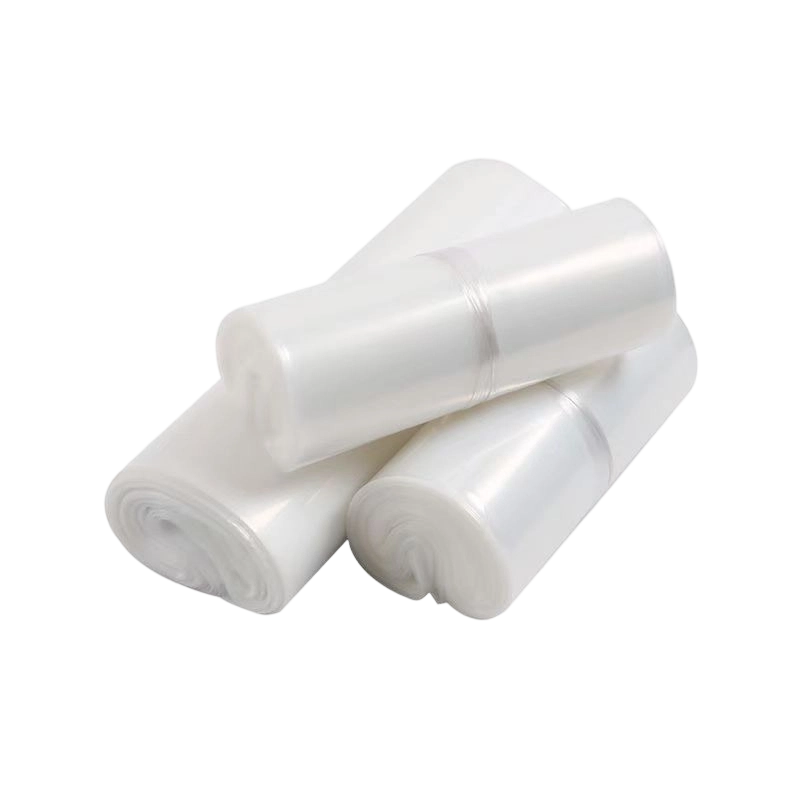
- 19 Product: PVC Shrink Film
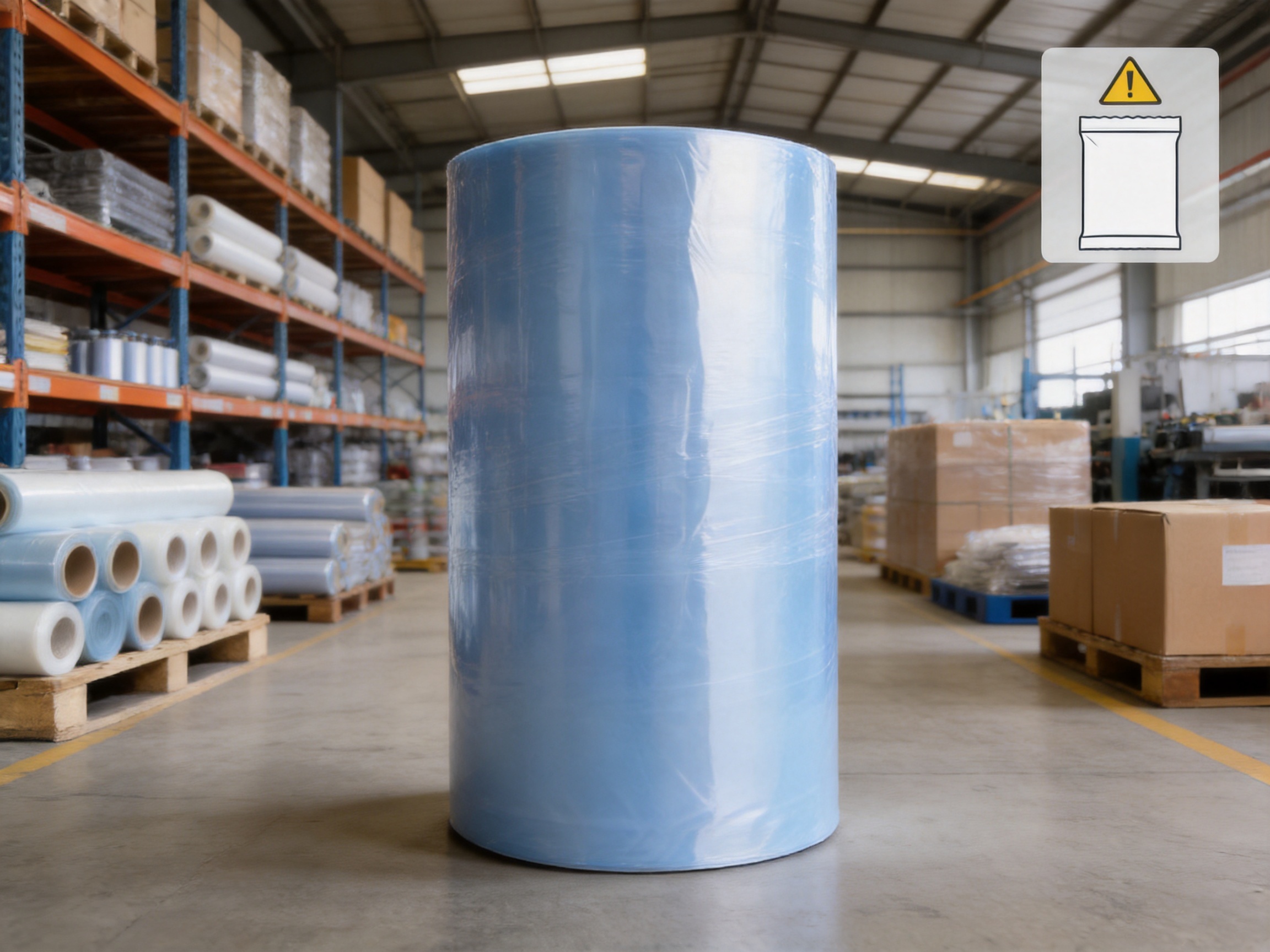
PVC shrink film remains one of the most practical materials for label packaging, product presentation and selected industrial wrapping applications. Its combination of low material cost, reliable shrink performance, strong stiffness and excellent printability makes it a familiar choice for manufacturers that need attractive packaging without investing in highly specialized equipment. When processed correctly, the film conforms closely to the shape of a container or product, creating a neat, secure and visually consistent package.
This material is produced from polyvinyl chloride through a calendering process. Calendering provides a smooth and even film surface, stable thickness and good dimensional consistency across the finished roll. The resulting film can be printed, slit and converted into sleeves, labels, sealing bands and protective wraps. It is especially suitable for customers handling small to medium packaging volumes because its shrinkage temperature is comparatively low. A standard heat gun or common hot-air equipment can often provide sufficient heat, keeping the initial equipment threshold low.
Although PVC shrink film is not intended to replace every other shrink material, it continues to offer a compelling value proposition in applications where cost, print quality, rigidity and straightforward processing are more important than premium environmental performance or direct food-contact suitability. For bottled beverage labels, health supplement sleeves, personal care seals, stationery packaging, toy packaging, building-material protection and disposable sterilized tableware packaging, it can deliver dependable results when the correct specifications and compliance controls are applied.
Understanding PVC Shrink Film
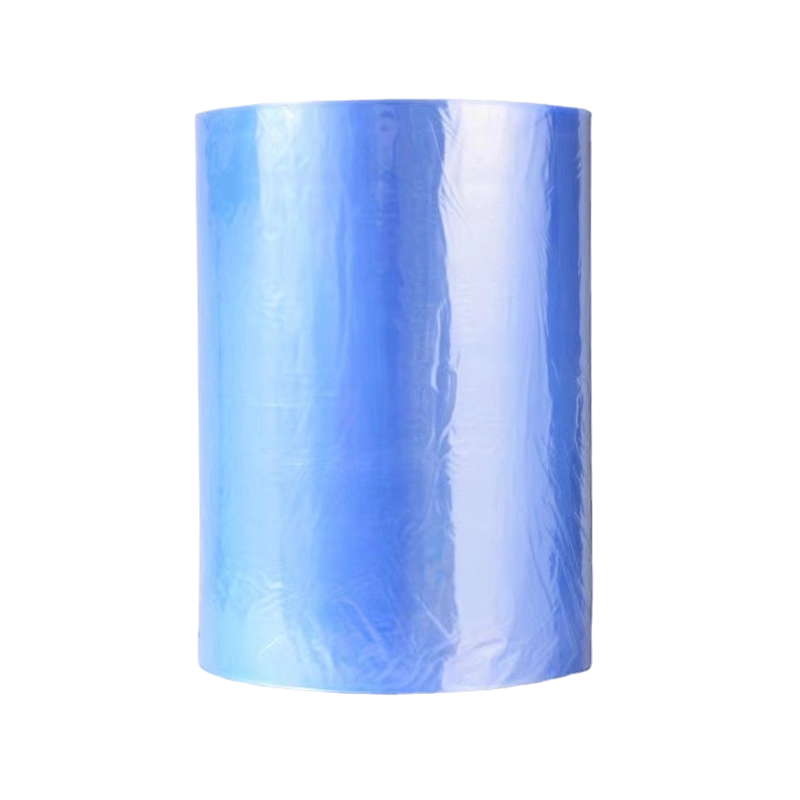
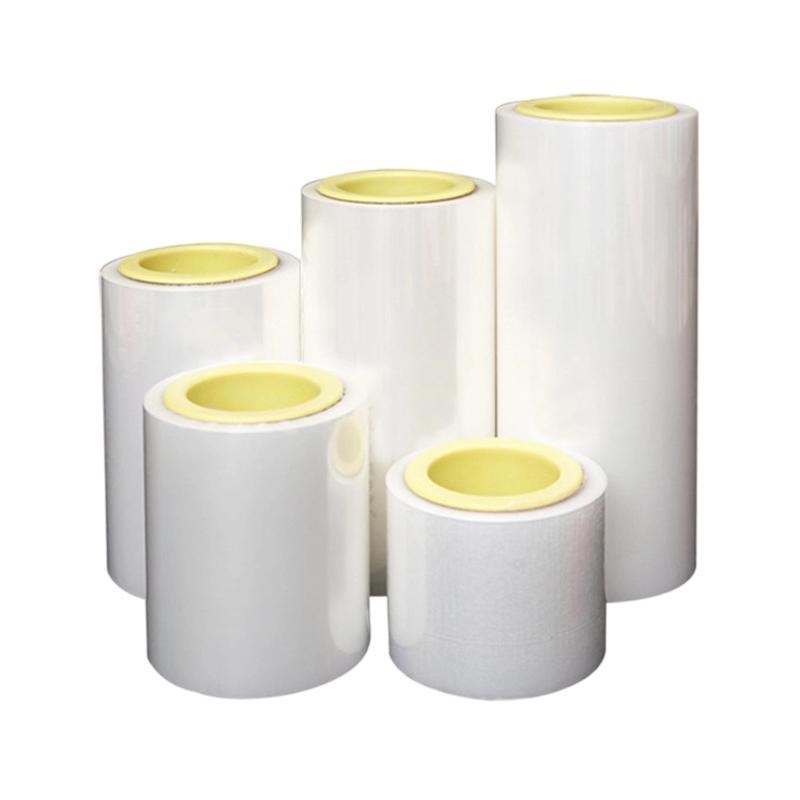
PVC shrink film is a thermoplastic packaging film designed to contract when exposed to controlled heat. The contraction creates a close-fitting layer around a bottle, container, bundle or industrial product. The film can be supplied in transparent or lightly coloured forms, including the transparent and light-blue options available in the product range described here. It can also be converted into printed sleeves or used as a plain protective layer.
The film’s performance comes from the balance between its polymer structure, thickness, orientation and processing conditions. During manufacture, the material is formed into a thin, continuous film and prepared so that it responds predictably to heat. When heat is applied, the film attempts to return toward its original dimensions. The resulting shrinkage helps the film grip the packaged article and maintain a clean appearance.
For this product, the stated nominal thickness is 0.05 mm, with customization available. The listed width range begins at approximately 3 mm and extends to 80 mm for standard specifications, while wider customized formats can be produced up to approximately 150 cm according to order requirements and production feasibility. This range allows the film to serve both narrow label and banding applications and broader industrial wrapping needs.
The stated shrinkage rate is approximately 50–60 per cent. Actual shrinkage depends on the direction of shrinkage, film construction, heating method, exposure time, package geometry and the tension applied during conversion. Buyers should therefore evaluate the film using the intended bottle, product or package shape rather than relying only on a nominal percentage.
Why PVC Remains a Cost-Effective Packaging Choice
The main commercial advantage of PVC shrink film is its balance of performance and acquisition cost. Packaging converters and product manufacturers often need a film that produces a professional appearance but does not require expensive machinery, complex process control or a large minimum investment. PVC addresses this need through a comparatively broad processing window and a low shrinkage temperature of approximately 80–100 °C.
A low shrinkage temperature can simplify the production setup. In many small and medium operations, a standard heat gun, hot-air tunnel or similar heating device is sufficient for testing and low-volume packaging. This reduces the need for high-capacity shrink tunnels during the early stages of a product launch. It also enables businesses to package irregular production batches, seasonal products and sample quantities without committing to a fully automated line.
The film can be particularly attractive when the packaging objective is visual identification rather than long-term structural protection. A printed sleeve can present a brand message, product information, decorative graphics, warning text or tamper-evident indication around a container. In industrial applications, a plain film can help keep dust away from profiles, components, stationery products or packaged accessories during storage and transportation.
Compared with some premium films, PVC may provide a lower material cost for applications that do not require high-end optical performance, exceptional puncture resistance or direct food-contact certification. It is therefore often selected for mainstream label packaging and general-purpose wrapping, where the economic return from a more expensive film would not justify the added cost.
Cost-effectiveness, however, should be evaluated across the entire packaging process. The correct film width, roll length, shrink temperature and package design can reduce waste and rework. A film that is inexpensive per kilogram may still become costly if it is difficult to print, unstable during shrinking or prone to excessive sealing defects. PVC’s established processing characteristics and good printability help reduce these risks when it is converted under suitable conditions.
Excellent Printability for High-Impact Labels
One of the most important strengths of PVC shrink film is its smooth and even surface. A uniform surface supports the application of printed graphics and helps maintain consistent ink coverage. For product manufacturers, this means that label sleeves can display fine text, strong colour blocks, logos, illustrations and detailed product images with good visual clarity.
High colour fidelity is valuable in crowded retail environments. A label must often communicate product identity from a distance, while small text must remain legible at close range. A film with a regular surface helps printers achieve cleaner edges and more stable colour reproduction. When the film is properly treated and the ink system is correctly selected, graphics can remain crisp and rich in detail after shrinking.
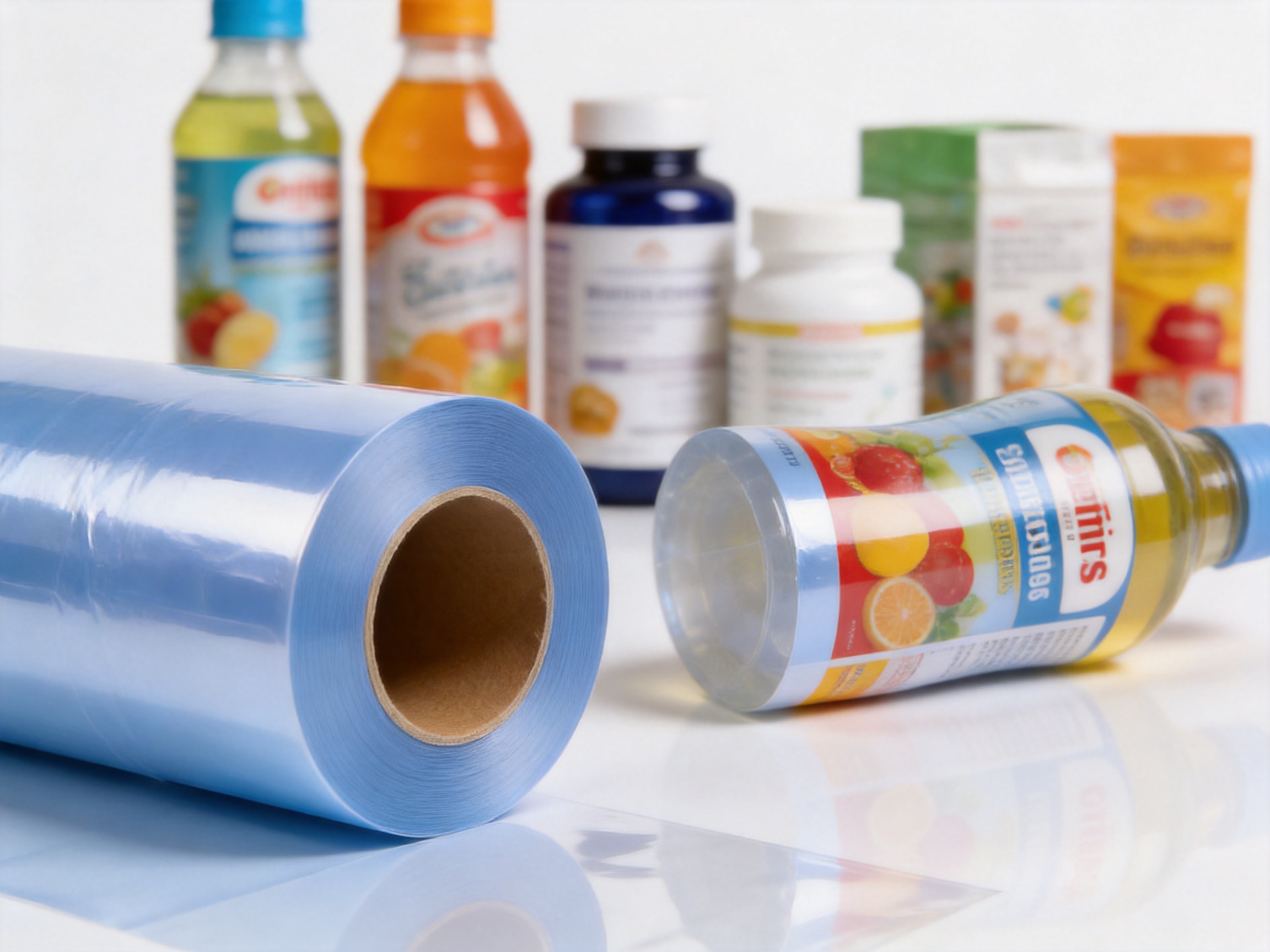
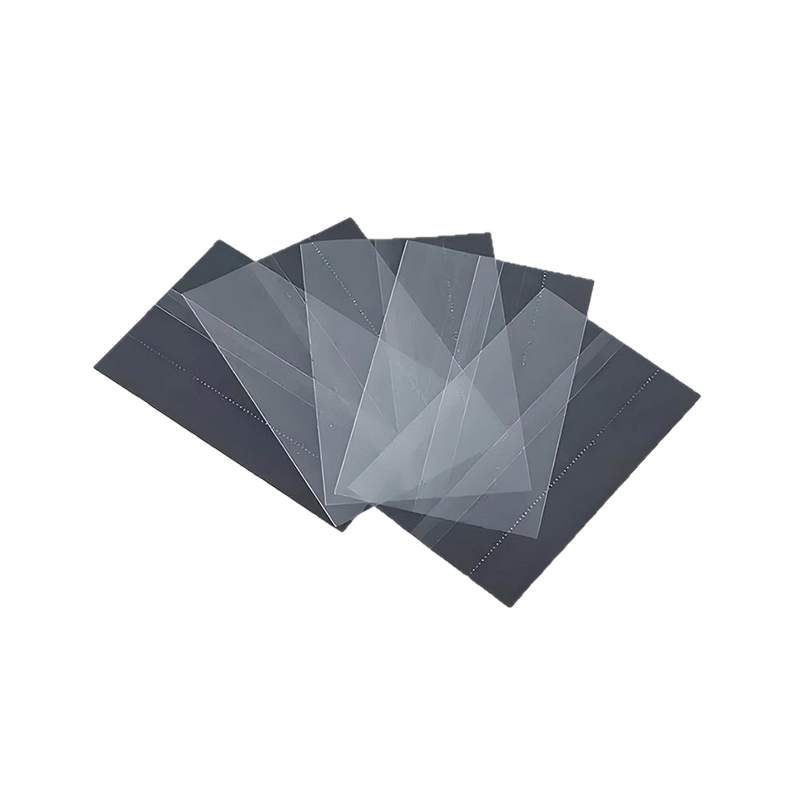
Printed PVC sleeves are commonly used for bottled beverages, health supplement containers, personal care products and household packaging. The sleeve can cover a large portion of the container, providing more printable area than a small pressure-sensitive label. It may also create a continuous decorative effect around curved or unusually shaped packaging.
The film’s stiffness contributes to print handling. Extremely soft films can wrinkle, stretch unpredictably or become difficult to position during slitting and sleeving. PVC’s relatively high rigidity helps it retain a stable form before heat is applied. This can support cleaner feeding, more accurate positioning and better alignment during manual or automated application.
Printing performance still depends on more than the film alone. Surface treatment, ink compatibility, drying conditions, storage humidity, printing speed and winding tension all affect the final result. Converters should confirm ink adhesion and rub resistance through practical trials. They should also assess how the printed surface behaves when exposed to the selected shrink temperature.
PVC Shrink Film
Shrink Performance and Application Flexibility
PVC shrink film is designed to respond to heat in a controlled and visible way. With a shrinkage range of approximately 50–60 per cent, it can accommodate many common bottle and container geometries. When the film is correctly sized, heated evenly and allowed to contract without obstruction, it can form a close-fitting sleeve with a smooth appearance.
The shrinkage process normally involves several stages. First, the film is cut or formed to the required sleeve dimensions. It is then positioned around the product, container or bundle. Heat is applied progressively, allowing the film to soften and contract. Finally, the package is inspected for wrinkles, open seams, bubbles, distortion or incomplete shrinking.
The low processing temperature of approximately 80–100 °C provides practical flexibility. Small packaging operations can use a heat gun for individual items or short production runs. Larger operations may use a heat tunnel for better speed and consistency. The exact temperature setting should be established through testing because the air temperature at the equipment display may differ from the actual film surface temperature.
Uniform heating is essential. Directing excessive heat at one point can cause local distortion, holes or excessive contraction. Conversely, insufficient heat can leave loose areas and wrinkles. Operators should move a heat gun continuously and maintain an appropriate distance from the film. For tunnel equipment, conveyor speed, air circulation and tunnel temperature should be adjusted together.
The film’s adhesion and smooth sealing characteristics support a finished package that looks neat rather than loosely wrapped. Depending on the package design, the film may be heat-sealed, overlapped or converted into a sleeve before heat shrinking. The chosen construction should account for the shape of the container, the required opening method and whether the package must provide a tamper-evident function.
Every product shape should be tested before full-scale production. Bottles with shoulders, handles, deep recesses or sharp transitions may require a modified sleeve design. A flat film dimension that works well on a cylindrical bottle may not provide the same result on a square container. Testing also helps determine whether the film should be applied with slightly more or less allowance for shrinkage.
Rigidity, Stiffness and Finished Package Appearance
PVC shrink film has high rigidity and excellent stiffness compared with many softer packaging films. These characteristics help the finished package retain a firm and upright appearance. Instead of sagging loosely around the product, the film can create a more structured outer layer after shrinking.
Appearance is especially important for retail packaging. A sleeve that remains smooth, vertical and well aligned can improve shelf presentation. The label can follow the container profile while maintaining a consistent visual plane for printed graphics. This makes the product easier to identify and can support a more orderly display across a group of packages.
Stiffness also benefits handling before and after application. During conversion, the film is less likely to collapse under its own weight than a very soft film. During transportation, a well-shrunk sleeve can help keep the label positioned around the container. The film is not a substitute for a rigid carton or protective structural packaging, but it can provide useful surface protection and visual stability.
For industrial wrapping, rigidity can help the film remain in place around long profiles, packaged stationery, toys, components and selected building materials. The wrapping may reduce dust accumulation and limit light surface contact during storage. It can also keep small parts together when used as an external bundling layer, provided that the package is not subjected to loads beyond the film’s intended capacity.
Rigidity must be balanced against flexibility. A package with sharp corners or high deformation may require a different film construction or a protective inner layer. Operators should avoid forcing the film over sharp projections that could puncture it during shrinking. Rounded edges and suitable product preparation generally improve the final result.
Manufacturing Process: PVC Calendering
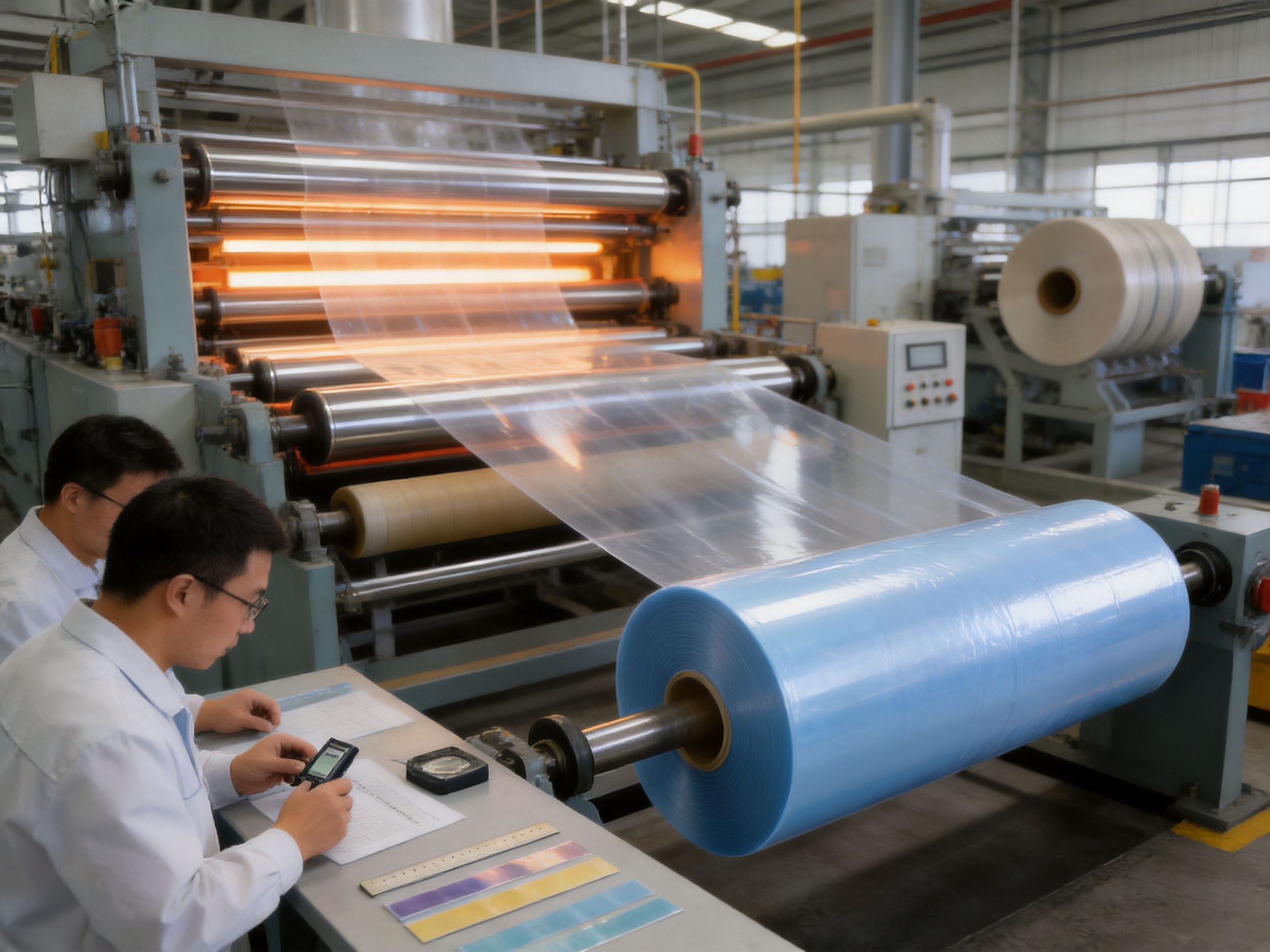
The product is manufactured using a PVC calendering process. Calendering is a mature industrial method for producing continuous polymer films with controlled thickness and a smooth surface. In a typical process, carefully selected PVC compounds and additives are blended, heated and plasticized before being passed through a series of heated rollers. The rollers shape the material into a thin sheet or film while helping establish the required thickness and surface finish.
Raw-material preparation is the first important control point. The polymer resin, stabilizers, plasticizers, pigments and other formulation components must be measured consistently. The formulation influences flexibility, stiffness, colour, heat response, printability and long-term stability. A controlled batching procedure helps maintain uniformity from one production lot to the next.
During mixing, the components are distributed throughout the compound. Inadequate dispersion can produce colour variation, weak spots or inconsistent processing behaviour. Proper blending and temperature control help the compound achieve a stable structure before it enters the calendering section.
The calender rolls then apply pressure and heat to form the film. Roll temperature, roll gap, line speed and tension must be coordinated. The roll gap is directly related to film thickness, while line speed affects residence time and output. Excessive variation in these conditions can lead to thickness differences, surface marks or unstable winding.
After forming, the film is cooled and inspected. Cooling helps stabilize the film before it is wound into rolls. Tension must be controlled during winding so that the roll is neither too loose nor excessively compressed. A stable roll supports later slitting, printing and sleeve conversion.
Advanced manufacturing is not limited to the main forming machine. It includes raw-material inspection, equipment maintenance, process monitoring, in-line visual checks, thickness measurement, roll identification and final quality inspection. Each stage contributes to predictable performance for customers.
For a professional packaging-material supplier, manufacturing strength also involves the ability to customize width, thickness, colour, roll length and packaging format. The product information specifies a standard thickness of 0.05 mm while allowing customization. Such flexibility is valuable because packaging lines differ in sleeve dimensions, product geometry, machine design and order volume.
Quality Control from Raw Materials to Finished Rolls
Quality control should begin before production. Incoming PVC resin and additives should be checked against purchasing specifications. Materials should be stored under suitable conditions and protected from contamination, excessive humidity and direct environmental exposure. Correct material identification reduces the risk of mixing incompatible or incorrect batches.
During production, operators should monitor the calendering line continuously. Important controls include film thickness, width, surface appearance, colour consistency, roll tension and visible contamination. Depending on the customer’s specification, additional tests may include shrinkage, tensile performance, heat response, print adhesion and sealing behaviour.
The listed tensile strength value for this product is 20, although the supplied information does not state the measurement unit, test direction or test standard. Buyers requiring tensile-strength certification should request the applicable unit, test method and quality report before approving the material for a critical application. This is an important example of why technical data must be interpreted together with test conditions.
Thickness consistency affects both appearance and processing. A thinner area may shrink differently from a thicker area and could be more vulnerable to tearing. Excessive thickness variation can also change the amount of material used per package. Reliable thickness control therefore contributes to consistent shrink performance and predictable cost.
Surface inspection is equally important. Scratches, gels, pinholes, dirt and uneven gloss can become visible after shrinking or printing. A controlled inspection procedure helps identify these defects before the film reaches the customer’s production line.
Finished rolls should be clearly labelled with product name, width, thickness, colour, batch number, roll length or weight and production date where applicable. Traceability allows the manufacturer and customer to investigate any quality issue efficiently. It also supports repeat ordering because the same specification can be matched to a previous production record.
Available Dimensions and Custom Specifications
The product range includes narrow and wide options. Narrow widths from approximately 3 mm can be used for small bands, seals or specialized label components. Wider formats can serve bottle sleeves, industrial wraps and larger surface-protection tasks. Customized widths can extend to approximately 150 cm according to the supplied specification and production requirements.
The listed material thickness is 0.05 mm. This thickness provides a practical balance between handling, printability, shrink response and material consumption for many label applications. A different thickness may be considered when the package requires additional puncture resistance, a heavier protective layer or a particular machine setting.
The product information also provides approximate length values by weight for a range of widths. These values are useful for initial planning, but they should be treated as reference data rather than a universal guarantee. Actual roll length can vary with thickness tolerance, density, winding tightness, core size, weight tolerance and production configuration.
| Width | Approximate Length per 1 Jin | Potential Use |
|---|---|---|
| 3 cm | Approximately 240 metres | Narrow bands, small labels and sealing applications |
| 4 cm | Approximately 180 metres | Compact containers and narrow sleeve components |
| 5 cm | Approximately 140 metres | Small bottles and product bands |
| 6 cm | Approximately 120 metres | Small to medium label formats |
| 7 cm | Approximately 100 metres | Container bands and general label work |
| 8 cm | Approximately 90 metres | Bottle sleeves and product seals |
| 9 cm | Approximately 80 metres | Medium packaging formats |
| 10 cm | Approximately 70 metres | Common sleeve and wrap applications |
| 12 cm | Approximately 60 metres | Broader bottle labels and protective bands |
| 15 cm | Approximately 49 metres | Large sleeves and industrial wrapping |
| 20 cm | Approximately 37 metres | Wide product wraps and surface protection |
| 30 cm | Approximately 21 metres | Industrial products and broad protective coverage |
| 50 cm | Approximately 13 metres | Large packages and profile protection |
| 80 cm | Approximately 7 metres | Large industrial wrapping formats |
| 100 cm | Approximately 5.2 metres | Wide product surfaces and oversized packages |
| 150 cm | Approximately 2.3 metres | Customized wide-format industrial applications |
The supplied specification includes additional widths such as 11, 13, 14, 16, 17, 18, 19, 21, 22, 23, 25, 28, 33, 35, 38, 40, 43, 45, 48, 55, 60, 65, 70, 75, 85, 90, 110, 120, 130 and 140 cm or corresponding width units as listed. Customers should confirm the exact unit notation, core size, roll weight and final length during quotation because some commercial specifications may use centimetres, millimetres or locally defined roll conventions.
Applications in Label Packaging
Bottled Beverage Labels
PVC shrink film is widely used for sleeves on bottled beverages that require strong shelf visibility and full or partial container coverage. Its printability allows manufacturers to display product names, flavours, illustrations, promotional graphics, ingredient information and handling instructions. Its stiffness supports a firm sleeve that follows the bottle profile after shrinking.
For beverage packaging, the suitability of the film must be evaluated according to the exact application. Direct food contact is not recommended for this PVC material, and the film should not be treated as a food-contact layer simply because it is used around a beverage container. The package design should ensure that the film is separated from the contents and that applicable packaging regulations are satisfied.
Health Supplement Bottle Sleeves
Health supplement bottles often benefit from a large printable area. A shrink sleeve can provide a continuous design around the bottle and may improve tamper-evident presentation when combined with an appropriate neck or cap seal. PVC’s smooth surface supports detailed graphics and clear colour reproduction for product differentiation.
Manufacturers should verify regulatory requirements for the destination market, particularly where the package includes direct contact, ingestion-related claims or child-oriented presentation. The film is best considered an external label or protective sleeve unless a specific compliance assessment confirms otherwise.
Personal Care Packaging
Personal care bottles, tubes and containers can use PVC shrink film for decorative sleeves, security bands and external sealing films. The material’s low shrinkage temperature may help protect heat-sensitive package components when the process is carefully controlled. Operators should test the compatibility of the film and ink with oils, lotions, alcohol-containing formulas and other substances that may be present in the production environment.
Stationery and Toy Packaging
Stationery sets, writing instruments, small accessories and selected toys can be wrapped to prevent dust and keep grouped components together. Transparent film allows the contents to remain visible, while printed or coloured versions can contribute to product presentation. Because children’s products require strict safety attention, the material should not be assumed to be suitable for direct contact with children or for applications where chewing, prolonged skin contact or ingestion could occur.
Disposable Sterilized Tableware Packaging
The film can be used as an outer packaging layer for disposable sterilized tableware and similar products when the package construction prevents direct contact between the PVC and the product. The sterilization method, temperature, duration and post-treatment storage conditions should be reviewed carefully. The packaging manufacturer must confirm that the complete system, including inks, seals and inner wrapping, meets the requirements of the intended market.
Industrial and Protective Wrapping Uses
In industrial packaging, PVC shrink film can help protect surfaces from dust, handling marks and general storage exposure. It is suitable for selected building materials, profiles, stationery products, components and bundled goods. The transparent film allows visual inspection without completely removing the outer layer, while the light-blue option can provide a distinct appearance or help identify a product group.
For long profiles and building-material products, the film may be applied around sections or bundles. The product must be clean and dry before wrapping. Sharp edges should be covered or rounded where possible, since concentrated pressure can puncture a thin film during shrinking or transportation.
For industrial components, PVC shrink film can reduce loose dust accumulation and help maintain order in storage areas. It may also be used as a temporary protective wrap during internal movement. It should not be considered a substitute for corrosion protection, moisture-barrier packaging, impact protection or heavy-duty export packaging unless the complete package has been tested for those functions.
For toys and stationery, the film can retain multiple items together and create an orderly retail pack. Its stiffness helps the package stand upright and resist minor deformation. For larger or heavier bundles, additional strapping, cartons or rigid supports may be necessary.
The film can also be useful for non-food promotional bundles, seasonal packages and sample kits. A heat-shrunk outer layer can keep the group visually unified and reduce the risk of small items separating during handling. The correct film width and shrink allowance should be selected to avoid excessive stress on the product.
Comparison with Other Shrink Film Materials
PVC shrink film competes with PETG, polyolefin and other shrink materials. Each material has its own strengths, and the best selection depends on the package, regulations, production equipment and commercial objectives. PVC’s principal advantage is not that it is universally superior, but that it offers a particularly accessible combination of low cost, printability, stiffness and low-temperature processing.
| Evaluation Factor | PVC Shrink Film | Typical Competitive Consideration |
|---|---|---|
| Material cost | Generally positioned as a cost-effective option | Some premium films may cost more but offer specialized performance |
| Shrinkage temperature | Approximately 80–100 °C | Other films may require different temperature ranges or equipment settings |
| Printability | Smooth surface and strong colour presentation | Performance varies according to surface treatment and ink compatibility |
| Rigidity | High rigidity and good stiffness | Softer films may be more flexible but less upright after shrinking |
| Equipment threshold | Suitable for heat-gun testing and small to medium operations | High-speed lines may require dedicated tunnels and precise controls |
| Environmental profile | Contains chlorine and requires careful compliance review | Alternative materials may be preferred for specific sustainability targets |
| Best-fit positioning | Mainstream labels and selected external industrial wraps | Premium, food-contact or specialized applications may require another material |
PETG shrink film may provide high shrink performance and strong visual results for complex containers, but it can carry a higher material cost and may require different processing controls. Polyolefin films are often selected for certain food, retail and general packaging applications, especially where a chlorine-free material is preferred. However, the choice should be based on the full specification, not on a single feature.
PVC can be advantageous when a customer has existing equipment capable of operating in the 80–100 °C range, needs a firm sleeve, values detailed printing and wants to control packaging expenditure. It may also be a practical material for small production runs where a high-speed automated line is not justified.
At the same time, PVC is not the preferred solution for direct food contact, children’s products or high-end packaging requiring a premium environmental profile. It contains chlorine, and its use may be subject to market-specific chemical and waste-management requirements. Responsible material selection means recognizing these limitations rather than presenting the film as a universal replacement for every alternative.
Compliance and Responsible Use
PVC shrink film should be selected and used in accordance with the regulations of the destination market and the actual package construction. The supplied product information specifically notes that direct contact with food and children’s products is not recommended. This limitation should be communicated clearly throughout the supply chain.
For European exports, compliance with REACH requirements should be reviewed. REACH compliance may involve the substances used in the film formulation, additives, inks, adhesives and other components of the finished package. The exact obligation can depend on the role of the company, the product composition, the import route and the intended use.
Customers should request current technical documents and declarations appropriate to the market. Depending on the application, these may include a technical data sheet, safety information, composition statement, restricted-substance declaration, test report and quality certificate. Documentation should be linked to the correct product grade and production batch whenever possible.
End users should also assess disposal and recycling arrangements. PVC packaging can require separation from other plastics, and local waste systems vary widely. A responsible packaging plan considers the full life cycle, including material reduction, efficient roll usage, appropriate package design and disposal instructions where required.
Compliance should not be treated as a substitute for technical testing. A film may meet a chemical requirement but still fail mechanically, visually or during heat shrinking. Conversely, good processing performance does not automatically establish regulatory suitability. Both dimensions must be evaluated.
Company Manufacturing Strengths and Supply Capability
Zhejiang Geruite Packaging Materials Co., Ltd. is based in Zhejiang Province, China, an area known for its developed manufacturing sector and extensive packaging-material supply chain. The company focuses on the research, development, production and sales of tapes and packaging materials for industrial and commercial customers.
Its wider product portfolio includes BOPP tapes, kraft paper tapes, masking tapes, high-temperature resistant tapes, metal tapes, PE stretch film, PP strapping and high-strength PET strapping. This product breadth gives the company experience across several important packaging functions, including bundling, sealing, surface protection, cargo stabilization and unitization.
A supplier with knowledge of multiple packaging materials can help customers compare film, tape and strapping requirements within a broader packaging system. For example, PVC shrink film may provide the external label or protective layer, while strapping may stabilize a larger shipment and adhesive tape may close a carton. Coordinating these materials can simplify sourcing and improve package compatibility.
The company reports advanced production equipment and a rigorous quality-control system covering raw-material procurement, manufacturing and final inspection. These controls are important for shrink film because consistency in thickness, surface quality and heat response directly affects the customer’s conversion process.
The company also reports an annual output value exceeding RMB 60 million. This indicates an established operating scale and a developed commercial base, although customers should still evaluate production capacity, lead time, minimum order quantity and technical support according to their specific project.
Its location in Zhejiang offers access to industrial infrastructure, manufacturing services and logistics networks. For international buyers, practical supply capability includes more than production machinery. It also involves export documentation, packaging for shipment, communication, order coordination, quality records and the ability to repeat a specification accurately.
The company’s stated emphasis on research, innovation, craftsmanship and service supports a long-term supplier relationship. For customized PVC shrink film, this relationship can be valuable because the correct product may require several rounds of sampling, printing tests, shrink trials and dimensional adjustments before mass production.
How to Select the Correct PVC Shrink Film
Start by defining the product geometry. Measure the circumference, height, shoulder shape, corners, recesses and any protruding parts. A sleeve designed for a simple cylinder will require different dimensions from a sleeve designed for a square bottle or irregular container.
Next, determine whether the film is being used as a decorative label, tamper-evident band, external protective wrap or temporary industrial cover. The intended function determines the required width, shrink allowance, print area, sealing arrangement and inspection criteria.
Confirm the nominal thickness and width. The standard 0.05 mm thickness may be suitable for many applications, but heavier or more demanding packages may require a customized construction. Width should be selected with enough coverage for the product while avoiding unnecessary material use.
Review the printing requirements. Provide artwork dimensions, colour expectations, print direction, repeat length, registration needs and any small text requirements. A trial should confirm ink adhesion, colour appearance and distortion after shrinking.
Define the heating method. Tell the supplier whether the film will be processed with a hand-held heat gun, semi-automatic equipment or a continuous heat tunnel. The heating method affects the preferred roll format, shrink response and operating settings.
Establish the compliance requirements before ordering. Identify the destination market and whether the product is associated with food, children, cosmetics, medical goods, sterilized products or chemicals. If direct contact is possible, the film should not be approved without a specific regulatory assessment.
Finally, request a sample or pilot roll. A practical trial is the most reliable way to evaluate the film. It can reveal wrinkles, shrink distortion, sealing problems, ink behaviour, roll handling issues and package compatibility before the customer commits to a larger volume.
Recommended Processing Practices
Store the film in a clean, dry location away from direct sunlight, excessive heat and sharp objects. Keep rolls in their original protective packaging until they are ready for use. Allow the film to acclimatize to the production environment if it has been moved between significantly different temperatures.
Check the roll before installation. Confirm the width, direction, batch information and surface condition. Damaged roll edges can create feeding problems or initiate tears during shrinking.
Use clean equipment. Dust, oil and adhesive residue can transfer to the film and affect printing, sealing or appearance. Slitting blades should be sharp and properly aligned to prevent rough edges and deformation.
Set the heating process gradually. Begin with moderate heat and adjust temperature, air flow and exposure time while observing the result. Excessive heat may cause holes, surface distortion or unwanted shrinkage, while insufficient heat may leave loose sections.
Inspect the finished package from several angles. Look for uniform contact, smooth surfaces, correct label alignment, clean seals, legible graphics and signs of overheating. Record the successful settings so that future production can be repeated more consistently.
Frequently Asked Questions
What is PVC shrink film mainly used for?
It is mainly used for printed label sleeves, bottle labels, sealing bands and selected protective wraps. Common applications include bottled beverages, health supplement bottles, personal care containers, stationery, toys, building-material profiles and external packaging for disposable sterilized tableware.
What temperature is required to shrink the film?
The stated shrinkage temperature is approximately 80–100 °C. The actual operating setting depends on the equipment, air flow, exposure time, package shape and film construction. Users should confirm the process through trials rather than relying on a single preset temperature.
Can a heat gun be used?
Yes. One advantage of this film is that a standard heat gun can often be used for samples, individual products and small to medium packaging volumes. The operator should keep the heat moving and avoid concentrating hot air on one point.
What shrinkage rate can be expected?
The stated shrinkage rate is approximately 50–60 per cent. Actual results depend on the shrink direction, package dimensions, heating conditions and film specification. A sample trial should be performed on the actual product.
Is the film suitable for direct food contact?
Direct food contact is not recommended based on the supplied product information. The film should be used only as an external label or packaging layer where the package design and applicable regulations permit it.
Is it suitable for children’s products?
Direct use with children’s products is not recommended. Children’s packaging requires careful assessment of chemical composition, possible mouthing or skin contact, small parts and applicable safety regulations.
Can the film be exported to Europe?
It may be considered for suitable external packaging applications, but European export compliance must be reviewed. The supplied information specifically notes the need to comply with REACH requirements. Customers should request current documentation for the exact grade and intended use.
What colours are available?
The listed colours are transparent and light blue. Other colours or printed constructions may be available through customization. Colour, opacity, print coverage and visual requirements should be confirmed before production.
What thickness is available?
The listed standard thickness is 0.05 mm, with customization available. The best thickness depends on the package geometry, handling conditions, desired appearance and machine requirements.
What widths can be ordered?
The listed range begins at approximately 3 mm and includes standard widths up to 80 mm, with customized widths available up to approximately 150 cm according to the supplied specification. The precise unit, tolerance and roll format should be confirmed in the quotation.
How should the film be compared with PETG or polyolefin film?
PVC is positioned as a cost-effective, printable and relatively easy-to-process option with good stiffness. PETG or polyolefin may be preferable where a different environmental profile, food-contact position or specialized shrink performance is required. The correct choice depends on the complete application.
What information should be supplied when requesting a quotation?
Provide the required width, thickness, colour, roll length or weight, core size, application, product dimensions, printing requirements, estimated order volume, destination market and heating method. A sample of the package or a technical drawing can improve quotation accuracy.
Conclusion
PVC shrink film remains a practical and commercially effective material for mainstream label packaging and selected industrial wrapping applications. Its strongest advantages are low cost, low-temperature processing, excellent printability, reliable shrinkage, strong stiffness and a broad range of available widths. These characteristics make it particularly useful for customers seeking an attractive package without a high equipment investment.
The calendering manufacturing process supports a smooth surface and consistent film formation, while quality control across raw materials, production and final inspection helps create dependable conversion performance. Customization of thickness, width, colour and roll format can further improve compatibility with different packaging lines and product shapes.
At the same time, responsible use requires clear recognition of the material’s limitations. PVC contains chlorine, direct food contact and children’s-product applications are not recommended, and European exports require appropriate REACH compliance review. It is best positioned as a value-focused solution for label printing, external sleeves, industrial product wrapping and selected protective packaging rather than as a universal material for premium or highly regulated applications.
With appropriate product testing, accurate sizing, controlled heating and complete compliance review, PVC shrink film can provide an efficient balance of appearance, processing simplicity and cost control. Zhejiang Geruite Packaging Materials Co., Ltd.’s experience in tapes, films, strapping and related packaging materials provides a foundation for supplying customized solutions and supporting customers from specification development through repeat production.
References
1. Product technical information supplied for PVC Shrink Film, including material, thickness, width, colour, shrinkage performance and application guidance.
2. Internal product information concerning PVC calendering manufacture, printability, stiffness, processing temperature and customization options.
3. General principles of thermoplastic film processing, calendering, heat shrinking, roll handling and packaging conversion.
4. General guidance on packaging-material selection, product-contact assessment, chemical compliance and responsible use of PVC packaging.
5. REACH regulatory framework and related European chemical-substance compliance guidance.
Product: PVC Shrink Film

CONTACT DETAILS
- Address:No. 241, Yaojiafan, Zhangpanqiao, Shushan Street, Xiaoshan District, Hangzhou City, Zhejiang Province, China
- TEL:+86-0571-83175630
- Phone:+86-13336160217
- Email:jeffrey@grtpk.com
- WeChat/WhatsApp:+86-18058115265
PRODUCTS
NEWS CENTER
MOBILE TERMINAL
Copyright© Zhejiang Geruite Packaging Materials Co., Ltd. All Rights Reserved.
Privacy Wholesale industrial packaging tape Manufacturers